There were two indoor malls in our town in 1968, when I was 8YO.
Our mall didn’t open until about 1980.
For some reason, Baltimore was crazy for malls; couldn’t build them fast enough.
For those who don’t want to click on my link above

How stupid does one look snorting coke off a spoon with a big letter M on the end? Isn’t that why you grew the extra long pinky fingernail?
Leaded gas started to be phased out in the early 1970s. By the late 70s or early 80s I think all new cars were required to use unleaded gas. Gas stations continued to sell both leaded and unleaded gas though, since there were still a lot of older cars on the road that needed the leaded gas.
Yes. Now, as a tall guy, I can’t fit into economy. They have been chipping away for years.
Our travel budget just has First Class built in it. But often you can’t get it unless it’s international.
I’m not sure, but there was certainly stranger danger.
If you were a kid in the 1950s…
Or 1960s…
Or 1970s…
Or 1980s…
Or even 1990s…
Then you were at risk of being abducted.
Age 65. Let’s see…
Unless you were dialing long-distance (and paying for it by the minute), telephone numbers were seven-digit.
Computers were big machines that businesses used. Data was on paper. You referred to a dictionary or a good encyclopedia set, or else went to the library. Letter mail was important. So were daily newspapers and weekly magazines.
With rare exceptions, television was three or four channels on the open airwaves. Radio was the primary format that new music was introduced to the public.
With great difficulty and usually detectable photographs could be faked, but otherwise “seeing was believing”.
I’m 78, and I remember mail delivery TWICE a day back in 60-70s
That’s damned depressing. Thanks for the research. It’s a big, wide, wonderful world we live in, isn’t it?
I also remember meals in a box Chun King and Chef Boy a Dee
I remember milk delivery. There was an insulated metal (me-tal?) box that sat on our front porch and the glass  jugs were left in there. The jugs had cardboard plugs at first, replaced by a plastic seal that covered the entire neck of the bottle and became a handle.
Ultimately, it was cheaper to buy milk at the supermarket just down the street.
The A&P had a huge, red pickle barrel. Cukes were a quarter(?).
There were small blue mailboxes about the size of a microwave oven dispersed along streets ev erywhere. They usually were mounted on concrete posts. They only accepted letters or a very thin parcel. Milk was delivered to our porch in steel galvanized crates in glass bottles. Our family had a set of encyclopedias. Almost any argument could be solved by “looking it up”. I felt we were privileged to have them as most kids needed to go to a library to find something. Soda pop was sold in machines in glass bottles that had a wire rack on the side to place the empties. The opener was in the front door. Gasoline was dispensed into your car by an attendant who knew you were there because you ran over a red rubber hose in the driveway that rang a bell. The cheapest time to call “long distance” was after 11 PM on sunday night.
Ours was only once a day.
I grew up in West Virginia, which only has about 4 square feet of flat space in the entire state. Everything else is on a hill. 
Every lot on our street was 40 feet wide, and each house was 1 floor up from the house next to it. In other words, If you were on the 2nd floor of our house, you could look out the window directly into the 1st floor of the house on the left. And their 2nd floor was even with their neighbor’s 1st floor, etc.
Being a mailman there probably sucked.
I remember milk delivery being a thing, but we didn’t have it in our area.
Glass bottles were definitely the norm. We’d save up our soda bottles and take them back to the grocery store to get our 5 cent deposit back for them.
I also remember this style of soda machine:
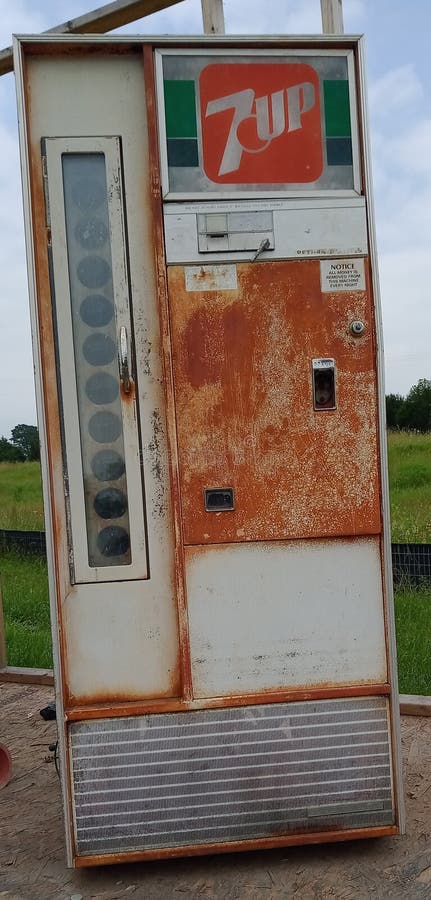
You put in your money, opened the door, grabbed a glass bottle, and yanked hard. You didn’t want to limp-wrist it because if you pulled the bottle partway out and let go the bottle would go back in and you’d lose your money. You had to pull hard enough to get the bottle out in one quick pull.
There were plenty of soda machines that dispensed cans, but those were newer. The older machines were all glass bottles.
We didn’t have those.
Eh, not that privileged. Supermarkets in our town would sell one volume a week. So the first week you could buy A, the next week you could buy B, and so on. Took you half a year to get the entire set, but they were reasonably priced. It was mostly a gimmick to get you into the same store every week.
If you bought an entire set from a door to door encyclopedia salesman (those were a thing), that could be a bit pricy.
But yeah, a lot of families didn’t have encyclopedias back then.
I used to browse through ours for fun.
I was born in 1978, and I have photographs my mom took bringing me home from the hospital. She was holding me in the front seat.
When my son was born in 2013, they wouldn’t have let us leave the hospital unless we had a car seat properly installed in the backseat.
Beach seats. In the front. Of your car.
Except that the whole concept of “stranger danger” was greatly exaggerated and dangerously misplaced. The abduction and/or molestation of children by complete strangers has always been vanishingly rare in comparison to those acts committed by family members, friends, and trusted authority figures.
It was the Adam Walsh case in particular, his appearance on milk cartons, and his father’s media crusade, that was largely responsible for whole generations of children and parents becoming paranoid about kids’ safety, making sure that their every free moment was scheduled and supervised, and ending the era of free-range childhood that so many here have happily recalled.
And it wasn’t until the scandals of abuse by Catholic priests, a decade or two later, that anyone even started to take the issue of child sexual abuse seriously. They highlighted the fact that the danger was NOT primarily from strangers, and eventually led to a slight retreat from the earlier paranoia.
The sex. My god, the sex.
Considering that, compared to modern teens who basically carry parental tracking devices in their pockets (viz, cell phones), we Gen-X teens in the 80s were downright feral. Already discussed at length in this thread is the long periods of time in which we were effectively devoid of adult supervision; not discussed is how that freed us up to have all the sex.
I don’t know if teens today are having as much sex with each other as we did back in the day. I’ve read that they aren’t, and I wouldn’t be surprised. Between not being able get enough time away from the technological reach of the ‘rents in order to complete the transaction, and the need for expressed, written consent for every sex act, I’d be surprised if most teens weren’t chaste.
ETA: I am certainly not minimizing the need for consent. Certainly in my day, I understood and abided by the need for consent, and understood that “no” means “no.”