# Human consumption of sundew nectar
**URL:** https://boards.straightdope.com/t/human-consumption-of-sundew-nectar/974701
**Category:** Factual Questions
**Created:** [November 10, 2022, 6:34pm UTC](https://boards.straightdope.com/t/human-consumption-of-sundew-nectar/974701 "2022-11-10T18:34:20Z")
**Posts on this page:** 4
**Page:** 1
### Author:  [@Max\_S](https://boards.straightdope.com/u/Max_S)
#### Post date: [November 10, 2022, 6:34pm UTC](https://boards.straightdope.com/t/human-consumption-of-sundew-nectar/974701/1 "2022-11-10T18:34:20Z")
I just read about carnivorous sundew plants (_Drosera_) and how they attract prey with sweet mucilage on the tips of the tentacles.
[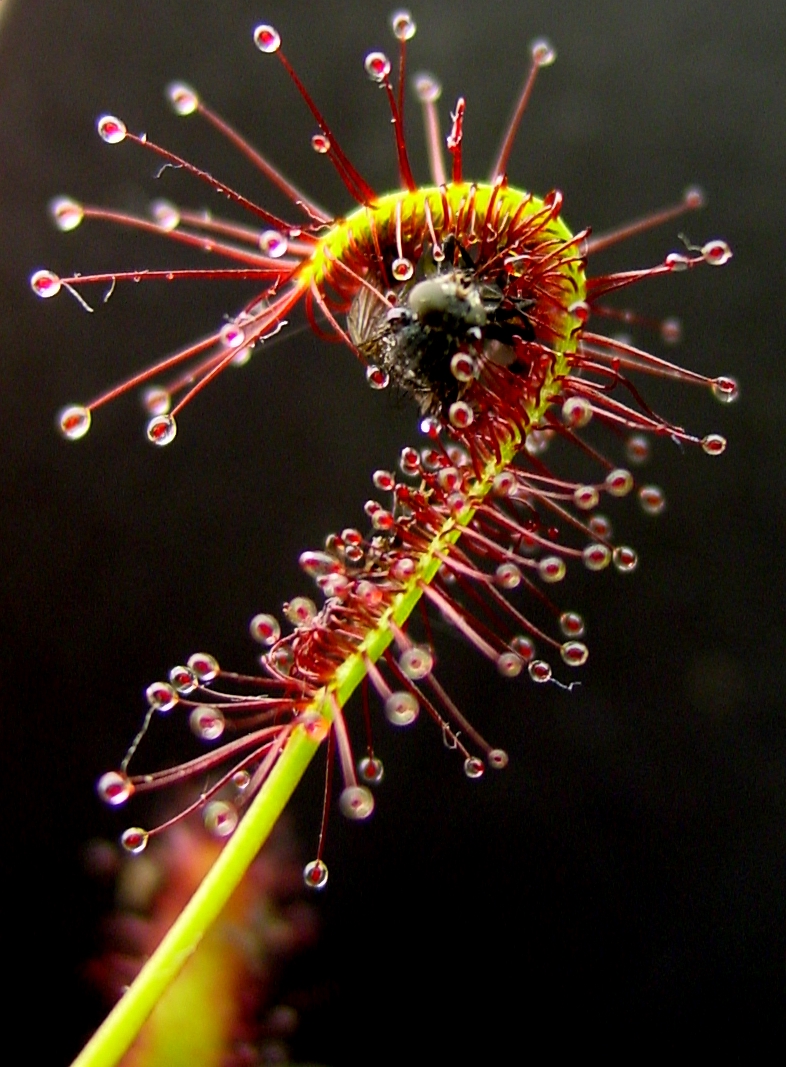 ](https://upload.wikimedia.org/wikipedia/commons/0/0f/Drosera_capensis_bend.JPG)
[ ](https://upload.wikimedia.org/wikipedia/commons/thumb/0/06/Drosera_rotundifolia_leaf1.jpg/1280px-Drosera_rotundifolia_leaf1.jpg)
I’m talking about the droplets.
I was just wondering, is this stuff safe for human consumption? Obviously you don’t want to mess with it when wrapped around prey because it will be secreting acids. But otherwise I’m imagining you could run your finger (or tongue) over the bristles. What would it taste like? Could some (small) amount be regularly harvested without killing the plant?
~Max
---
### Author:  [@Darren\_Garrison](https://boards.straightdope.com/u/Darren_Garrison)
#### Post date: [November 11, 2022, 1:26am UTC](https://boards.straightdope.com/t/human-consumption-of-sundew-nectar/974701/2 "2022-11-11T01:26:34Z")
Those droplets are not nectar, they are glue.
> **[Sundew adhesive: a naturally occurring hydrogel](https://www.ncbi.nlm.nih.gov/pmc/articles/PMC4590509/)**
>
> Bioadhesives have drawn increasing interest in recent years, owing to their eco-friendly, biocompatible and biodegradable nature. As a typical bioadhesive, sticky exudate observed on the stalked glands of sundew plants aids in the capture of insects...
---
### Author:  [@Mangetout](https://boards.straightdope.com/u/Mangetout)
#### Post date: [November 11, 2022, 9:35am UTC](https://boards.straightdope.com/t/human-consumption-of-sundew-nectar/974701/3 "2022-11-11T09:35:27Z")
It’s made of polysaccharides though, but whether it would taste sweet depends on whether it’s a polysaccharide our salivary enzymes can break down to simpler sugars
---
### Author:  [@Max\_S](https://boards.straightdope.com/u/Max_S)
#### Post date: [November 12, 2022, 7:11pm UTC](https://boards.straightdope.com/t/human-consumption-of-sundew-nectar/974701/4 "2022-11-12T19:11:15Z")
> [@Darren\_Garrison](#):
>
> Those droplets are not nectar, they are glue.
Your cite goes above my head, unfortunately. It does mention that “sundew adhesive has been extensively exploited in the pharmaceutical and food industry.”
Just because a fluid is adhesive, means it isn’t nectar / isn’t sweet? I mean, sugar is naturally sticky. You can make flypaper by soaking paper strips in a mixture of sugar, honey, and water.
That “exudate” is referred to by the U.S. Dept. of Agriculture as nectar,
> **[English sundew](https://www.fs.usda.gov/wildflowers/plant-of-the-week/drosera_anglica.shtml)**
>
> Thousands of wildflowers grow on our national forests and grasslands, in many shapes, sizes, and colors. Celebrating Wildflowers periodically features a different wildflower plant found on our national forests and grasslands.
> English sundew or great sundew is a carnivorous plant. It has long tentacles on its tiny leaves tipped with red colored **glands that exude attractive nectar**. Insects that land on the leaves **stick** fast.
> [@Mangetout](#):
>
> It’s made of polysaccharides though, but whether it would taste sweet depends on whether it’s a polysaccharide our salivary enzymes can break down to simpler sugars
I haven’t had even basic education in chemistry so hopefully you (or someone else) can help me understand this. From a cite within **Darren\_Garrison** ’s cite,
Rost, K., & Schauer, R. (1977). Physical and chemical properties of the mucin secreted by Drosera capensis. _Phytochemistry_, _16_(9), 1365-1368. [https://www.researchgate.net/profile/Roland-Schauer/publication/229203421\_Physical\_and\_chemical\_properties\_of\_the\_mucin\_secreted\_by\_DroSera\_capensis/links/5b277f60aca2723fbeef5e1d/Physical-and-chemical-properties-of-the-mucin-secreted-by-DroSera-capensis.pdf](https://www.researchgate.net/profile/Roland-Schauer/publication/229203421_Physical_and_chemical_properties_of_the_mucin_secreted_by_DroSera_capensis/links/5b277f60aca2723fbeef5e1d/Physical-and-chemical-properties-of-the-mucin-secreted-by-DroSera-capensis.pdf)
> The sundew _Drosera capensis_ produces a highly viscous mucin of pH 5 which can be obtained in good yield by gauze collection and represents an about 4% aq. solution of an acidic polysaccharide. […] The secreted mucin represents a pure solution of polysaccharide in water. […] The homogeneity of the polysaccharide was shown by the following physical and chemical investigations […] Analysis of the mucin and of its acid hydrolysate by calorimetry, TLC and GLC has demonstrated the presence of xylose, mannose, galactose and glucuronic acid in a molar ratio of 1:6:6:6. […] The polysaccharide contains 3 % ester sulphate as calculated from elementary analysis and from turbidimetric sulphate determination. This corresponds to a molar ratio of about 1 when related to the ratio of the 4 monosaccharides given above. […] Concentrations of 22 mM Ca2+, 19 mM Mg2+, 0.9m M K+ and 0.2 mM Na+ were determined in the native secretion.
>
> […] _Drosera capensis_ was cultivated in insect free glass houses at an average temp. of 15° and 50% humidity. The mucin droplets were collected weekly between May and August using a coarse fibre asbestos cloth. The mucus harvest (5 g pooled droplets) […]
If I read this correctly, then for the species _D. capensis_,
1. You can harvest about 5 g of exudate per week per plant using coarse cloth (but for human consumption, probably don’t use asbestos?)
2. The fluid is 96% water and 4% is composed of an acidic polysaccharide
- The polysaccharide is probably tasteless as it isn’t a starch, and our saliva is equipped to break down starches not all polysaccharides
- Would it taste rotten due to the sulfur ester?
3. It has pH 5 which is apparently [comparable to](https://www.ncbi.nlm.nih.gov/pmc/articles/PMC4808596/) the acidity of Dasani water (pH 5.03 ± 0.04) or Red Diamond sweet tea (ph 5.04 ± 0.02)
~Max