No, work is when a force acts on an object that is moving. The point is that if you hold a glass steady in your hand, it is not moving, so no work is being done. However, inside your muscles, lots of moving objects are having forces applied to them, hence, work is being done inside of your muscles.
In case anyone is interested, The Slo Mo Guys have a video in which they shoot ball bearings and then bullets at a Newton’s Cradle. Well, it had to be multiple cradles, but you know what I mean.
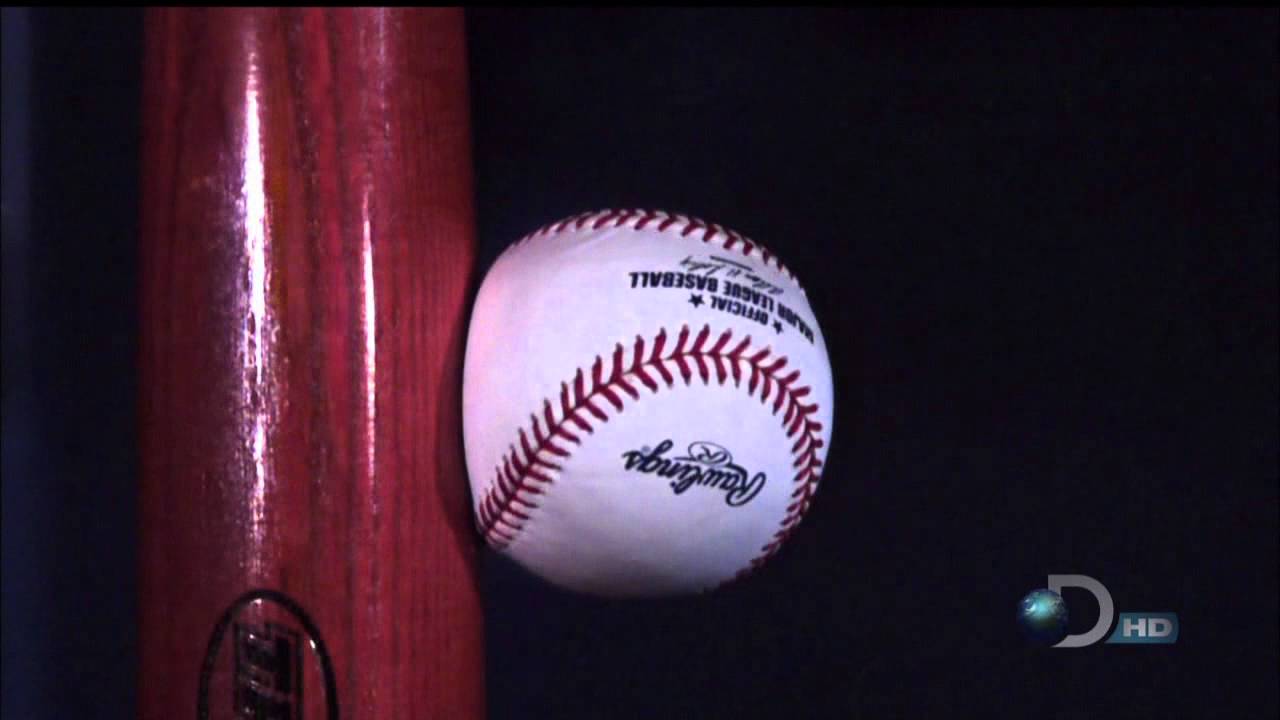
There is deformation in at least some of the tests.
Some nice slow mo footage of bat and baseball…
And some intense golf club on golf ball action:

No, it has a downward force on it because it’s a non-zero mass and so is the Earth and any two masses pull on each other with the force of gravity.
A very basic intuitive idea of the table exerting an equal force against the glass is, if the glass was not countered by an equal force, it would break through the table.
Maybe this will help. Or maybe it will make it worse.
Sure, the table exerts a normal force on the glass in an upward direction. But, the glass also exerts a normal force on the table in a downward direction. The upward normal force exerted by the table is greater than the downward normal force exerted by the glass. As a result, the combination of these two normal forces is a net normal force in the upward direction. And guess what. The difference in the magnitudes of these two normal forces just happens to be the magnitude of the gravitational force on the glass.
If you think that this is just because I am stupid, consider this scenario. A glass and a table are held together sideways in a vise that has been tightened as tight as it can get without breaking the table or glass in a zero gravity frame of reference. Do you want to argue that there are no normal forces acting on the table and glass in this situation?
Also, always remember that force is a vector and has both a direction and a magnitude.
I think ‘everything is a spring’ is probably the way to go with this. It’s very easy to intuit that a spring is ‘pushing back’ when you push against it. It’s not much more difficult to accept that if you stack a small, soft spring on top of a bigger, stiffer one, that pushing on the small spring not only ‘pushes back’, but that the bottom of the small spring also ‘pushes down’ on the big spring, and the big spring also pushes back on that.
From that point, everything is a spring. Whatever object you push against is a spring. If it’s resting on another object, that is also a spring and the force of your push is also being transmitted to that, and so on.
Everything’s a spring.

I guess this thread is a good place to ask a question I’ve had for a while now.
A number of flat earthers also claim that gravity is false; the disk earth is accelerating at 1g, pressing us against it. I’m guessing they’ve latched onto Einstein’s elevator thought experiment to demonstrate how smart they are.
I got to wondering, just how long could we accelerate at 9.8m/sec2 before we started seeing relativistic effects? I’d guess a matter of a few months so even on a 6,000 year-old earth we should have experienced it long, long ago.
Wolfram alpha is smart, but fortunately not quite smart enough to take into account relativity, so asking it “how long to get to the speed of light at 1 g” gives the non-relativistic answer of 353 days 19 hours 45 minutes 23 seconds. Obviously, accounting for relativity, you aren’t going to reach light speed, but you are going to be rather steep on the curve by then.
Certainly fast enough to notice relativistic effects in the universe around you.
Of course, if your are in a dome and can’t see outside, then nothing will seem any different. A second will still take a second to pass. A meter will still be a meter long.
I’m not all that versed in flat earth arguments, so I don’t know if they take this into account, if they believe that we live in a dome with fake stars or what, but if that’s the case, then at least on that point (that there is no difference between gravity and acceleration without referencing something outside your frame of reference), we wouldn’t be able to tell differently.
Even if we’re in a dome, and the “stars” are just lights attached to the ceiling, there would be some relativistic effects (accelerational time dilation, which would affect the light we receive and the orbits of the binary stars we see moving).
If the binary stars aren’t actually moving in space, but are just moving around on the firmament dome, would we really see anything to differentiate?
And anyway, anyone with a telescope who knows how to use it is in on the round earth conspiracy. They can’t be trusted.
Can you calculate the world line deltas for the frames of references of the turtle at the top vs the turtles inserted at the bottom?
Yes, you just need to take into account the Chelonian invariance.
Wouldn’t being on a rotating disc be testable? The outer edges would have a different velocity than the center.
Bleh, even attempting to understand how somebody could believe Flat Earth theories gives me a headache.
Bah. De chelonian mobile…
You got me!
The disc does not rotate. The sun and moon are spotlights that follow sort of rosette-like paths (because, reasons) around the dome of the sky. They never actually go below the horizon, that is just an illusion of perspective (which totally explains why they look bigger rising and setting – totally explains it).
This is not a correct analysis. The upward normal force exerted by the table is equal to the downward normal force exerted by the glass by Newton’s 3rd Law. Furthermore, the upward normal force exerted by the table on the glass is equal to the downward gravitational force on the glass because the glass is in static equilibrium and hence the net force on it must be zero.
Your idea that the difference in normal forces is equal to the gravitational force conflates forces acting on different objects (and violates Newton’s 3rd Law).
The force pushing up pushes the surface of the table up… a very tiny distance, but given the stiffness of the table…its got to be tiny since the glass is a tiny weight.
All materials can be compressed. The thing is that with the glass on the table, the force only compresses or bends the table some tiny tiny amount. The floor below the table experiences that increase in force and pressures too…
So you see, the equal and opposite reaction is explained considering the pressure in a gas … If there was no reaction, the gas would be expanding outward and hence heading to zero pressure… if its got a constant pressure, there must be something constraining … the opposite force…
Are you asserting that the glass experiences no compression whatsoever? That seems to be what jshore is asserting as well.
However, I think we call all agree that the glass is stationary and therefore the sum of all the force vectors acting on the glass is zero.