I think you wrote unclear LSLGuy, do you really think the Chinese armed forces can defeat the US?

Yeah, “nothing to be brushed aside”, but losing a few subs (which would be tragic, of course – and I was a submarine officer) in a shooting war with a superpower is not the same as losing a carrier. And yes, it would be very difficult to operate in the littoral water around Taiwan, but difficult isn’t impossible. And it’s very likely, IMO, that even a 688 class (the US’s oldest attack sub class) submarine could pick off multiple surface transports with torpedoes before it was seriously threatened.

If we expect a conflict like this to be zero major losses for the US, then yes, we would fail and ultimately withdraw. But if this became a major shooting war, and we were fighting alongside Taiwan (and our other allies) and willing to take losses as long as we were inflicting more damage on the enemy, then I think we could make it virtually impossible for Chinese transports to cross the sea to Taiwan en masse.

As much as the United States has supported Taiwan (ignoring, of course, that Kissinger and Nixon opened up relations with the People’s Republic of China, leading to the negation of the Republic of China as a recognized nation by the United Nations), I strongly doubt we would intentionally go to war with China or risk multi-billion dollar strategic nuclear assets over it, especially as the PRC could not realistically hold Taiwan (and it would be destructive to them, militarily and economically, if they tried). The loss of even an older Los Angeles class attack submarine would be an enormous embarrassment to the US Navy, and that is almost a foregone conclusion if we attempted to operate in or around the Taiwan Strait during open hostilities.

Stranger

This is my feeling, too, and I think the goals of a different US administration would also greatly change the likelihood of this. China may “win” the war with the US on the diplomatic front before a shot is ever fired. A future US administration more isolationist or more friendly to authoritarian leaders may give China tacit approval to invade Taiwan.

Okay, that’s a political argument (about US willingness), and you might be right.

As to attack subs in the Taiwan littoral …

IANA sub guy. Per wiki the US owns a total of about 50 active attack subs of Los Angeles, Seawolf, and Virginia classes combined. That’s the entire arsenal. In one sense that’s a vast amount of firepower. In another sense, Earth’s oceans are a very big place.

If we assume (I have no real data) each sub spends about 2/3rds of its time at sea and 1/3rd being refurbished and/or re-whatevered in port that suggests about 34 are out on patrol or could be put out on patrol pronto. Of which WAG roughly half are in the Pacific or Indian oceans and are immediately relevant while the other half in the Arctic, Atlantic or Med and are near term irrelevant and might not be redeployed for strategic reasons. So baseline about 17 subs to prosecute the attack against a sortieing PLAN invasion fleet.

From wiki I gather each sub of those types carries ballpark 40 to 50 torpedoes or torpedo-tube-launched anti-ship Harpoons. Which suggests on the order of 750-800 total launchable rounds. Less whatever part of their load-out is land attack missiles, but let’s assume (unrealistically IMO) there’s zero of those.

At least in aerial missile firing doctrine a standard approach is “shoot, look, shoot”. IOW: launch, observe the outbound missile for signs of gross error, and fire a second after confirming whatever airplane-side stuff needs to be tracking the target is still doing so correctly. With two goals: one, missiles malfunction often. A second shot greatly raises the combined kill rate. Second, if the enemy recognizes they’re under attack and reacts, the presence of the second missile may be unnoticed in the excitement, and even if not, there are no defensive actions that can be optimized against both incoming rounds simultaneously.

IOW, there’s counter-defense synergism with two rounds in the air. It’s also common to fire the first round very promptly after you enter lock-on + in-range conditions then keep driving in a bit before loosing the second round in a more favorable geometry where the enemy escape maneuver options are much more, or entirely, foreclosed.

I have only the slightest notion of sub torp deployment doctrine from a long ago convo with a former LA -class deck officer. But I think it might be similar to aerial practice for similar reasons. So assuming the subs shoot-look-shoot, they can prosecute a total of 400 targets.

I have no clue what the success rate might be but again borrowing from aerial combat, in the modern digital computerized missile era the publicly available numbers are roughly 80% success. Despite “shoot look shoot”. So we can expect something north of 300 targets to be hit, and some lesser number of those sunk, before the entire sub fleet is out of ammo and must withdraw to a harbor (or tender ship well away from the hostilities) to reload.

As long as the SSN’s are disciplined and they’re shooting at high-ish value targets, say frigates and above, they have more ammo than the PLAN has targets. But if they try to plink landing ships, or worse yet debarked landing craft, the enemy has more targets than we have bullets. I hate it when that happens.

Gonna be a shit-show of brilliance and buffoonery on both sides. And astonishingly expensive. But a story to live down the centuries if it goes off.

China may just count on U.S. reluctance to get into a shooting war with a nuclear power. Likewise, because losing a carrier would almost certainly force the U.S. into a major war with China, carriers may not even come into play, but remain 1000 km or more away out of range of Chimese SRBMs.

Given what we’ve seen about handling Russia, the most likely response from the U.S. would be to provide aid and arms and information, but try to stay out of the conflict. More sanctions on China, perhaps attempting to cut Chinese supply lines through sabotage, that sort of thing.

So it looks like China is definitely planning to take Taiwan

Stranger

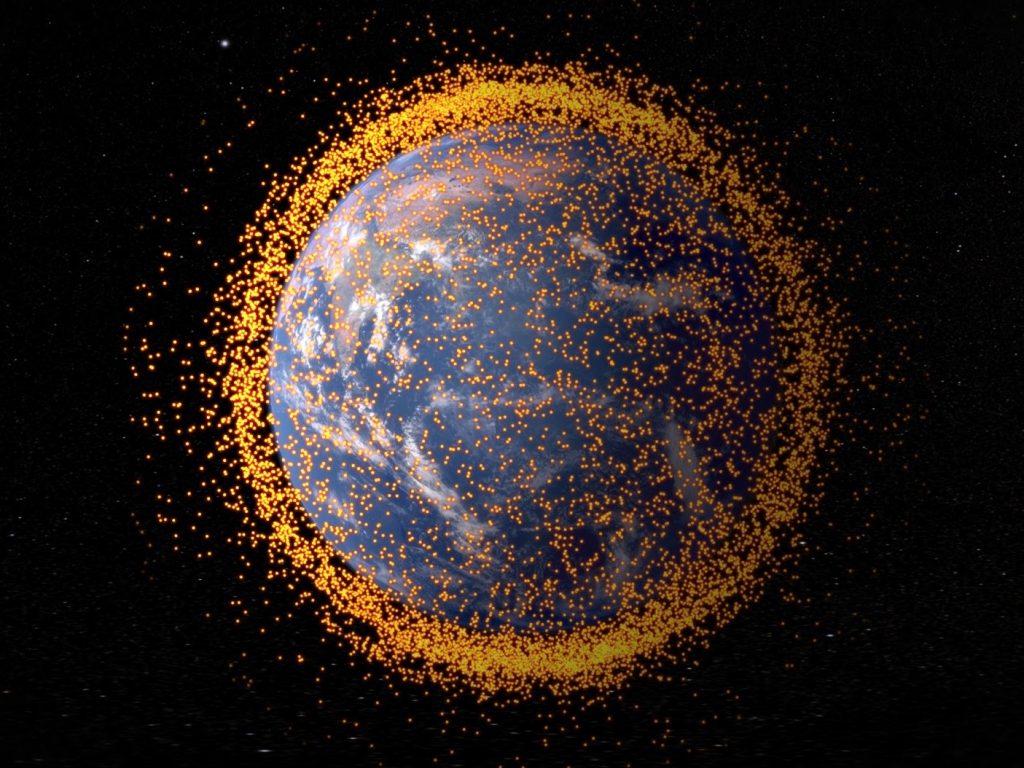
Very coo video. I’m familiar with chain reactions, though. The question is, how long does it take between collisions, and how long does it take to eliminate enough of a 12,000 constellation? Space is very big.

The timeline for a natural developing Kessler syndrome is decades to centuries. It’s never happened, so all we can do is model it. Intentionally creating a Kessler syndrome by exploding frangible bombs or throwing gravel into orbit or something would certainly speed it up, but I don’t know if it would speed it up enough for it to take place over days, weeks, or months.

If it takes years, then doing it would be a terrible idea because the Americans would have years to retaliate before the constellation is useless.

But maybe it would be faster than that. As I said, I don’t have a good handle on what would happen if you tried. It’s complex.

i reckon the distance between the individual mousetraps is the operating variable, here …

Yeah. There’s a characteristic time constant that’s a function of density and of fan-out.

With ping pong balls and moustraps, each triggering launches the ball on a bouncing trajectory and the mousetrap on a different bouncing trajectory. One lands with a small and nonlocal footprint, the other with a large but much more local footprint. The ball can keep bouncing each time it triggers something else, but the trap not so much.

And all these sorts of vids the density is very very high. Space is not. For entertainment, let’s rough in the math.

Starlink is deployed in a couple different orbital radii and apparently intends to use even more shells eventually. Let’s assume it’s just one shell. Let’s further assume every orbit is perfectly circular and perfectly nominal and so the shell is effectively of zero thickness. So we’re not trying to blanket a 3D region of space, just an idealized 2D shell.

The surface area of a sphere at Starlink’s current most common orbital radius is ~3E8 square miles. But let’s lop off a third of our sphere’s area to remove the polar regions from consideration. In truth Starlink goes more poleward than that. OK, so now we have 2E8 square miles of Starlink-occupied space.

Right now they have about 3500 satellites up. But let’s be generous and give them all 12,000.

So now we’ve 12,000 targets the size of refrigerators spread around 2E8 square miles. Each fridge has an area of 17,000 square miles to roam in solitude. That’s an area a little smaller than West Virginia.

You’re going to have to launch an awful lot of gravel to blanket an area the size of West Virginia in sufficient density to snag the one and only passing refrigerator. And even if that ~500 lb fridge disintegrates neatly into 8000 1-ounce fragments (or even 80,000 0.1 ounce fragments), that’s not gonna add much gravel to the amount necessary to cover West Virginia.

I don’t see Starlink being Kessler Cascadable in a timeline less than multiple years, and probably low multiple decades.

“Space is very big” but orbital space is quite crowded..

Again, it isn’t possible to give simple answer to how long it would take for a Kessler cascade to grow because it depends on both the traffic in the affected azimuths and the distribution of the debris field. In order to get estimates of how long it would take for X satellites to be impacted you’d need to set up and run a Monte Carlo-type simulation and perturb various parameters.

But it should be obvious by inspection that the rate of increase is at least geometric in scale, and with each collision thousands of fragments of various sizes will be broadly distributed along the original orbital azimuth, some in more eccentric orbits that reach above and below the original altitude. And once you have (or intentionally induce) a handful of collisions you’ll have an ever increasing rate, not just satellites but debris fields colliding with each other, scattering a finer, more numerous cloud of debris farther. Starting with a few deliberate impacts or explosions in well-targeted orbits you can expect that portion of LEO to be uninhabitable in a few weeks, and maybe even faster given the “12,000 Starlink” spacecraft all at similar altitudes and many in following orbits on the same azimuth.

Stranger

I would suggest that we might not even see any US surface warships get involved, period. The bulk of the fighting may best be done by submarines and stealth bombers. Those would be the two assets that could deliver firepower while being the hardest-to-kill and putting only a relatively small number of American lives at risk.

It’s more complex than that. For example, the debris will also deorbit in a few years, so the rate of debris accumulation has to be faster than the rate of decay of degree particles. We’d have to set up some differential equations to figure that out, if we knew the rates.

Do you have a ballpark idea of how long you think it would take? Days? Weeks? Months? Years?

Submarines are not likely to play much of an impact in and conflict with in the Taiwan Strait for reasons discussed above. And while we’re super proud of the B-2 ‘Spirit’, it is forty year old technology that can be detected with the right radar system, and there are only (at most) 18 of them operational so they are of limited use against distributed forces.

Stranger

Again, it is not a situation where you can make a trivial calculation, or create a simplified model based upon unverified assumptions. This is the kind of scenario that requires Monte Carlo-type simulation along with some validation on inputs such as debris distribution and cumulative effects such as orbital decay rates. I can say that at above 500 nmi altitude that decay of even small debris is on the order of a decade or more even assuming that it occurs during a solar maximum, so it isn’t as if a debris field is going to disappear; and even as it decays, it will fall down into lower orbits where other satellites can be affected. The aggregate rate at which a cascade will increase could be estimated depending on how far along the curve of debris generation you are, and deliberately creating whole new debris fields has the effect of essentially pushing the scenario up the curve. I do know people who did or do this kind of modeling (and have dabbled in it casually myself, although I’ve never developed anything that I would consider to be a validated model), and from that I can say that it is entirely plausible that a dedicated attack could make entire orbital azimuths unusable within a few weeks, and possibly less. At orbital speeds with even a slight differential in elements, even a piece of debris the size of a small pebble would have a catastrophic effect on a spacecraft, rupturing it into many thousands of pieces of similar sized debris, and it takes only a few of these events to create an expanding and ever increasing field that is statistically likely to take out any spacecraft within the field within a few hundreds of orbit cycles.

Stranger