One more thing, the “crackling” noise you report would have been imaginary. Meteors are miles away, so by the time any sound reached you, the event would have been over.
Darren Garrison, where are your manners? Couldn’t you at least have welcomed Questinia to the Dope before you said his claim was bullshit? 
I have no personal anecdotes to share of visible asteroids, but about 10 years ago, when I was living in Quincy, Illinois, I heard an explosion that sounded like a sonic boom or a transformer blowing, but the lights never went out. Lots of other people heard it too, and it was never explained. There are no military bases in the area, and I personally believe that it may have been a meteoroid that was not bright enough to be seen at midday and never hit the ground.
Having read back over the older posts on this thread, I thought I’d take a bunch of moments to expand on my earlier 0ff-the-cuff post. I do this not to pile on Questina, but to provide information for others who might find this thread in the future (since I see that it has been bumped a few times over close to 8 years.)
First, a few basic terms:
A meteoroid is a solar system object that is too small to be called an asteroid or comet. The upper size limit of what should be called a meteoroid is arbitrary—some place the limit at 10 meters, some put it at 50 meters. (I won’t get into the distinctions between an asteroid and a comet because they don’t matter much for the sake of this rant.)
A meteor is the glowing atmospheric effect seen when a meteoroid enters the Earth’s atmosphere.
A bolide is an especially large and bright meteor.
A meteorite is a meteoroid that has survived being a meteor and has reached the ground.
A meteoroid in space is not captured by Earth’s gravity—instead, it hits the Earth when the Earth happens to literally pass in front of the meteoroid’s path.
The speed that a meteoroid hits the Earth’s atmosphere varies depending on the direction that it is approaching from. A typical meteoroid may be orbiting the sun at a speed of around 26 miles per second at the distance that it encounters the Earth. The Earth has an orbital speed of around 18 miles. If the meteoroid is traveling in the same orbital direction from the Earth, then it has to catch up with the Earth and “rear end” it, leaving “only” 8 miles per second / 28,800 miles per hour. If the meteoroid is traveling in the opposite orbital direction from the Earth, the speeds add up for a “head on collision” of 44 miles per second / 158,400 miles per hour.*
That lower speed is 13 times faster than the fastest manned aircraft ever made (the SR-71 Blackbird) and the higher speed is 72 times faster. Even 8 miles per second is dozens of times the speed of sound, and instead of smoothly flowing around the meteoroid, the air is compressed in front of it. And as you compress a gas, it heats up. The compressed air and shock wave around a meteor is dense enough to heat to incandescence at around 60 miles up, when the atmospheric pressure is still thousands of times lower than at sea level. (This is the point that the atmospheric effect called a “meteor” begins.) This very hot air melts an extremely thin layer from the surface of the meteoroid very quickly. Some of this melted rock or metal is heated enough to become a plasma and contributes to the glow that you see from the incandescent air. The rest of the melted rock flows off of the back of the meteoroid and condenses into microscopic droplets—this is the origin of the “smoke” trail that is visible behind large daytime bolides. As each thin layer of melted rock flows away, a new thin later is heated and removed from the newly exposed surface. (Imagine pointing a hair-dryer at an ice-cube, with the water flowing to the back of the cube and spraying off the back.) Other than the size and composition, other factors affecting the amount of time that a meteoroid is incandescently hot are entry speed (the faster they are moving, the faster they burn out) and angle of entry (the more shallow the angle, the longer it can remain in the thinner part of the atmosphere, leaving it incandescent longer. A rare extreme of this is the “Earth grazer”, which skims through the Earth’s atmosphere tangential to the surface and continues onwards through space.
When a “meteor” fades away, it means that the meteoroid has either completely melted away or that it has slowed too much to heat the air to incandescence. A very small meteoroid of any type will melt completely away. A larger stony meteoroid will usually be shattered by the extreme stresses it is experiencing. The resulting fragments will have a much larger surface area and will therefore melt faster (and decelerate more quickly) than the intact meteoroid. A larger iron meteoroid will have more structural strength and have a higher chance of remaining intact through the meteor stage.
When you see a meteor or bolide, you are seeing hot air, not a hot rock. The heat that the meteoroid experienced is carried away in the melted material, and is the inspiration for the similarly behaving ablative heat shields used on some spacecraft designed to land on a planet. Any piece of a meteoroid that survives the meteor stage will be around the same temperature that it was when it entered the atmosphere (which depends on the type of meteoroid—from around 15 degrees Fahrenheit for a stony to around 190 degrees Fahrenheit for an iron.)**
If some part of the meteoroid survives the few seconds of the meteor stage, it goes into something called “dark flight” and is invisible for the remaining minutes that it takes to fall to the ground. The speed that the meteoroid is traveling when it hits the ground (and officially becomes a meteorite) is determined by the same rules of terminal velocity as any rock dropped from a tall building or an airplane. If you see a meteor or bolide, then you are miles away from any fragments that may have made it to the ground. Also, a single witness of a meteor is insufficient to accurately determine the height, angle, and direction of a meteor’s travel. To determine these characteristics (and estimate the possible location of any surviving fragments) requires a few witness descriptions from different positions relative to the meteor.
The above is all for a small meteoroid. If a meteoroid is large enough (maybe house-sized, as a rough estimate) there is not enough time for the atmosphere to slow it down from hypersonic velocities before it hits the ground. This meteoroid would be still surrounded by incandescent air and a shock wave all the way down and would make a large crater when it hits. Not only would the shrapnel, heat, and pressure at the crater site kill or injure anyone for miles around but the heat and pressure radiating from the path of the meteoroid while it is near the ground (a small number of miles) would injure and kill, too.
(In 2007 an unusual coincidence of conditions allowed a meteroid much, much smaller than would normally reach the ground at hypersonic velocity managed to reach the ground in Peru still traveling at around 3 miles per second. It left a crater more than 40 feet across. It isn’t known exactly how large the Carancas meteroid was just before it hit the ground, but the largest fragment found afterwards was around 340 grams.)
In conclusion:
When you see a meteor, you are seeing incandescent air, not hot rock. And the envelope of hot air will be much larger than the rock.
A meteor will never be actually moving slowly. If it looks like it is moving slowly, that is because you are seeing it from miles away.
You will not see craters on a meteor because a meteor is the above mentioned envelope of incandescent air that surrounds a meteoroid, not the meteoroid itself.
A meteoroid far enough away to appear to be moving slowly that isn’t surrounded by an envelope of incandescent air would have to be mountain-sized for you to clearly discern surface details.
You would never see a meteoroid the size of a mountain that isn’t surrounded by an envelope of incandescent air because any meteoroid that size would never have time to slow down enough to lose it.
Surrounded by an envelope of incandescent air or not, if you saw a meteoroid the size of a mountain you would be minutes at most away from the end of your life.
*Example numbers lifted from Rocks from Space by O. Richard Norton.
**Rough calculations of equilibrium temperature at Earth’s distance from the sun, adapted from a table originally calculated by a member of a meteorite collector’s mailing list.
Any chance that “about 10 years ago” could be “about 14 years ago”, or more specifically, March 26th, 2003?
Great post by Darren Garrison. I would add that another complication in reports by inexperienced observers is that people in general are very poor at estimating the apparent size of objects in the sky. For example, someone upthread said they saw a meteor the size of a trash can lid at 20 feet, which is absurd. Many people when asked to estimate the size of the Moon will say something like, it’s the size of a dinner plate held at arm’s length. In fact the Moon is about the size of a pea held at arm’s length. So any report of the size of a meteor has to be taken with a grain of salt.
I saw a meteor the size of a grain of salt.
I appreciate Darren Garrison’s et al. responses. But I am quite clear as to what I saw that evening. Since I first wrote I visited a blog site called Terra Firma Terra Firma: Meteor recalls 'Great Fireball' of 1966
A number of people saw what I saw. Each give their own account of something too identical to others to be coincidental.
I’ve taken physics and have an advanced science degree (I am an MD FWIW) and I am not prone to exaggeration or manufacture. This was a phenomenon that defies logic to be sure. I had an unobstructed view of the object’s eastern flank and underside. It looked like a meteoroid with a jet pack, hissing like a pressure cooker valve, solidly streaming at low altitude but much slower than you’d think. It was moving steadily. It was a ragged boulder, pockmarked with craters. It most definitely had a sound although the sound was not its most memorable feature. What was memorable was the surface of the thing. I had the time to see it distinctly. I could see flames licking and smoke, perhaps steam(?). It was NOT engulfed in flame. Fire was not the prominent feature. The prominent feature was the craggy physicality of ROCK and the details observable of its topography. It looked to be the size of a small aircraft at low altitude. Really low altitude. The trajectory was parallel to the ground going south to north. I was on the northern slope of a hill with a 6-7 mile unobstructed view to the north where I saw it continue and disappear. There was a contrail which persisted. I recall going inside and back out to look at the vestigial contrail to reaffirm I had actually seen what I thought I saw.
Could this have been an early break-off of the original meteoroid? A piece which decelerated but did not burst into flames right away, but had the momentum to continue on a flat trajectory, maybe even leaving earth’s atmosphere like a flat rock skipping on water? Or a fragment landing in the Adirondacks shy of the rest of the larger piece which continued into Canada? Or was this a doomsday event narrowly escaped and unpublicized by those not wishing to cause panic? I don’t know. All I know is what I saw: A visual wonder emerging out of nowhere with no time to create biases or throw cognitive doubt. It was primitive sensory data, visual and auditory, of a primordial celestial body in an unexpected location. Its unexpectedness and the surprise of its presentation of such amazingly surreal detail came to me only after it was long gone.
This event happened in my childhood and as such has remained sequestered as a childhood memory rarely subjected to my adult understandings of the world. Until now. I have become mildly obsessed with this ever since the memory sprang back into my consciousness a few days ago and I decided to research on the internet again. The memory of what I saw was researched many years ago, before the advent of this thread, and although there was scant written about it then on the internet I do recall I had identified what it must have been: The Great Fireball of April 25, 1966. However when I saw it, or perhaps a part of it, it was not a fireball… yet. Truly a conundrum.
If you saw ‘rock’ you did not see a meteor. Rock is never visible in meteor sightings. If you have an advanced science degree then you will understand why, especially if you have read Darren Garrison’s excellent post.
This is probably a so-called ‘flashbulb memory’ a vividly-recalled event or series of events from a significant time ago. Flashbulb memories are very clear, but they are not very reliable.
I didn’t dispute sound before because sound is a not uncommon (though poorly understood) aspect of even small meteors, with a new hypothesis being published in the past few days.
On to other issues–a meteoroid is not “on fire”, what you see (as I mentioned) is a shell of air heated to incandescence by the compression caused by the meteoroid traveling through the air at hypersonic velocities, and the moment the meteoroid is moving too slowly to heat the air to incandescence, there is no longer any light associated with the meteoroid. A supersonic aircraft can have it’s skin heat to hundreds of degrees (and I’m sure LSLGuy or someone else can step in on this element) but they are exposed to supersonic speeds for minutes at a time–a meteoroid is exposed to much, much higher speeds for only seconds–the heat they experience is much higher, but is taken away by melting the surface and never has time to penetrate deep into the meteoroid. There is also never any “smoke” or “steam”, but a trail of tiny condensed droplets of rock and metal that melted off the meteoroid. That trail will also stop forming when the meteoroid slows down below hypersonic velocities, and will always be streaming behind the meteoroid, never in front of it (Think about the “hair dryer blowing water off the back of an ice cube” analogy I gave–or think about the contrails forming behind a high-altitude jet airplane.)
In theory, could it have been something that “skipped out of the Earth’s atmosphere”? That type of object has been mentioned by myself and others–it is an “Earth grazer.” But the fireball of 1966 wasn’t one. As for being “unpublicized”, something that impressive seen by many people being able to be “covered up” in 20th-century America is an impossibility almost on the scale of the meteoroid actually looking like you misremember it. Which brings me to
I don’t think for a moment that you are lying. But I also don’t think for a moment that your childhood memories are accurate, not just because what you describe breaks the laws of physics (because it does) but because nobody’s memories are accurate. Not yours, not mine, not anyone else’s. Other people in this thread remember seeing the fireball the same way you see it? This isn’t uncommon, either.
My qualifications on this subject–I’m not a professional meteoriticist, astronomer, or astrophysicist. I have never personally seen a meteor larger than the “large green roman candle round” type. But I have been a (low-budget) meteorite collector for more than 15 years and pay close attention to how they get here, and have read extensively on the subject. There are several thousand professional scientists and serious amateurs in the world that know more than I do about this subject–but several billion people in the “general public” who don’t. If you search for my name and the word “meteorites” you’ll find a hit or two.
Thank-you @ Darren Garrison, @ eburacum 45 for thoughtful answers including the interesting phenomenologies of “flash bulb memory” and the “Mandela Effect”. My issue with flash bulb memory at least per wiki, is that it is heard and requires an informant. This is something I saw. This was a direct witnessing.
I was also in lower Manhattan on 9/11 and saw and a heard a lot. I am significantly more suspect of my experience of that morning than I am of the evening of the “1966 Fireball”. However I do not doubt my having seen the towers falling. Certainly peripheral details and information have been lost and modified through, amongst other things, the numerous accounts during and after the event. The fireball however was more like sitting at the beach and looking over the ocean when all of a sudden an enormous fire-breathing dragon emerges from the water, snorts fire, then submerges leaving only the ripples of a wake to attest to it having been there.
The Mandela effect is more false memory based on suggestiveness and modification/alterations. I spoke to no one about what I saw (as far as I can remember), there were no competing realities at the time. It was an eye-witnessed event frozen, hermetically sealed in my mind, occasionally mused upon, until recently.
Rather than attributing what I saw to errors in perception and memory, what if one started with: under what sort of conditions could what I have seen be true or plausible? Is it an absolute impossibility to see what I saw?
In the article that came out the next day (April 26th) in the New York Times, people did see flames, people did see a lot of things, in fact people saw so many things the article reported that scientists had a hard time pinpointing what the object actually was… https://timesmachine.nytimes.com/timesmachine/1966/04/26/issue.html
What I saw was close. It was intimate. I saw detail. It was large but not immense (the size is difficult to assess) What if I saw was a portion of what entered the atmosphere, a part that exploded off but had not yet incinerated, a piece of the “roman candle” that had assumed a flattish trajectory for quite a long bit before it either burnt out or landed somewhere? What if I was in the perfect place to see something that presented itself perfectly to be perfectly seen?
Yes, it is literally impossible that you saw a cratered surface with flame licking out of cracks. As in, it breaks the laws of physics. What you did see is an envelope of hot plasma surrounding a rock that was a few feet across that was around 60 miles high (and an unknown horizontal distance) from you. What you are saying you saw is the equivalent of saying that you saw Mohamed Atta piloting the plane as it hit the north tower and you noticed that he had an enamel filling in his left canine.
Let’s examine this for a second–“people saw so many things … that the scientists had a hard time pinpointing what the object actually was.” In other words, the observations were inconsistent and contradictory. People who saw it disagreed about what they saw. Mull on that.
As for “pinpointing what the object actually was”, there is nothing unusual about confusion in the near-aftermath. A first worry would be that it was a crashing plane. But the trail is far too long, so the remaining options are the atmospheric entry of a piece of satellite debris, a piece of an asteroid, or a piece of a comet. And then as today, news agencies tend to interview local astronomers or even a local meteorologist. And most astronomers (like most other people) never see a major bolide in their lives. But (as I posted a link to before) a scientist that did know his stuff about meteors and meteorites used still frames from a film made along one portion of the entry path and a photo from later in the entry path to calculate a rough orbit of the asteroid fragment. (With more photos, there could have been an even closer determination of the orbit.)
It was not.
You did not.
It was not.
If it was large enough to see surface details from 60 miles up, you would have been incinerated. Here you mention that you’ve visited Meteor Crater. The object that you are describing–to be visible in detail 60 miles up–would be much larger than the hunk of iron that dug out that crater. (BTW, the “Dad” guy there wouldn’t be able to find his ass with both hands and a flashlight.)
BTW, here is a mailing list read by some of the greatest experts in meteorites and meteoritics in the world. You might want to subscribe and ask your questions there. A word of warning, though–they won’t tell you what you want to hear either.
Here is another scientific paper on the fireball of 1966. Note that its height at the end of its visible trail is around 9 or 10 miles up.
Meteorites travel very fast, right up until the time when they lose forward momentum, then they either explode or drop straight down (literally like a stone). If you had been close to the object, it would have either been travelling sideways at 14 miles per second, or falling straight down out of the sky. Either way it would have been travelling too fast to see any details. So if you saw a meteor that seemed to be travelling slowly, then it was too far away to show any details. I suspect you saw the plasma cloud around the meteor, and interpreted that as a rocky shape.
Here’s a portion of the Chelyabinsk cloud, moving quite slowly, and glowing with heat; this could easily be misinterpreted as a nearby solid object.
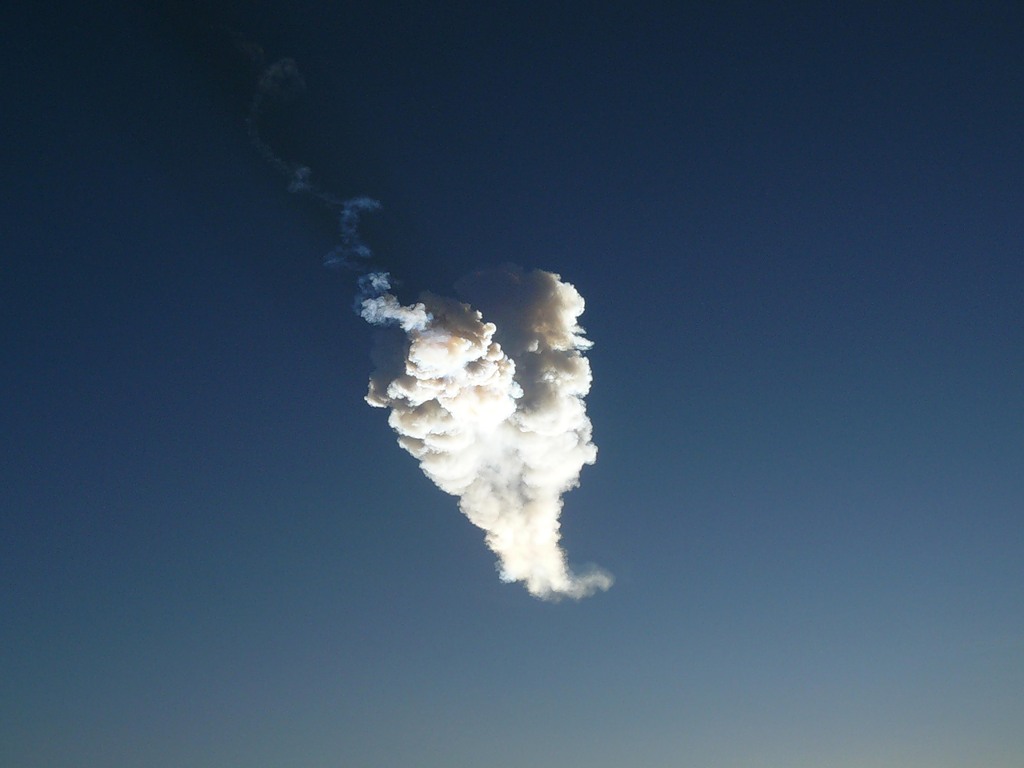
[ pedant ] meteroid [ /pedant ]
Mostly correct, but the meteoroid doesn’t lose all of it’s forward momentum–it slows down below hypersonic and supersonic speeds, but then the remaining forward velocity isn’t slowed down by air resistance any more quickly than a thrown baseball or a fired bullet would. The larger pieces have more inertia that the smaller pieces and therefore travel further before they hit the ground (and become officially a meteorite.) Meteorites on the ground from a bolide that shatters in the air are dispersed in an elliptical area known as a strewn field, with the biggest pieces tending to be the furthest away from the path of entry. (Here is a strewn field map for 2008 TC3, and here is one for Bruderheim)
Playing around with some numbers. As I mentioned yesterday, the fireball of 1966 was calculated to be approxamately 9 to 10 miles high at the time it entered dark flight in Canada. To be very generous, I’ll use the figure of 10 miles for its height when it passed over New York. Now, how large would it look? The figure “size of the full moon” gets thrown around, and that is a reasonable size to see surface details on (if you could see them.) So for a meteroid to look roughly half a degree across at a height of 52,800 feet it would have to be around 460 feet across. There are several variables on how much energy the airburst for a meteroid this size would have, but it is on the order of 5 megatons, or around 250 Hiroshimii. A meteroid around 10 feet across (the estimate for the 1966 fireball) would be around 1/50th of the angular diameter of the full moon.
This is about 40 arcseconds, smaller than Venus at its brightest, and (slightly) below the limit of resolution of human eyes. You certainly couldn’t see craters on such a small object.
So what did these witnesses see? I have only seen one bolide, a daylight observation back in 1980; this is long enough ago for the ‘flashbulb memory’ effect to have changed the details significantly, but I remember seeing an orange fireball with a trail of ‘smoke’ behind it. The orange fireball had some structure to it, but I couldn’t really give an exact description - it was changing too fast.
I suspect that it would be easy to observe this fireball as a solid object, perhaps a ball of burning material, whereas in reality it was a ball of luminous gas or plasma surrounding a small or invisible object.
Yeah, I have no doubt that the plasma sheath could be “puffing out” and changing color/brightness in spots, especially as the meteoroid tumbles and breaks apart, and that someone could mistake that for a large object with a small sheen of flame clinging to its surface. The problem is that I believe that you would actually have to see it live to be able to tell–if you are recording it the light is going to saturate the film or CCD, losing that detail. (Here is what video of Chelyabinsk looked like.)
This film of the 1972 earthgrazer (no, not the more famous clip) is probably about the best recorded evidence we have of what you would see with the naked eye.
(This photo is pretty good, too, but still saturated in the brightest parts.)
*I think it was June 1968, I was 9 years old.
It was a hot early summer evening in West Hills California just past dusk. My father put the TV on the back patio were we would watch the tube on lounge chairs. I was laying back looking up at the sky, when I saw a huge fireball pass directly over me, It looked like the size of a basketball, yellowish in color with a long flaming tail streaking across the entire sky. It looked so low, as if it was only a few hundred feet up. It traveled from the east to the west.
Then yesterday (Tuesday 7/18/2017) I was sitting in the very same back yard (I inherited my family home) looking to the north and saw a very large fireball. This time It looked to be about 15 miles off, low on the horizon, on a downward trajectory as if it was going to impact the ground. It did not look as huge in appearance as the fist one did that I saw in 68 as it was further off in the distance. But it did appear to be very low. It was a greenish color with a long fiery tail. *