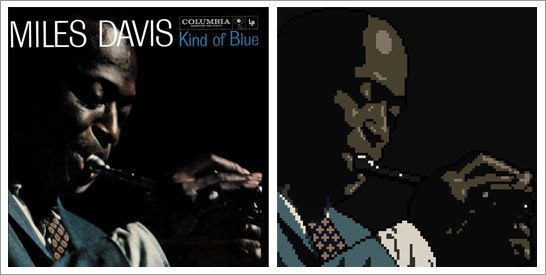
When Kind of Bloop was sued over the cover art, [on the right]
I believe the producer was the one threatened with massive damages, not the actual artist.
An important lesson, and one that occurs again and again, is that he was forced to settle out of court simply because that was much cheaper than months and months and months of defending his fair-use claim. (Would he have faced legal action in the first place if he had had deep pockets?)
A typical example of a derivative work received for registration in the Copyright Office is one that is primarily a new work but incorporates some previously published material. This previously published material makes the work a derivative work under the copyright law. To be copyrightable, a derivative work must be different enough from the original to be regarded as a “new work” or must contain a substantial amount of new material. Making minor changes or additions of little substance to a preexisting work will not qualify the work as a new version for copyright purposes. The new material must be original and copyrightable in itself. Titles, short phrases, and format, for example, are not copyrightable.
The earlier image was pixelated without other change. My feeling is that no “substantial” new material is present and that mere pixelation is not “copyrightable in itself.” IANAL, so I can’t be sure what the current case law is, but if I were Columbia I’d be all over Kaufman.
According to him it was absolutely not the result of pixellating the original photo; in fact he tried and failed to do such a thing himself, and ended up commissioning an artist to make “a pixel art recreation of the original album cover”. A glance at the side-by-side comparison seems to confirm this.
This problem goes well beyond IP rights. Think about how long the US code is. And the code for whatever state and county and city you might live in. No one has a working knowledge of what all the laws are.
That may make a difference. As any real lawyer will tell you, the specific facts of the case are more important than the law in cold print.
And that’s why just knowing the code isn’t sufficient. You have to know all the case law as well.
IP law is a small and extremely specialized branch of the law. Experts are few and far between. They would laugh and cry at the thought of an easy solution.
A related question. Someone writes me that my book is out of print. I tell him to go to my web site, download the pdf file and take it to a copy shop. Which he did. Now he obviously has my permission but the copy shop never inquires. He doesn’t even know that I own the copyright (I do, but only because the publisher returned it to me and my coauthor when it went out of print). I guess you could argue that by posting it on my web site I have given implicit permission.
I think ultimately the answer is that someone making a copy or two for themselves, even if not fully approved by the copyright holder, is small time enough that it’s not worth doing anything about.
But put up a webserver that serves it to everyone or make a few thousand and sell them and you better make sure your ducks are in a row.
Back in the day Napster tried unsuccessfully to argue “All we’re doing is allowing users to share files. It’s not up to us to make sure those files aren’t copyrighted.” Since Napster’s argument didn’t hold up in court, my guess is the same would apply to the OP.
Kinko’s used to be extremely meticulous about this. (Obviously, this was a long time ago.) I once brought in a book to get its illustrations properly reproduced. The content was long in the public domain, but this was a reprint edition with an introduction by an academic. The Kinko’s staffer refused to copy the illustrations even though the copyright page explicitly stated the only the introduction was copyright.
Today, who knows? I would have thought that big chains still had that policy but I haven’t checked in for forever.
The legal framework was not as settled in 1999 as it is now, and Napster was arguably a worse actor than Scribd. Napster had little legitimate use outside of copyright violations and no process to respond to legal takedown requests, instead hoping that they’d get by on a technicality because the materials weren’t on servers they owned.
Scribd has licensing agreements in place with many publishers and at least appears to have a fully functional and legal business… and also some people who upload stuff they don’t have copyright to. But they are protected by DMCA safe harbor as long as they respond appropriately.
Not just Kinko’s. As an assistant trainer for the Black Rock Rangers I would get the trainer’s manual printed two-sided and spiral bound at Staples or Office Max for use at the half-dozen or so trainings I would be at. One year Office Max actually looked at the copyright page on the PDF file and refused. I grumbled about it so the next year copyright was changed to give permission for “authorized users.”
It’s moot now because between the manual getting longer and inflation the cost went from $8 to $22 the last time I printed it in 2018. I just load it into my large-sized tablet now.