And you handle this situation the same way you handle all the other situations where the English language can be ambiguous.
“He owns literally a thousand CDs.”
“Do you mean an actual thousand, or just a lot?”
“No, I just meant he owns a lot.”
And you handle this situation the same way you handle all the other situations where the English language can be ambiguous.
“He owns literally a thousand CDs.”
“Do you mean an actual thousand, or just a lot?”
“No, I just meant he owns a lot.”
Thing is that without the “literally” we’d understand it to mean he in fact owned a thousand CDs. Not very ambiguous.
Oh, and as for “quantum leap”: Quantum does not, in any context, mean “small”. It means something more akin to “discrete”. A quantum leap, in any context, means that you go from one state to another, without passing through any states in between. It’s perfectly appropriate to apply it, for instance, to a new product that’s 10% better (by some metric) than the previous best product: They didn’t have to make a product that was 1%, or 5%, or 9% better along the way.
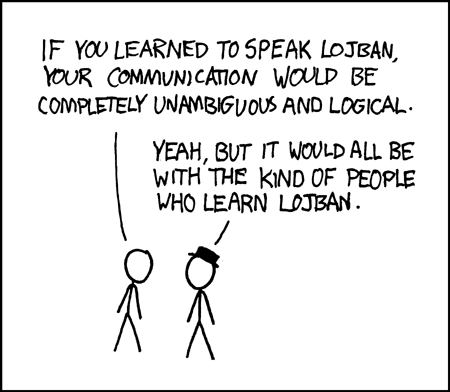
Lemme tell you about Lojban. . .
I’m not sure we would, though, because how likely is it that the number of CDs in the collection is precisely 1,000? That would be odd enough that if someone meant that, they’d use a word like “precisely” or “exactly”: “He owns precisely 1,000 CDs.”
If someone says, “He owns literally a thousand CDs,” I’m unlikely to think it means precisely 1,000 (since that word is missing). I’ll think it means a lot of CDs, same as I’d think if the person said, “He owns a thousand CDs.” It’s just an intensifier.
I think the same reasoning applies to most times “literally” modifies a number. If you mean the person has exactly that number, the word “precisely” or “exactly” will be a better choice. It’s gonna come across as an intensifier.
If you mean that he owns more than a thousand CDs, then the sentence, “He owns more than 1,000 CDs” is unambiguous. If you said that sentence but meant he owns a lot (but fewer than 1,000) CDs, I’d think you were communicating very poorly.
I’d have read it that way but yeah it still would not have been the best way to express the idea.
I’d actually expect something more along the lines of: “he owns about a thousand CDs.”; or “… one thousand CDs, give or take a few.”; or even an exact number “… 1002 CDs.” If the incredulousness is a desired part of the communications then “he literally owns about a thousand CDs.” would work.
Before I posted that, I looked up the phrase “literally a thousand.” The uses I found mostly meant, “no shitting, more than a thousand.”
Which is interesting, because it’s a third comprehensible use of “literally,” most closely related to “No exaggeration” meaning–but it doesn’t mean literally, as in, this is the exact truth.
Seriously, ambiguity can be a good thing sometimes. Are there many good jokes in Lojban?
“Fear where old men tread.”
In the usage we’re talking about, literally does not mean figuratively. It’s being used figuratively, as a hyperbolic intensifier of metaphorical language. It doesn’t mean figuratively, it means pretend literally, not the same thing at all.
Simile:
It’s as if she’s glowing.
The comparison is explicit.
Metaphor:
She is [pretend] glowing.
We describe her as actually glowing even though there’s an understanding that this is not literally true, as a way to intensify the imagery.
Doubling down on the metaphor:
She is [pretend] literally [pretend] glowing.
A natural next step to intensify the imagery still further is to use a form of words that appears to deny that it was a metaphor, and to appear to claim that it is literally true that she’s glowing; but of course, there’s still a perfectly clear understanding from context that it’s not literally true.
A couple of things for the naysaying prescriptivists to consider.
(1) It’s a common prescriptivist argument that a proscribed usage introduces irreconcilable ambiguity into the language, that it literally makes it impossible to communicate ideas clearly. It’s certainly possible to construct isolated sentences where the intended meaning of “literally” is unclear. But there are all kinds of ambiguities in isolated sentences in natural language. We discern the intended meaning from context. Have any of my uses of “literally” in this post been ambiguous? Bear in mind that there’s a certain amount of natural selection in the evolution of language. If some usage were really inhibiting the efficient transfer of information in some significant way, I think it would naturally fall out of favor without requiring any active proscription.
(2) The idea that we should “reserve” certain words and make their figurative or hyperbolic usage taboo is likely to be a red rag to a bull. The notion that an expression is taboo probably makes it more likely that it will be attractive for dramatic hyperbole.
What word has that meaning now? “Multiply by a factor of 0.9”?
'Cos that seems a trifle cumbersome.
Huh. Coulda sworn that I edited out that “approximately 21.854 times” bit.
Maybe the next time you find the need for a single word to mean “kill every tenth person” you can improvise and let us know what you come up with. Should be any day now, right?
That’s really the point. There’s no current need for a word for that concept any more than there is need for one that means to kill off 16% of the population. So the word got re-used for other meaning. If that repurposing had not happened it would have otherwise just disappeared from use other than by historians of that empire.
Meanwhile we add new words for new concepts at a rapid clip.
Anyone know if any authoritative source for the trend in the average American’s working vocabulary?
My WAG is that it has increased over the last several decades as a greater fraction have become more highly educated. But that’s just a guess.
Thankfully, the OP didn’t use “nauseous”. I don’t think the board hamsters could have taken the strain.
It’s funny to see someone complain about the misuse of a word, while misusing it in the thread title.
If we pedantically insist that “literally” must (must!) be used in its original sense, then “literally” means “related to words.” One might say “He literally told me to move along” - meaning that he used the words “move along.” One might also say "Translating ‘de nada’ literally gives you “of nothing” but of course the real meaning is “You’re welcome.” But to talk of “literal ignorance” is a figurative use - using “literal” to emphasize the ignorance one claims to see, just like “literally exploded” is a figurative use.
Can we talk about how “backslash” seems to mean “forward slash” now?
Is this guy \ leaning back or stepping forward? I can never remember and frankly, I don’t care.
Regardless of whether you care about the figurative inspiration, the fact that choosing between the two symbols has consequences means that they need to have distinguishable names.
If I recall correctly …
If you’re typing a URL, you have to use the forward slash /
In you’re specifying a directory path, you have to use the backslash \
They’re not interchangeable.
Some URL’s are “special” and "" is allowed. In particular Windows file system URLs.
Many OSes uses “/” as a file separator. MS-DOS started with “/” as a command line option indicator. When they added paths they couldn’t use that so "" was used.
In the early MS-DOS days there was a command (SWITCHAR=) to change which character to use. But that was often ignored by 3rd party software.
You can even use “/” as a path separator on the command line even on Windows 10 and it will often work!
But I do agree that knowing the difference between the two is a really good idea. And nothing to be proud of.