According to my amateur understanding of physics, G-force is the same no matter whether it’s positive or negative (negative in the sense of stopping, not starting).
OK - I get it now.
Oh, and
Actually, I’d expect that the acceleration would be fairly steady, with the peak not much greater than the average. Remember, it’s all due to things specifically designed as safety features, and very well-engineered safety features at that. The crumple zones, seat-belt slip, and airbag would all be designed to provide a constant acceleration of just such a magnitude as to stop from 60ish MPH, in the distance available.
I used to work for Ford in test crash analysis (they prefer to call them “barrier tests”) and the cars were typically towed into a concrete barrier at 35 MPH to exceed the federal requirements for performance at 30 MPH. The tests were primarily to confirm steering column intrusion limits. I do not not if there are any regulations specifying performance at 60 MPH. This test was performed by an insurance institute, so it’s not clear what they were evaluating here. Also, the crash was not into a fixed barrier (which simulates a head-on collision with an equal-mass vehicle going the same speed in the opposite direction) but rather a collapsible barrier, which also mitigates the impact. It also appears that the engine compartment is just shredded, so I don’t know if that is a stock car.
I thought that only happened in the movies. How can a car launch from flat ground to the height of a three-story building?
Anyway, I’m glad you survived it and here’s hoping for a fast recovery.
this is not true. old cars were death traps because they were not designed to control or mitigate the crash energy in any way. Those “rigid” frames would buckle easily, the lack of a crumple zone meant the front/rear end just folded up uselessly, and the lack of a reinforced passenger cage meant the pillars would collapse and force feed you the dashboard and steering column.
This. Here’s an offset-frontal crash test pitting a 2009 Chevy Malibu against a 1959 Chevy Bel Air. The Bel Air’s passenger compartment gets destroyed (see at 0:50), and its driver eats the steering wheel. In contrast, the Malibu’s passenger compartment is barely distorted at all (see at 1:08), giving the seat belt and airbag (and front crumple zone) a chance to safely decelerate the driver.
Based on the OP’s description of his crash, if he (she?) had been driving a vintage car when he crashed, he’d be a mangled corpse today.
obbn, sorry for what you’re going through. Hopefully your physical injuries will heal well in the coming weeks and months, but pay attention to your mental health, too. I was in a serious crash a couple of years ago, and although I escaped without any physical injury, it really messed with my head for a long time after. Look for friends and family to talk to about it - and, if necessary, professional help.
That seems to be horizontal distance there, not vertical.
Guessing OP meant a 30’ horizontal flight distance - although with the right ramp/hill and enough speed, anything’s possible. Here’s a crash into the second story of a building.
Thanks. That’s still a pretty impressive long jump.
You are correct, I misspoke. However, jerk definitely does play into how the impulse is perceived and applied to a flexible body that may experience differences in acceleration at the different points at which it is applied, e.g. for an occupant in a forward impact, the head will experience a significantly different acceleration profile than the restrained torso, and how different depends on the rate at which acceleration changes.
It is the goal of all of those occupant safety systems to mediate the impulse and present a more constant level of acceleration rather than a dramatic peak. The energy being delivered will be the same at any level of kinetic energy, but how it is applied can be radically different. People often look at how older vehicles would survive an impact with repairable damage while a modern vehicle will experience crushing and deformation of the chassis, rendering it unrepairable, but that is exactly the point; it is cheaper to buy a new car than to rebuild a person, so the car is sacrificed to absorb as much energy as possible and mediate the rest of it, as well as to protect the occupant from direct impact with hard components. Surviving impacts at >60 mph in an unreinforced passenger car used to be virtually unheard of because even if the occupant was wearing a lap belt he or she would slam forward into the dash and suffer trauma to the head or being impaled upon the steering column. Now you actually have a pretty good chance of walking away from a frontal impact at that speed provided you are wearing your three point safety belt and don’t choke on your chewing gum, and even rollover impacts are surprisingly survivable in many (but not all) vehicles. Oblique and side impacts are still pretty deadly just because of the limited ability to absorb and protect occupants but those are generally multiple vehicle collisions which can be reduced by active driver aids and (eventually) autonomous piloting systems.
Stranger
Airbags have a lot of powder which looks like smoke when they deploy. People, whether occupants or bystanders not-infrequently report a MVA (Motor Vehicle Accident) with vehicle fire based on the ‘smoke’ in the passenger compartment.
There are three crashes, microseconds apart:
[ol]
[li]Car hits object[/li][li]Occupant(s) hits car (steering wheel, dash, back of front seat, etc.)[/li][li]Occupant(s) internal organs hits occupant (rib cage, body walls)[/li][/ol]
The first one is always survivable; it’s the second two that cause injury & death. Airbags & crumple zones help minimize the second & third crashes.
If the car hits a ditch, the start of a Jersey barrier, or even a short but steep driveway ramp with enough speed they can go airborne. Here is a video of a crash that happened earlier this year where the car ended up embedded in the second story of a building.
You are very lucky to be alive. Just G-forces alone can certainly kill you.
Back in my LEO days, I had a guy who crashed a Fiero in almost the same circumstances. We determined he had three fatal injuries. He left his left leg in the car when he exited through the front window, which would have caused death by blood loss pretty quickly. The G-forces also caused a torn aorta (with no external chest injury), which would have caused very fast death through immediate loss of circulation and blood volume. But even that wasn’t fast enough to be the real cause of death, because he flew headfirst into a really solid tree, and that was immediate lights out.
And yet, surprisingly, the car didn’t catch on fire.
“Can’t trust them foreign cars, ya’ know?”
Stranger
I, for one, am glad the OP doesn’t, “NEED ANSWER FAST.”
Get well.
First of all, I think everyone on this board (to say nothing of you and your family) is delighted that you are not dead.
You’re right to credit the various crumple zones with your survival. However, the sheer size of your car is probably a red herring, especially in a collision with a quasi-fixed object like a tree.
A well-designed smaller, lighter car would have protected you at least as well as your Mazda CX-9. As an extreme example, a Formula One car has perhaps 15-20% of your Mazda’s mass, but protects its occupant well against much worse impacts than yours.
I’m not suggesting that a small car would have been more protective—I’m just saying that the protection came from the quality of the engineering (specifically, of the explicit dynamics simulations) rather than the mass of your car.
The more mass involved, the more energy the crumple zones have to absorb. In many situations, increasing mass is basically (from a safety perspective) a zero-sum game. Head-on collisions with another vehicle are different, though, and not in a good way. More mass protects the occupants of the heavier vehicle at the expense of the occupants of the lighter vehicle. It quickly becomes an arms race and/or tragedy of the commons.
Again, the important point is that you’re alive and kicking. I hope you heal quickly!
Oh, to clarify, I traveled about 30’ THROUGH the air after hitting the driveway. I don’t know how high, but I do know you can clearly see skid marks, driveway, no skid marks and then see where the car came down again.
I can attest first-hand to the efficacy of seatbelts and crumple zones. Get well soon. There is one thing I regret: not taking a photograph of the impressive bruise the seatbelt left.
A sudden stop is negative acceleration.
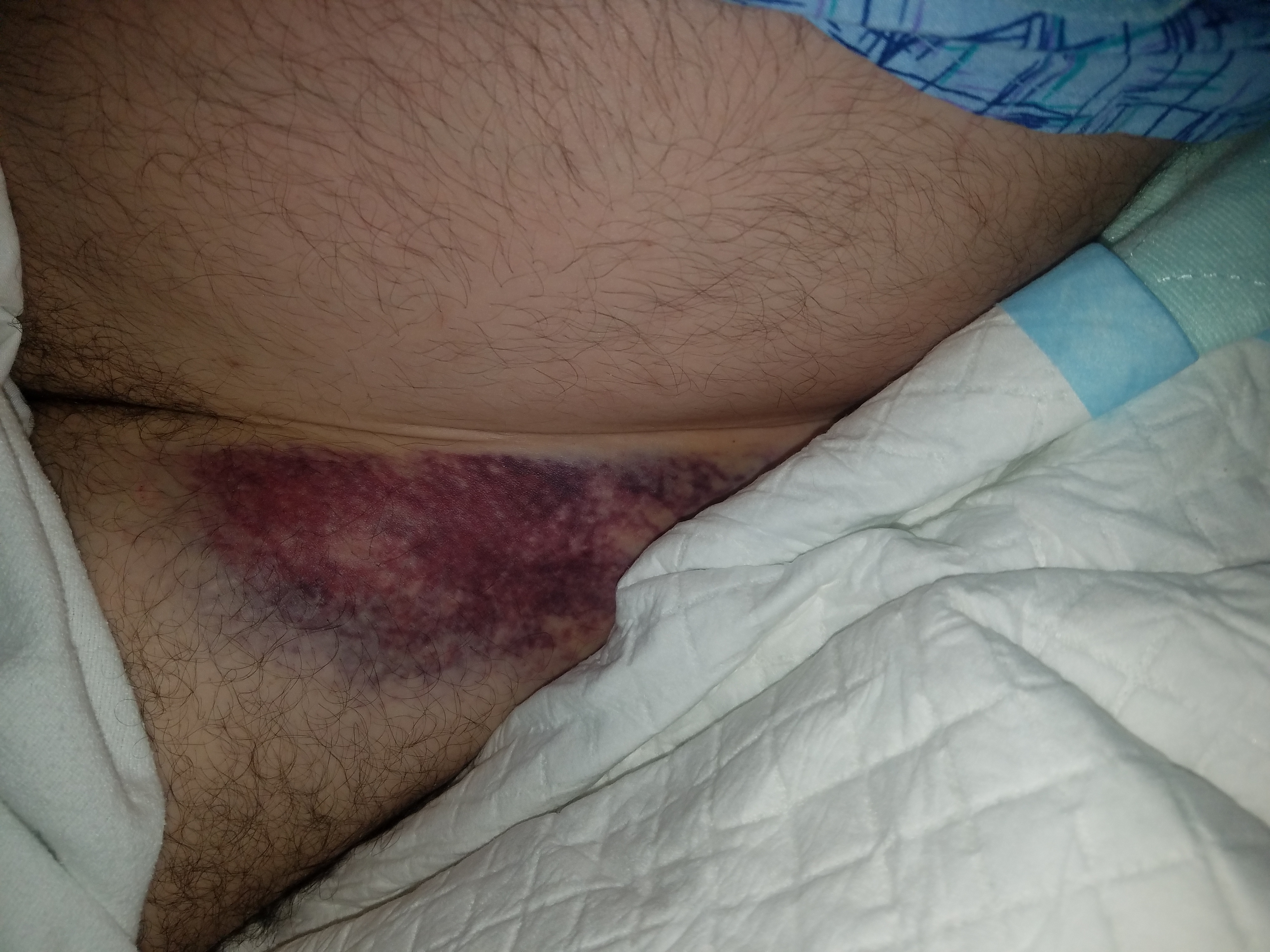
I took one and you aren’t kidding. The bruise on my left thigh from the lap belt is HUGE and horrible. Doesn’t hurt but looks nasty!
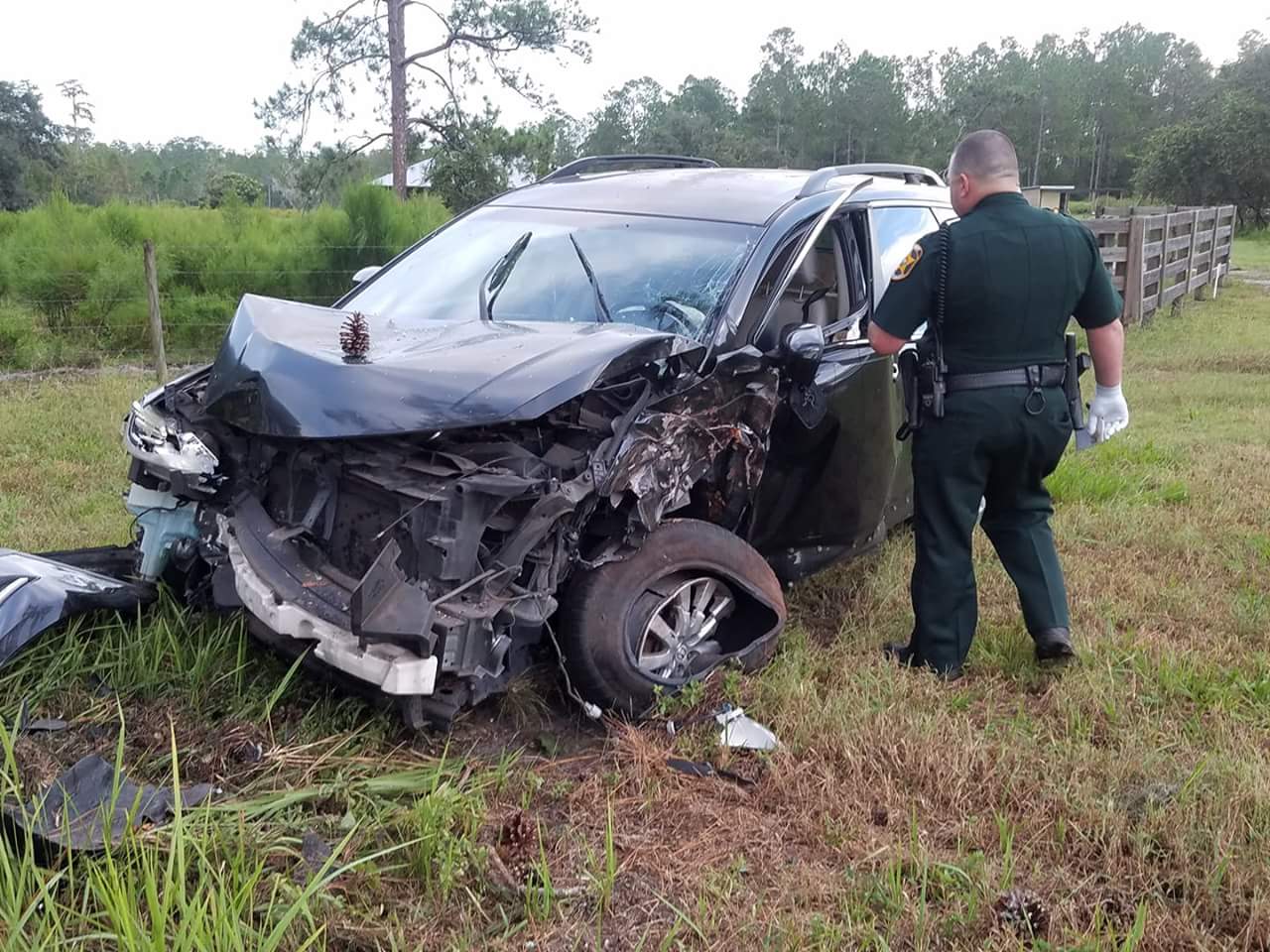
If you are interested here’s a picture of the seatbelt bruise and what’s left of the Mazda
Bruise
Mazda