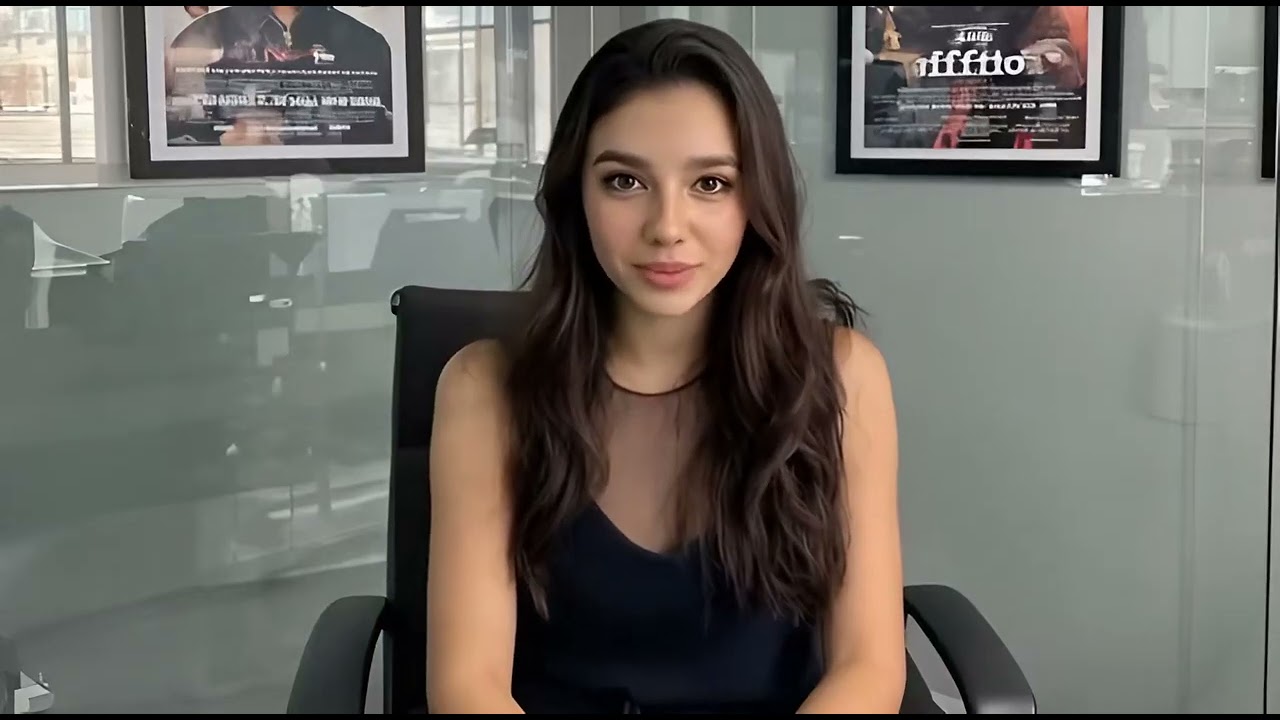
(I didn’t note how long that took to generate, so I had Grok make another one this time choosing it’s own dialogue. Generating this next clip took 20 seconds.)

(I didn’t note how long that took to generate, so I had Grok make another one this time choosing it’s own dialogue. Generating this next clip took 20 seconds.)
Yes, asking it to “Write a short story in the style of Mark Twain” you might get the tale of a 14 year old traveling back in time to King Arthur’s time and using his clever skills against the monarchy, aristocracy, and the Catholic Church in Twain’s satirical style, which allows for pulling elements from many of his novels and short stories. It might be decent, or a hot mess of inane dialog.
Ask it to produce a screenplay for the Marx Brothers meet the Three Stooges, it might be able to have a decent first reel introducing the characters and the hijinks that happen when the Stooges try and rob a bank run by the Marxes (?). Hmm..that one might be good.
Yet to say write a write a screenplay romance novel where the protagonist falls in love with a man of low moral character, you might get Jane Austen meets Nathaniel Hawthorne.
Surely, at this time, there are AI-based tools to assist a filmmaker with a screenplay. Give a good synopsis of the characters, their profession, and location, it might be able to scaffold various Act II conflicts with their respective Act III resolutions. Perhaps provide some dialog and storyboards. The extent to which the human guides things will vary and perhaps become less and less over time. Still, the human writer might have to tell the AI, “The old man isn’t after a Great White, it’s a Marlin!” and then the AI either complies or lets the writer know, "It’s been done.
I reckon if not there already, Hollywood has gotten away from the Uncanny Valley for human actors. Indeed, many actors have signed off on their rights for their likeness and voice to be used (and some have forbidden it)
Nothing uncanny about that!
Replace Meg Ryan with her, Billy Crystal with a similar original AI for “When Harry Met Sally”. Set it it Glasgow (appropriate accents - though maybe the guy is from London originally) and only change geographic terms or stuff like references to dollars and you will rake in the box office cash.
That depends — who helmed it?
[Moderating]
I realize that @Wendell_Wagner was being facetious when he said he’d had a conversation with Norwood, but let’s not accuse each other of lying.
And no, I’m not distinguishing between you telling an AI to say that he’s lying, and you saying it directly. If this were a non-facetious context, that’d have been a Warning.
ChatGPT. And honestly, at least for the first one, the novelty value would probably be enough to sell a lot of tickets for opening weekend. The real test would come in the long term, and Hollywood would be well-advised to not release the movie until they’re sure that it’s actually good, because if the first Hollywood all-AI release is a stinker, it’d probably be a generation before any audience would ever give another one a chance.
I agree. Probably not in five years, but it wouldn’t surprise me in ten years. Unless it was banned.
I was considering making a movie of a Shakespeare play, where the only twiddling might be which boring parts to get rid of to make the movie hit a 2 hour length. These days that isn’t an issue.
I’m sure it will soon be able to do crossovers like you suggest. How good is something else. But I’m not sure how much better a human scriptwriter can do. More likely adaptations, like Emma being adapted for Clueless. (Haven’t read or seen either.)
The big problem today, which they are working on, is maintaining consistency at great length and planning ahead - to hide clues about later plot points. LLMs right now do a good job on flash fiction. Novels, not so much. A good novel is not just patched together from independently written components. Ditto a good screenplay.
Massive on location shoot - maybe. Filming Shakespeare on a sound stage, no way. The cost of the generation of a movie - and even more the training that would have to be done to make it possible - is over and above normal. The on-location craft services meals I’ve had (and I’ve had a few) were probably more environmentally friendly than everyone going out to get fast food, studio cafeterias would be even more so.
Yeah, building a set costs energy, but nowhere near the equivalent of a small town energy LLMs require.
On the fantasy novel website I did for my wife, I added a page that, as I said, you can choose the mode of the response, reading level, band revity. And I do submit a rather large prompt to one of a choice of AI engines. I understand the results - as uncanny as they may seem - are likely confirmation bias yet sometimes insightful. I have an adjunct message board page where I seeded it with OPs from one fake user, and had it using the different AI engines and previous replies to populate a thread (to make it seem popular and used - I often point potential (contract) employers to the site). In regular use, just as on the Dope, sock puppetry is not allowed. Yet I am #1 user in the DB. And I daresay that the back and forth on things like “is this character really evil or play-acting,” it is just about indistinguishable from “real people” replies.
If we’ve gone past screenplay/storyboard and even plot tips and dialog AI assistance, and the actors are AI-“live” (not animation), that movie is going to bomb big time. Especially if 1980’s “Harrison Ford” or 1941 Humphrey Bogart is in it.
“Tron” was a unique movie for its time. It almost broke even, though, as most movies that do not double their budget, it was a write-off. Real actors, in somewhat animated-looking suits (motion capture was a couple of decades away), and playing games to defeat the Master Control Program, represented as some big red spinning cake that was parodied years later by South Park.
Is this a kissing computer movie?
Indeed, it was. One of the first to use CGI. And using computers disqualified it from the Academy Awards for Best Visual Effects because they felt using computers was “cheating.”
If Disney and Sony dig in their heels and keep making AI-contribution movies, the Academy might make a special category. All bets may be off, however, if the screenplay was written by a combination of NVIDIA, Nokia and Alcatel Lucent tech. You take the magic out of Hollywood, you can create your own damn awards.
Let’s say for the sake of argument that the AI needed to create a movie from scratch operates at 1 megawatt (as reasonable a guess as any, I would think, current top generative AIs use single-digit kilowatts) and that it can generate the video at 1/10th realtime. A two hour movie would consume 20 megawatt hours of electricity. Global energy production is around 31 million megawatt hours per day.
A movie would require a lot of information.
Each character has to be described in general terms.
The actions of the characters.
Conflict.
AI, Write a story about Wanda, a recently retired woman. She misses her adult children and recently began dating.
Mike, her son is a police officer and concerned his mother could be victimized.
Jenny, is currently unemployed and dating Wanda.
A movie would require a lot more details. 90 minutes requires describing sets, scenery, costumes. The AI needs general information that it can expand.
Rick Beato demonstrated a AI program that creates songs. There were multiple prompts to give the AI material to use.
It did create a nice country song. Rick wasn’t happy because it will change how new music is written.
The creativity comes from the details that are input into the AI. The songwriters will learn to use AI as a tool. The AI is not the same as a songwriter.
The thing about the Turing test comparison is that it was originally intended to represent something that was computationally difficult (fooling a human), and over time became misunderstood as something that was impressive in and of itself. In other words - hooray for winning that particular trophy, but it barely scratches the surface of human achievement.
Likewise we’ll definitely see AI make motion pictures. Definitely a Michael Bay or Avengers type film, since those are significantly AI anyhow. An AI may accidentally make something that’s odd in a particular way that it will become a cult classic, maybe even something you’d enjoy watching or be willing to pay money for.
But art isn’t just a blob of content to consume. It’s a conversation between the artist, the audience, and the rest of society. The filmmaker holds up a mirror to us and says “this is what I see, and why I feel that way, and I chose to represent it in this particular fashion.” An AI content generator will never be able to participate fully or meaningfully in that conversation. It didn’t look at the world around it and experience a creative urge. It can’t tell you why it made what it made.
That’s why an AI will never make great art. It might make something desirable or technically skillful or popular, but nothing that will be important to anyone in 1000 or 100 or probably even 10 years from now.
I always find it hilarious that for decades or more people have been saying that you can’t limit what is considered art (as in splatter in a canvas or a can of poop or a banana taped to a wall) but as soon as AI comes around suddenly they are very insistent on what isn’t art.
For 99.99% of people, they care about wherever they like something or not. Whether or not it should be labeled as “art” is absolutely irrelevant.
I would imagine it would be done scene by scene like a real movie. At least that is what I assumed, if we are talking telling the AI to just “make a movie” with certain parameters that would be a lot more difficult than what I was envisioning.
That would be more practical for AI within the next five years.
AI is already developing faster than I expected.
That’s because the art isn’t the object, and never has been. Jackson Pollack is an enduring name not because of the quality of his splatters but because of the conversations he started (which you are currently participating in). You may not like the banana taped to the wall, but you seem to like talking about it. No AI will ever make a piece with that kind of interest.
This is just content. If someone is interested in content and not art, that’s their individual taste, but getting a computer to make content is not particularly an impressive or even new achievement.
That’s why my point is that a computer will probably make movie content before too long, but nothing you’re ever going to pay to go see, because your artistic gut will easiliy detect that it was made by nobody, for nobody and hence find it wholly uninteresting.
Okay, thanks for your permission. I don’t give a flying fuck about “art”. I’m content with content. A comouter can never make art because a computer can never make art is a tautology that doesn’t either interest or impress me.
A quick search shows that an advanced model uses 2 kWh to generate a single image, so your estimate for a movies seems rather low. And you need to count iterations.
A five second Sora video takes 1 kWh. I suspect that this is a lot less detailed than something suitable to replace a traditional movie. A movie in 1/10 real time? Seems implausible to me. And you neglected training costs, which seem to be one of the main power draws.
Also, from Google AI
No one has released the energy cost of training on videos, but it seems high.
One movie isn’t going to make a dent in global power usage, but neither does set building or craft services.
I wonder how the energy usage for significant CGI in a movie compares to the cost of live filming?
I know it’s an aside but computer chess didn’t really play out like that.
The critical gap was between being able to beat a grandmaster once, before they spot patterns in the computer’s play, and being able to consistently beat grandmasters, which required deep learning.
And I am not sure that the majority of people with interest in this field handwave it as not being intelligent. Modern chess computers seem to have some kind of chess intuition. They aren’t AGIs obviously, but within their domain absolutely it’s intelligence.
To me clear, I mean 10 times slower than realtime. (If I had meant faster I would have said 10x.) And I was a little sloppy with terms. Megawatt hours is the rate of electricity consumption. Megawatts is the amount of electricity consumed. Hence a two hour movie made at a rate of 1 megawatt hour uses 20 megawatts.
The 7 second clip I made up-thread took 20 seconds, so was rendered at around 1/3 realtime (not in 1/3 realtime). I estimated the full-resolution video on a much more powerful setup progressing at three times slower than that.
Again, I meant use 20 megawatts not megawatt hours as I accidentally wrote. So I estimated the rate of energy consumption at 500 times higher than the rate for producing a single image. One million watts per hour as opposed to 2,000 watts per hour.
I just ran a test image prompt in Sora, which uses the same OpenAI model that is used by ChatGPT, Copilot, and Bing (among others). It counts as one of the advanced models. From the moment I submitted the image to the queue until it was finished took approximately 30 seconds. So assuming that it spent the entire time rendering, using 2 kilowatt hours in 30 seconds means that the render was using energy at a rate of 240 kilowatts per hour.
I don’t know what GPUs were used, but a very high end Grace Hopper 200 uses around 500 to 1000 watts per hour. If 100 percent of that 30 seconds of rendering was spent on GPUs, that would mean that it took the combined output of 240 to 480 Grace Hopper 200s to create that single image. Allow lots of that power to be used by other infrastructure, and call it “only” 100 GH200s. GH200s cost more than $30,000 each. So that single image would be using in excess of three million dollars worth of resources.
However, if what you and your source really mean is that the image was generated at the rate of 2 kilowatts per hour (which is entirely plausible for one GH200 plus all of the infrastructure surrounding it) using that rate means the single image used appropriately 16 watts of electricity. (2,000 watts per hour divided by 1/120th of an hour.)
A two hour movie at 24 frames per second is 172,800 frames. At 16 watts per frame, the movie would take around 2.76 megawatts to produce, 7 times less power than my hypothetical 20 megawatts. (The hypothetical movie would need a higher resolution and a more intelligent model, so being an order of magnitude more demanding doesn’t seem implausible.)