Apparently, such a player can report as ineligible, but is not required to, as their position in the formation determines if they are eligible or not. It’s not as big a deal as the reverse (a player wearing 50-79 being an eligible receiver), as the defense needs to be aware that they need to defend against that player in pass coverage.
Also, a player with a 50-79 number who is continuing to serve in an eligible receiver position for multiple plays must report as eligible on each play.
This web page appears to be pretty comprehensive about the rule, and has this excellent summary:
Suppose the right guard reported to the officials he was going to be eligible in the next play and lined up half a yard behind the line of scrimmage but otherwise between the center and right tackle. If you had a ginormous guard who had soft hands, I would think it might make for an effective trick play, a screen dumped to a guy who would be difficult for linebackers and DBs to bring down. Yeah, the defense would be advised, but when no lineman lined up in one of those traditional ‘tackle eligible’ formations, the right guard might be lost get the defense in the shuffle until a 300-pounder was rumbling downfield after catching a short pass. Could it work?
I think the context that is missing here is “why can’t everybody be an eligible receiver?” and the reason ultimately boils down to safety.
Football is still a violent, dangerous game but it was much more so over a century ago. As in several fatalities every year. The forward pass itself was a “new” innovation in football back then. And to make it somewhat safe, it came with restrictions, e.g. having 5 ineligible receivers on the line every play, to prevent some dangerous formations.
The newer rules, such as a 6th lineman declaring, are basically refinements on that principle.
I don’t think that’s true. Specifically, even if a TE is going to block, there’s an advantage to being a yard behind the line, or even in the backfield, it gives you time to see who is rushing and move to intercept. It often looks like there are more than 7 players on the line, but as I said above you only need to be 1 yard back to considered in the backfield. One illegal formation penalty that happens sometimes is a lineman will be called for NOT being on the line, because they lined up too far back to make blocking easier - it happened to Denver’s left tackle last night.
I googled your question about the guard, and the AI answered NO. An eligible receiver must line up at the end of the line of scrimmage, not between the center and tackle.
By the way, if a pass is deflected by a defender or eligible receiver, ANY offensive player can catch it before it hits the ground. Furthermore, pass interference can’t be called on a deflected pass. So, you can shove an opposing player out of the way to catch the ball, or to prevent them from catching it. I’ve never heard, though, of an ineligible offensive lineman catching a deflected pass and making a big play with it.
I think the simplest way to think of it is it happens when they want to have a regular offensive lineman play tight end. On very rare occasions there is some shenanigans and that player winds up with the ball. For the most part it’s to have more meat on the line to block. I think the OP assumes it is to have more players who are allowed to catch the ball when really it’s so they can have more blockers on the line. It most commonly happens in short yardage situations when they need a yard or two and plan on getting it by brute force.
But ricepad’s theoretical has the eligible guard line up behind the line of scrimmage:
I don’t know if that positioning is legal or not, but receivers line up a yard behind the LOS but between the tackle and another receiver who is at the end of the LOS all the time.
I mean, at that point they are a fullback, right? They would have to be basically level with the quarterback, if not behind him, unless he’s in the shotgun. And you just left a massive hole in your offensive line for a defensive tackle to burst through.
Also, you have to have 5 guys on the line of scrimmage that aren’t eligible. So you would have to have some sort of unbalanced line with a center, a guard and tackle to one side, and then a gap and two tackles the other way?
If you want to do something similar then the various interior “shuttle pass” options to a big dude lined up at the end of the line makes a lot more sense.
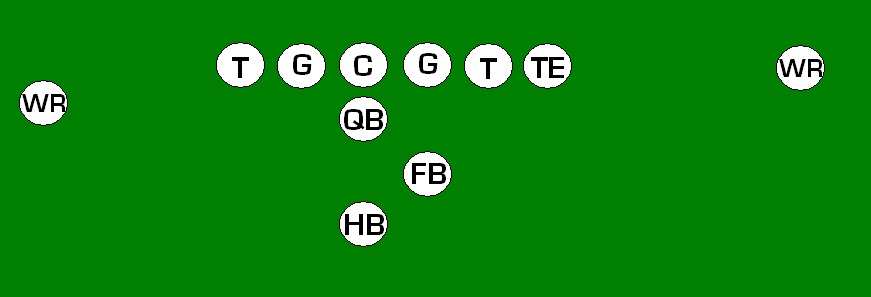
As you can see, the WR on the left side is lined up opposite the tackle on that side making them the last player on the line on that side (‘“end)”) , but the WR on the right is stepped back off the line- in this case the tight end (TE) is the "end’.
Eligible receivers are the “Ends” as described above (left-side WR, TE), and the backs (i.e. not up on the line), who are the FB, HB, QB, and WR (right).
The classic tackle-eligible play has the two WRs basically switch where they are on the line. The right-side one steps up to the line, and the left-side one steps back off it. This means the TE is no longer eligible since he’s not the end of the line anymore, and it means the left-side tackle (T) is eligible, since he’s the end on the left. It’s basically relying on the defense to not notice that the WR is a few feet back on the left, and a few feet forward on the right.
In the NFL, there’s weirdness about what numbers play where, etc… which are more than ridiculous, but apparently as a result, you have to tell the referees about it if you’re doing this sort of thing, which to me, seems like you’re required to tip your hand.
That’s exactly right. The NFL takes pains to keep teams from using this as a trick play, though it doesn’t mean that every player on the defense picks up on what’s going on, even after the “reporting as eligible” announcement is made.
Is this a fair summary? The last question is where I’m getting hung up
You need 5 ineligible players on every offensive play. Whether a player is eligible or not is determined by the formation / how they are lined up.
Usually
Those are the 5 ineligible are the lineman. The other 6 players are skill position players - QB, TE, RB, WR.
But Sometimes
You can have traditional linemen become eligible with non-traditional formations. When this happens, the offensive lineman must also declare themselves eligible to become eligible.
Why not always use-non traditional formations?
Just to bluff so the defense never knows the 1-2 times you’d actually throw a pass to the lineman?
You don’t want to always use a non-traditional formation because it inherently means you will need too many offensive linemen type bodies (6+) than is necessary to block a typical defensive line - unless the one declaring eligible might be some hybrid player that is really good at blocking but also is quick and catch, etc; or,
you’d have too few offensive lineman type bodies (5 lined up, but 1 is leaving to go catch a pass leaving 4 to block) than is necessary to block a typical defensive line and you’d be asking a TE or WR or RB to fill that role best filled by an offensive lineman - unless the non-traditional TE/WR/RB that would be indeligle would be some hybrid player that is really quick and can catch, but also can block well.
If that’s accurate, and including a unique hybrid player who can do all things, what is stopping the offensive in those situations from using non-traditional formations?
Generally speaking, a team which brings in a sixth offensive lineman (reporting as an eligible receiver, because that’s where they are going to be in the offensive formation) is using that person for additional run blocking strength – either by positioning that player as a tight end, or as a fullback/blocking back behind the line of scrimmage.
Yes, they may sometimes actually throw a pass to that player (see Mike Vrabel), or hand the ball to that player as a very large running back (see William “Refrigerator” Perry). A lineman who is “good” at pass catching is nearly always not nearly as good at it as even the team’s reserve receivers are; going with that sort of set-up is effectively handcuffing the team’s passing game, because you have one fewer true receiving threat.
So, most of the time, the “sixth offensive lineman” is being used for additional run blocking; unless the team has a tight end who is particular big, strong, and adept at run blocking (see Marcedes Lewis), a third offensive tackle is going to be much heavier, much stronger, and much more skilled at that block than a tight end will be.
If I’m parsing this correctly, you’re taking about a situation in which a team is only putting four “true” offensive linemen (uniform numbers 50-79) on the line, and putting a TE/RB/WR in one of those five “interior line” positions.
That sort of situation is exceptionally rare in “normal” plays from scrimmage; probably the only time you’d see it is if a team is so depleted by injuries in the offensive line that they are forced to use a TE in that role.
Regardless, “5 lined up, but 1 is leaving to go catch a pass” is illegal by the rules: the five interior linemen cannot be eligible receivers, regardless of jersey number or usual position, and the five cannot be beyond the line of scrimmage when the ball is passed – that’s an “ineligible man downfield” penalty. Just because the guy lined up at left guard is actually a tight end, wearing #82, does not make him an eligible receiver on that play.
However, it likely does happen somewhat more often on special-teams plays (PATs, field goals, and punts), where the special-teams “linemen” are usually reserves and specialists.
Back in 2014, Belichick ran a play against the Ravens in the playoffs where he’d have a running back report as ineligible, but instead of lining up in the center they’d be split out wide. Still on the LOS, with an eligible player outside them, so technically legal, but it confused the defense who wound up putting someone in place to cover the ineligible player. He ran it 4 times, by the end Harbaugh was complaining enough that the refs even clarified it “Number 34 is reporting as ineligible. Do NOT cover number 34.” The NFL wound up changing the rules that an eligible player reporting as ineligible had to lineup inside the tackle box just to prevent that kind of tomfoolery.
I’ll just note this as some have reported incorrectly: The T-formation quarterback, a quarterback who stands right behind the center and takes the snap directly from the center’s hands, is not an eligible receiver as eligible receivers must stand at least a yard the offensive line. A quarterback who stands further back, like in the shotgun lineup, is an eligible receiver. Nevertheless, the T-formation quarterback does not count as one of the required men on the line of scrimmage.
The first time I went to a live NFL game, I was surprised at how many times a lineman did line up as eligible. You don’t hear all of those announcements on tv. I don’t think a single one actually had a lineman passed to.
While the offensive lineman are all required to be lined up on the offensive line, there is no particular requirement as to how far apart they are.
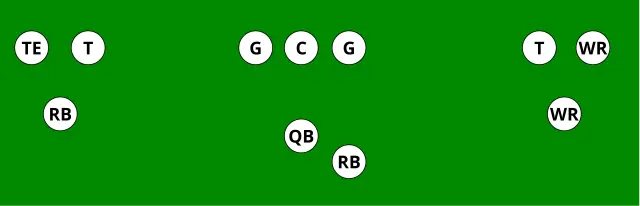
So you can get the Emory and Henry formation.
This was something that Steve Spurrier would occasionally pull out at the University of Florida back when I was still in school.
(Note that the tackles still can’t go beyond the line of scrimmage on a pass play. Even way out wide, they are required to stay behind the line of scrimmage to block, until the pass is thrown downfield).
Linebacker is a defensive position but Vrabel would occasionally play on offence as a tight end.
Long time since I’ve been to a live game (I live in Scotland) but I would imagine on FG attempts there would be quite a few reports for eligible receivers as usually everyone except the holder and kicker are there to block.
In the week 3 thread I posted about a Seahawks fake FG where the punter picked up the ball started to run with it and when then threw it to an Offensive Tackle who was playing in the TE position for the play.
While true that 8 of the 11 out there are there solely to block (the long snapper is primarily snapping the ball, but is also a blocker), a kicking play still has to follow the rules for number of players on the line, and eligible/ineligible receivers.
The two “ends” on the line of scrimmage are probably going to be the team’s backup tight ends, and there will need to be two more players (in addition to the kicker and holder) who are off the line of scrimmage, and are eligible receivers; they, too, are likely to be backup tight ends, running backs, or maybe defensive backs.
I’ve been to a lot of NFL games, and I honestly don’t recall ever hearing the referee announce a “reporting as eligible” player on a PAT or field goal attempt.