the “Idiots in cars” subreddit has almost daily someone who didn’t know how to roundabout.
It’s a little bit funny when it’s in the open and they are more or less the only car involved.
I think it’d be a whole lot less funny in a tunnel.
The roundabout idiots are virtually all drivers from countries that don’t have a long history of having roundabouts, such as the US and Canada. Or possibly Japan, which has only had them for about 7 years. The tunnels that have roundabouts are in Europe which has a longer history of them. But even if the tunnels were in the US, roundabouts are still safer than crossroads.
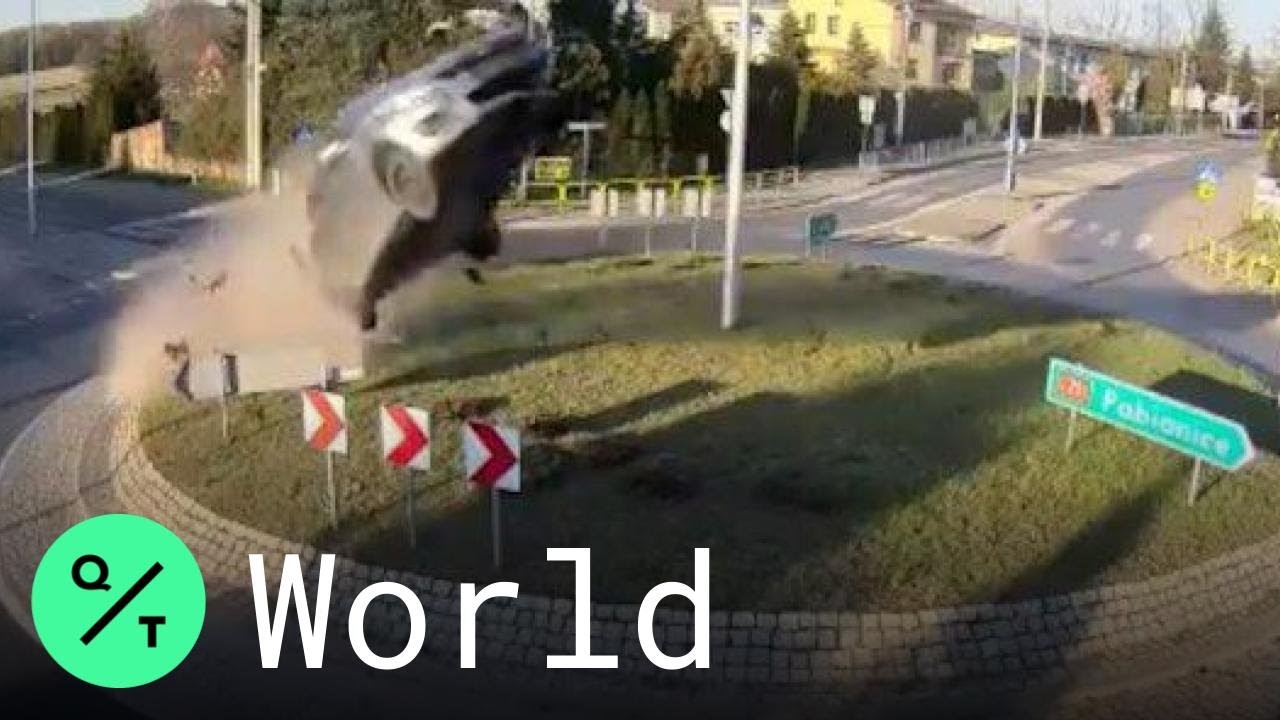
This was in Poland
This was in England

Seems that if that happened inside a tunnel, all sorts of problems would ensue.
My favourite is this one:
Another roundabout accident in a country used to them (although the car involved had out of country plates). No video, and it’s in Norwegian, but the article illustration should give you an impression: https://www.dagbladet.no/nyheter/kan-ha-kjort-i-over-256-kmt/63265185
Insane speeding through a long, downhill tunnel, bounce of the roundabout at the tunnel exit, 90 minutes through the air and landed in the river. Speed was possibly over 256 km/t as that’s the limit for the speed camera in the tunnel and it failed to register it.
That’s Impressive.
 meters, g-d-mm-t!
 That’s still actually pretty impressive.
Yes, even in Europe, there are people who have accidents in roundabouts; no one’s perfect. However, I should have said Western Europe, since Eastern Europe (e.g. Poland) doesn’t have that long of history either. From my reading about them, virtually all of these hitting-the-center-island accidents involve DUI drivers.
I followed the links back and the cops on the scene told press the car flew 70-90m and landed 15m from the shore. I checked a map and the shore is 55 meters from the edge of the roundabout at the closest. Quite the flight no matter what, and the driver and the passenger did not survive!
{Never mind.}
The big yellow-bordered sign and inner kerb / curb markings with big left-pointing arrows would seem to say that something about this roundabout fools more than the usual number of UK drivers. 
American driver here. There are only a few roundabouts where I live, and none on my daily commute. I can handle roundabouts ok but feel far more comfortable with a traffic light and a four-way stop. I suspect I would go so slowly through a tunnel’s roundabout that it would actually pose a hazard to others.
You’re supposed to go slow through roundabouts. Usually somewhere between 15 to 25 mph. Yes, lots of drivers will go faster than whatever is posted, but they do that for other roads as well. And just like other roads, they should always be aware there’ll be some drivers staying within the speed limit.
The google android mapping application I use is obviously influenced by that feeling, even though roundabouts are normal here, and are used anywhere a four-way stop would be required. As I come up to the small central roundabout in the normal residential street, Google is telling me: “Take the second exit from the roundabout”.
But I’m not “taking an exit from the roundabout”: I’m continuing to drive along the road, giving way to cars on the right*, with a small central reservation allowing us all to simultaneously enter it we get that problematic situation where 4 cars all arrive at the “give way to the right” signs at the same time.
We’ve only got 1 or 2 big roundabouts that might confuse the unfamiliar, a handful more that wouldn’t confuse you, because all you can see is traffic from your give-way side, and many that are just single-lane suburban 4-way give-way, slowed by a central reservation so that they don’t require stop signs.
*That would be “on your left” in keep-right countries.
Just throwing in that right-of-way rules in roundabouts differ between countries, and by that I don’t mean “yield to the left” (rather than right) in countries that drive on the left. In much of continental Europe, traffic that is already circulating in the roundabout has right-of-way over traffic entering the roundabout, which (in countries that drive on the right) is effectively the opposite of the normal rule to “give way to cars on the right”.
What, they go the wrong way around roundabouts? Apart from complex multi-circle roundabouts, that seems insane! How would that even work?
I’m on the left side of the road, I proceed on the left side of the roundabout, that means I’m coming from the right of any traffic entering, that means they are both (a) giving way to traffic on their right, and (b) giving way to traffic already circulating.
Re-wording that for most of the rest of the world:
I’m on the right side of the road, I proceed on the right side of the roundabout, that means I’m coming from the left of any traffic entering, that means they are both (a) giving way to traffic on their left, and (b) giving way to traffic already circulating.
If you don’t do it that way, you’ve created a traffic island that all oncoming traffic has to go the wrong side of, like a slot-car racetrack with lane changing.
Complex multi-circle roundabouts naturally go the “wrong way”, which is, of course, why complex multi-circle roundabouts are so mind bending.
No, the orientation of the traffic is as normal. To describe how it works in most of continental Europe:
We drive on the right-hand side of the road, and that goes also for roundabouts - as you enter the roundabout you turn right, which ultimately means that traffic on the roundabout circulates in a counterclockwise direction (when seen from above). At the points where the roundabout meets the roads leading into it, traffic in the roundabout has right-of-way over traffic that intends to enter it - even though the traffic that intends to enter it is coming from the right, and traffic in the roundabout from the left.
Legally, in the past, this was indicated (here I am speaking for Germany) by special “right-of-way” signs placed at each individual point where the roundabout meets incoming roads; nowadays it is governed by an explicit provision in the highway code, and now as you approach the roundabout you will see a “this is a roundabout” sign which puts this right-of-way rule into effect.
According to Wikipedia, these right-of-way rules also apply, as far as the United States is concerned, in the New England states, D.C., and New York State.
In New England (where I grew up and still live) we call them “rotaries” and the rule is always “Traffic in the rotary has the right of way”. This can be a problem when a main road and a smaller road come into a rotary, the main road traffic has to slow down considerably. In several intersections this led to replacing the rotary with a conventional intersection.