My guess is there will be some energy input in the form of illumination or a heat gradient or some such
Perhaps this is a better illustration… Instead of a beach ball, your float is a cylinder.
So we have a pipe with a sliding gate valve at each end attached to the bottom of the water column.
- The pipe is empty.
- Push the float in from the air side at the bottom.
- Once the float is all the way in this pipe, pushed against the second gate valve- close the first gate valve.
- Now push the float out of the pipe into the column of water. Close the second gate valve behind the float.
- The float is now ready to rise to the top. The pipe has no water in it.
The key here is step 4 as others have said. This is equivalent to a piston pushing into the water, thus pushing the column of water upward by the volume of the float. Whether the float as piston comes in from the side or pushes the column up from the bottom, it’s doing the same work of displacing the water upward.
You are pushing the float into the water against the water pressure at depth. the water side of the float has pressure that the air side does not. This requires work.
This is input work that is recovered as energy when the float rises.
(“But!”, you say, “I will use an airlock type of mechanism so there is water all around the float! Therefore, no pressure to push against.” True, but then we’re back to the work needed to pump the water out of the airlock, same idea of doing work, only with an actual piston pump.)
Also - The total work to displace the column of water upward also includes the energy that will be recovered when the float drops in the air back to the bottom of the column.
My spherical cow for this would put the air tube in the ocean to not have to think about any changes in water level and use potential energy and not ignore water pressure. I’d also use a cube as the float.
Since the change in potential energy due to gravity has the same absolute value going up as going down, we can ignore it.
The potential energy the cube has at 10 meters depth, compared to at the surface is 9.5 m * BF (buoyancy force, or the weight of 1m^3 of water). The last meter of movement on the way up the cube is not completely submerged, but the force changes linearly from BF to zero, so we can treat that 1 meter as .5 meters.
I’m supposing it gains this energy by being pushed through a magic one way valve against the water pressure. Playing a little fast and loose with units and detailed arguments, that’s one meter of motion against the weight of a 9.5 meter column of water (the average depth of the cube), or 9.5 * 1m^3 of water. Which works out to be the exact same as the potential energy due to buoyancy.
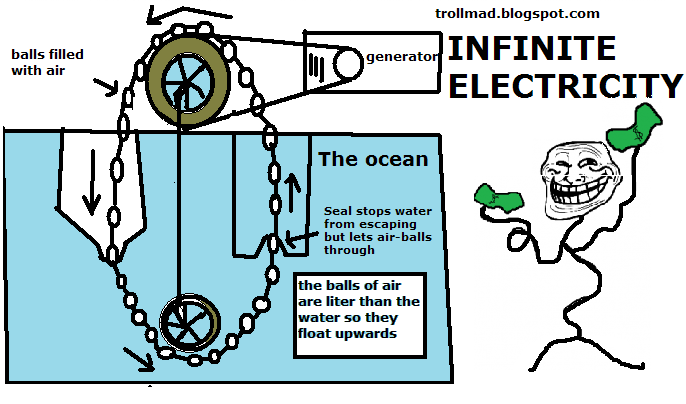
I haven’t read the whole thread, but I haven’t seen a picture either.
Basically, when spheres enter the tank from below, they need to displace water (against the column pressure), which, in an idealized system, takes exactly as much force as the buoyancy from the spheres above (and the weight of the spheres on the other side of the chain) provide.
So, OP, have you brought the insights of this thread to your obsessed engineer friend yet? If so, how was it received? Is your friend intuitively convinced that it won’t work?
I haven’t had the full conversation. I’ve been going over his notes to find the exact hole in how he’s represented the idea. I can clearly see that (as most people have said in one form or another) he’s failing to account for the water loss when the ball is re-inserted at the bottom, which must be either lifted back to the top, or pressurized into the bottom. And there’s a disproportionate amount of effort in converting the work to kilowatts, and representing that as how many homes it could run, as demonstration of the idea’s importance (appeal to consequences).
I have obliquely touched on this previously, and the closer I get to that subject, the faster he switches to things like “it’s not much lost water”, or “someone could pump it, people need jobs”, or “this is much cleaner than coal or nuclear.” But I calculated the cost of lifting the backfill water is enormous, just slightly greater than what the system actually produces. This is what he’s missing - the initial cost of doing that, and the intermittent cost of re-doing that.
At best, we could put this thing below a dam outlet or river rapid, with infinite overhead water supply, and now it’s essentially an overcomplicated, lossy hydroelectric water wheel using balls instead of blades.
Basically this thread is to help me get my ducks in a row before I talk to him, because I am concerned there the underlying issue may be re-emergence of an old and supposedly resolved psychiatric illness, or the feared emergence of a hereditary neurological illness. So this exercise will help me determine whether he’s actually unwell, or his mental capacity is diminished by age, or he’s just so excited as solving global energy problems that he’s let himself fall into a rabbit hole.
He thinks he’s invented a perpetual motion machine—of a design that could have been built centuries ago, no less. On its face, that’s an extraordinary departure from reason and/or reality in that one area at least, and perhaps more generally if he has an engineering or physics background. When someone gets to that point, I wouldn’t call it a sign of mental illness (mostly because I’m not a mental health professional and so am not qualified to make such a call), but I would start to wonder if maybe no amount of reason and even evidence would be enough to convince him he is wrong.
I worry that continuing to engage with him on this premise, even if to try and debunk him, will only cause him to dig in deeper, going more and more down the rabbit hole and beyond reason. If you are genuinely concerned about his mental health—if that’s what this thread is really about, as it now seems to me it is—perhaps this is not the way?
I believe this is the type of device.
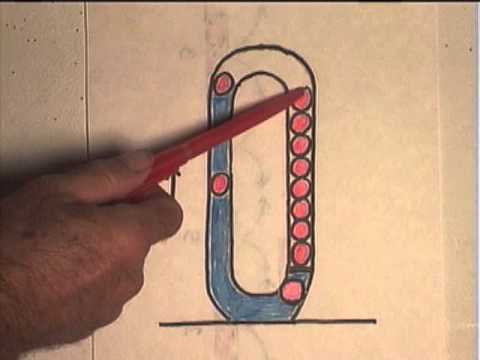
There’s a kernel of a good idea in there, and it’s already been done. Of course, an energy source is required.
This is why I need to follow through on this, to observe how he responds when I point out the flaw (now that I can quantify and demonstrate it). I need to see whether he sheepishly admits to overlooking some details in his excitement, or whether the deflection gets more intense. Or it’s possible that I missed a part of his pitch that’s leading me to misunderstand it.
If you’re going to build a perpetual motion machine that required someone to crank a handle to make it work, it would be simpler not to build the machine, and just have them crank a dynamo. Certainly more efficient than building a weird buoyancy column thing, then trying to run a dynamo off that, while someone cranks a handle to pump water. The amount of work done by the water they are adding cannot exceed the amount of work done by the float as it rises on each cycle.
The ‘work’ in this system is done by water, falling. It may appear to be related to a float that goes up. but the float goes up because water goes down - that’s what buyoancy is.
Right, this is the actual answer to the OP question of how to intuitively explain this. I didn’t understand it until I played with the buoyancy equation and compared it to F=ma.
It’s just like a seesaw, the ball goes up because the same volume of water is falling downward. To reset the action, you have to lift that volume of water back up to the top (or push it in at the bottom, under pressure. Same energy investment, however it’s performed).
I’ve found that the best way to debunk a perpetual motion machine is to deliberately get it “backwards” from what the designer is intending for it to do. So in the example pictured below-

-You say something like “Oh, the magnet on the stick is being pulled backwards so it pushes the car backwards”. Trying to rebut this gets the inventor to think out what’s happening and (hopefully) they realize it’s a zero-sum arrangement.
The intuitive answer is that you’re creating a water slingshot. As the floats rise, they’re bringing water with them. If that water doesn’t leave the tank - meaning that you’re having to return it to the tank, pealing it off the floats and any mechanical parts that might get wet - then you’re having to take all the energy put into the water and redirect it back towards the tank.
Or, the longer version…
I feel like it should also be mentioned that you need to block the water from getting out the bottom between floats.
Which, I’ll note, might lead us to a design where we have a single continuous float with segmented internal sections to act as our individual floats. But, here, because we have a continuous shape, it’s much easier to seal the insertion point.
Sealing the insertion point, though, is basically creating a brake for the system. It needs to be tight enough to create a seal against the entire column of water.
If you want to extract energy, you might also design it so that there are two wheels to create the top and bottom curves. This means that you need to have arms on the wheels that extend to the band and those need to go into the water, move through the water, and come out without losing any water. You need perfect, moving seals on those arms and - again - those will act like brakes. The arms as well, being pushed through the water, will act like a brake.
A much more efficient system is to remove as many seals as we can.
Imagine, for example, that we have a disk with cylindrical ring around the edge made of a buoyant material. This means that we just need a single seal that’s shaped like a line (for the disk to pass through) that terminates in a circular opening (for the ring). We end up with a large L-shaped seal when viewed in profile. This is the simplest and liable to be the most friction free setup that we can imagine.
But we do still have friction between the water and the surface of the disk. In fact, the disk is going to pull the water up along its surface and try to dump it outside of the tank. We will need to continue our seal up to the top part of our disk and wrap it all the way around the buoyant material to perfectly scrape all water off, lest a single drop escape. Indeed, we need to completely seal the entire water section or we’ll deplete our tank through evaporation.
Scraping water off the disk and our buoyant float, perfectly, also means that we’re having to redirect the force of water backwards. The disk is basically acting as a water slingshot. We are having to catch and throw back 100% of that water to keep it in the tank. To do that perfectly means that we’re using at least the same amount of energy as your floats put in.
And ultimately, we have to recognize that perfectly scraping all water off the surface of the device is impossible. For a real, working machine you would need to constantly top the water off.
My suspicion would be that, even if you don’t have a seal along the top of the device, the bottom half would still act as too strong of a brake to even allow it to move. If it should, at all, it’s going to be removing water from the tank at a sufficient rate that you are in essence going to be fueling it with water, from how much you need to fill in to replace the loss.
“Slingshotting” the water is completely irrelevant, as is “scraping off” water. Those are places where inefficiencies will creep in, but you can make inefficiencies arbitrarily small: That’s just a matter of engineering.
The problem, as everyone else has already said, is getting the float back into the bottom of the tank. No amount of engineering improvements will fix that part.
At some point you’ll just have to trust generations of physicists and mathematicians:
They do not call it “the First Law of Thermodynamics” because some guy in his basement is going to find a workaround anytime soon.
If that is not “intuitive” enough, I do not know what to tell you.
I’m out of my area of expertise, but there seem to be two separate issues here:
-
Is this a perpetual motion machine? and
-
Is this a practical machine to generate energy, similar to tidal energy
The first question is easily answered. Would the machine work in a zero-gravity environment? Of course not.
I am following to learn the answer to the second question.
I think this is easily answered too: It is not. Any kind of tidal energy machine has continuous energy input from an external source: The gravitational pull of the moon (and, to an extent, the sun); the machine can extract this energy. The machine discussed in this thread has, in theory, no input of external energy (beyond what may be used to get it started), and any attempt to withdraw energy would cause it to run down promptly.
Let’s get a bit meta here: Why does it matter if someone believes he has a design for a perpetual motion machine? Is there any reason that every believer in perpetual motion needs to be shown the light?
Does it matter if some people adamantly believe the earth if flat? Is there any point in arguing with such people? Note, I’m not asking if there is any point just because arguing will be futile anyway. I’m questioning whether there’s any reason such people need to be corrected. If someone thinks the earth if flat, or the moon landing was a hoax, or they have a real PM machine that will work, well, let them go ahead and think that. What does it matter?
Now, to be sure, there’s more going on in this thread: OP is questioning his engineer friend’s mental status, and wants to use the information here hopefully to try to evaluate the case. (OP, are you contemplating whether some kind of intervention is in order?)
I guess I’m missing something here. Isn’t buoyancy dependent upon gravity in the first place?