Is airliner design pretty much un-improvable now?

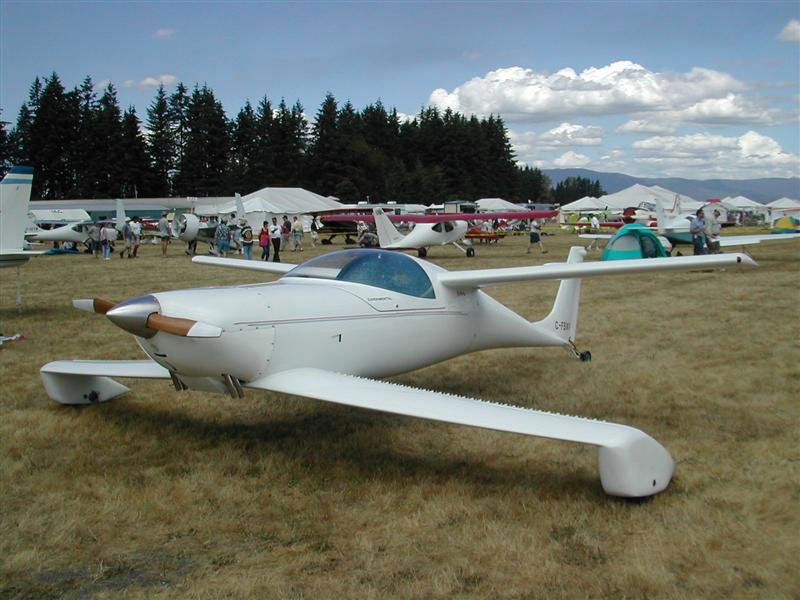
The Wright Flyer was a canard configuration aircraft. Designs quickly settled on what we see today. The Rutan Vare-Eze and Long-EZ were very successful canards, and IMO the Quickie Aircraft Compay’s Q2 and Q200 were better yet. The Piaggio P-180 Avanti is still being made though it’s not a ‘pure’ canard configuration.

But yeah. If canards were markedly batter than standard designs, I’d expect to see more of them.

But that would be necessary for going to all-composite construction, which I think is the next logical step. Of course it was already done on the Beech Starship, but not very well (I believe both the cost and weight greatly exceeded targets, and the whole project was a financial disaster).

I canard do it, Cap’n. I’m giving her all she’s got!

Just got a text from the kid saying, “Canard is nice, Triple tandem may be better.” I’m outta my depth, so I’m bowing out! :wink:

50 years from now they will be asking the same question as they sit in a crowded airplane, in a cramped seat, for the 30 minute flight from San Francisco to New York, at flight level 550.

The B-70 had a canard. Maybe if they had made more than just the 2 prototypes there’d be some canard type airliners.

There’s tweaking the design, making the engines more efficient. All these ‘improvements’ come with risks and costs. You want breakthrough? It’s going to come with developments in materials science.

NASA Tests Revolutionary Shape Changing Aircraft Flap for the First Time

I think the next innovation could be enhancing the flying expereince by giving passengers a better view.

Right now we only get to look outisde from a tiny window. However in the early days they actually made a plane where one could open up a top door and walk out onto the fuselage for a look around. But that was back in the 20’s I think when they flew much slower.

Also I once saw a “things to come” where they predicted airplanes of the future would be boomerang shaped (kind of like the B2 bmber) and the middle section would be glass giving passengers an almost pilot like view of the sky.

Just spitballing into the wind here…

The current bus with wings design is about the best we can do and still have the plane manageable in a dead stick scenario. Dead stick currently being defined as without computer assisted stabilization. Flying wings and most blended wing designs have all the aerodynamic stability of a brick without computer controls.

Yes, there are fly by wire passenger jets in use, but they look just like every other plane on the tarmac. Most of the passengers are under the impression that there’s a cable connecting the joystick to the rudder.

One of the restricting factors in aircraft design is the need to evacuate all the passengers in a limited time, and do it reasonably safely. (As it is, they accept that a few passengers will probably break legs or ankles - which shows how close to the edge the design is.) Double decked planes have some very difficult issues, and the hight the passengers have to drop makes things very difficult. Wide bodies were a challenge. Exits means more large holes in the structure, and thus more problems and weight, and so it goes.

A long cylinder is a nice structure. Perfectly circular the best. Once the shape goes out of round it means a less efficient structure, and more weight.

New shapes means new structures, and new engineering to make them, and not only that, design them so that they will survive in the face of reasonable damage. An engine throwing a fan blade can cause remarkable amounts of damage. You need to be able to come up with a design that can survive this.

Scant chance that we will see a major new design from Boeing or Airbus break the mould. Incremental changes in less risky smaller craft would be needed - or perhaps first in the military arena - and then proven, before being adopted in “bet the company” new designs. Hard to imagine, but it has been common that both Boeing and Airbus were close to insolvent during the development process of new planes, and they literally had bet the company on the new plane being a success. When a new conventional plane costs this sort of money and entails that sort of risk, it is hardly surprising there is significant conservatism. The usual mantra is to only change one major element at a time. Dreamliner went composite and electric systems in one go. That was considered a risky call. A380 went with size only, and the rest well worn design and technology.

There are other pics that even more dramatically illustrate the fact that the various Wright Flyers were very much a “tail-first” configuration; the dual rudders were at the back but the equivalent of modern elevators to control pitch were in the forward-facing tail.

And this isn’t just about the first powered flight at Kitty Hawk. The Wright Flyer 3 was a full-fledged airplane that could stay in the air for hours and fly a hundred miles or more.

That’s fascinating because although the design principles are probably quite different, “wing warping” was a fundamental part of the control surface design of the first Wright Flyers. They even took out patents on it. Just goes to show, “everything old is new again”.

you’re not going to be walking around on the outside of a plane going 600 mph.

Well, not for long anyway.

It’s a mistake to say that airliners haven’t changed. The B787 is built mostly out of carbonfiber composites. That’s a huge change - they’re not just making the plane out of a different metal, they’re not making it out of metal at all (well, most of it.) Fly-by-wire controls were a big change, too.

To say things haven’t changed much because they don’t go a million times faster or look substantially different is silly.

The family car isn’t a great deal faster than it was in 1960 and doesn’t look much different, but almost every component on a modern Ford Fusion is substantially better at what it does than almost every component on a 1960 Ford Falcon. The only thing modern cars don’t do as well as older ones is weigh very little, and that’s largely because we expect them not to fold in half in an accident.

How about interior comforts? Beds, bars, mini cabins, etc…

“The 8 most Expensive Airline Tickets” LINK

Compared to their 1960s counterparts, modern cars are immensely safer, more powerful, more reliable, and more durable. They also deliver better fuel economy and handle better. The exhaust also contains, quite literally, a fraction of a percent of the harmful pollutants that were spewed from the tailpipe of a 1960s car.

I think much the same could be said for commercial airliners. In addition, airliners are far quieter than they used to be. The advent of the ducted-fan engine (“turbofan”) was a big improvement in this area, and with the 787, we now see the addition of chevrons on the exhaust nozzle that further reduce noise.

We don’t know what improvements are coming 10/20/30/40 years down the road. If we did, we’d already be implementing them. But the unpredictability of future improvements should not lead anyone to believe that none are forthcoming.

A number of posts in this thread have been concerned with passengers. What about airliners without passengers: cargo airliners?

Anyone see any possibilities there?

I think you misread my post.

Not at all - I just think you were understating the changes in automotive technology over the past 50 years.

NASA & the EU equivalent plus the manufacturers have a bunch of innovative experiments going on. The aircraft would look quite different than what we have today. Here’s a few pix: http://www.nasa.gov/content/down-to-earth-future-aircraft-0. Try Future Aircraft | NASA and click the [more stories] bar at the bottom.

The big drivers in these nextgen +2 through +4 efforts are low cost and “greenery” = low noise & low exhaust emissions. So you may see very long thin wings, Looped wings with no tips, prop-fan type engines, blended wing/body designs, etc.

As said by many above, there are a lot of business and engineering advantages to incremental change. So any radical change must obtain a truly compelling gain. The 787 was exactly such a radical change in technology and in business arrangements, despite the humdrum gross shape. That ordinary gross shape is about the only thing the 787 has in common with earlier designs. And the early failures associated with those radical changes cost Boeing, many suppliers, and lots of investors a truly huge amount of money. The 787 will eventually earn back the early losses. But it’ll take a decade or more longer than planned, and investor-centric Capitalism isn’t a very patient system.

Similarly, it’s not clear the A380 will *ever *turn a profit. It was another step-change aircraft, although not quite as ambitious as the 787 from an engineering perspective. The cost of the A380’s leaps & associated errors will almost certainly erase any profits they ever hoped to make on the product’s entire lifetime.
One of the other challenges with anything that is shaped much differently than today’s typical aircraft is compatibility with existing facilities. The A380 has some very severe compromises in its design to make it fit (almost) within existing airports and terminals. If the A380 had been designed with the same exact mission parameters but no concern for fitting into existing airports, it’d be a bunch different.

The result is that introducing a new gross aircraft shape means *every * target airport needs to plan construction projects for new gates, boarding bridges, loading equipment, fueling equipment, etc. And each airline needs to pay for that. So the airplane better be able to save a lot of money in daily operation to bear all those extra costs. 'Cuz nobody is gonna pay extra to fly in a shiny new FutureJet.

Plus who has ever seen an airport reconstruction project go smoothly on time and under budget? Imagine taking delivery of a new jet and having your major airports, (all of them government run) say “Well, Congress (or the city council) nixed our reconstruction budget; it’ll be at least 5 years late.” Meanwhile you’re still making monthly lease/mortgage payments. Ouch.
One of the reasons Boeing & Airbus have in the last 5 years punted on building clean start replacement designs for the 737 & A320 series is precisely that the tech for radical gain isn’t quite ready for mass production. So the smart engineering / business decision is to embrace incremental improvements while spending the time & money needed to mature the radical step-change tech. Once it’s ready, then you build a new design embracing as much of that as you can / dare to.

Bottom line: The current state of play isn’t the result of a lack of imagination. Some of us will live to see some kinda weird-looking new aircraft coming from these efforts.