Which was 50 years after Batman was introduced. And many years after I stopped reading him. Definitely fits my definition of modern.
And yet, still more than forty years ago.
As I said, I wasn’t reading Batman when Fox was introduced (actually in 1979). But some searching found a reddit thread where three people all said that Fox wasn’t Batman’s tech inventor until the Batman Begins movie, incorporated into comics in 2010.
I can’t vouch for this, but 2008 is sure modern by anybody’s definition.
Lucius Fox being an inventor is a recent take on the character, but his original purpose as a character was part of an effort by Len Wein to ground the character after the excesses of the Silver Age. Part of this included the idea that Batman got most of his gear from various Wayne Enterprises R&D projects. Lucius’ role was Bruce’s facilitator, who managed the various projects necessary for Batman’s war on crime, and would follow his orders without raising too many questions about things like market viability and return on investment.
In current books, Batman’s still a polymath, and makes some of his own gear, but he’s no longer spending time in the Batcave building his own jet aircraft by hand, like he was in the Silver Age. He’s a billionaire. He can buy a jet, and use all that time he would have wasted welding airframes to go out and punch more murder clowns.
But more pertinent to the question that started this digression, he’s not “super” smart, in the way that someone like The Atom or Mr. Terrific is. He can build a wicked grappling hook, but when someone needs to build a ray gun to seal cosmic cracks in reality, Batman goes and looks up one of those guys.
Nowadays it’s hard to say where the lines even are, given that hardly any of the mainstream outlets even use them anymore. Barnes and Noble (which is the only place left for any kind of comic books where I live) just has a big “graphic novels” section and doesn’t subcategorize any of it.
At this point I’d consider Batman so long-lived and prolific that he’s completely become his own thing, like Sherlock Holmes or James Bond, well beyond the limits of petty labels. If DC or whoever’s in charge of the Batman movies now wants to market him as a superhero, I have no beef. He’s a living legend, he’s part of the Justice League, he’s a symbol of perfection, I say good enough.
As far as “superpowers” go, the only real distinction, as far as I’m concerned, are the abilities that are known, quantified, and spelled out (e.g. Spider-Man being able to lift 10 tons), abilities that are mentioned but not actually made clear (e.g. Scarlet Witch’s “Improbability Hexes”), and abilities which are never mentioned but are clearly way beyond what even an exceptional human being is capable of. The Punisher is a perfect example of the latter case. Can find anyone, anywhere, anytime, move without a sound with tremendous speed, and survive about ten times the injury as a human body should be capable of, plus he never misses, never accidentally harms an innocent, and can win the trust of pretty much anybody, plus putting on one little piece of protective clothing turns him into a supertank, and he can detect a muzzle flash from hundreds of feet away, and he heals with incredible speed…you get the picture. “No superpowers” just means “he’s powerful as we want him to be at the moment”.
I have it on the authority of no less than one Homer J. Simpson that Batman is indeed a Scientist.
So, was this actually a problem for DC or Marvel? (I’d guess not)
How many titles of books use the actual word? I’ve never seen “DarkHorse presents another superhero group: Black Hammer!” as the title of a book.
Then I thought of my favorite “heroes”, Quantum+Woody… and there it is on the cover, above their names, even… “The World’s Worst Superhero Team”.
So, I get that they’ll probably have to change that for future issues, but there are so many digital and “floppy” back issues floating around, for sale… would a DC lawyer try to get a comic shop owner to… what… go back and put black tape over that?
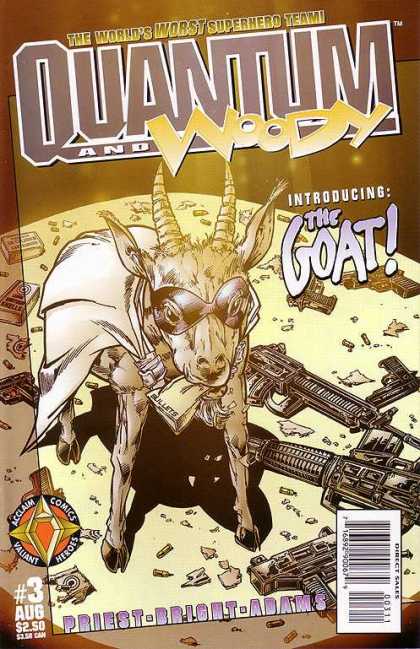
The Super-heroes trademark was just another element in a pissing contest that reached its pinnacle with Marvel securing the exclusive right to publish a comic with the title “Captain Marvel” (the name of a hero DC acquired in a lawsuit with Fawcett). After that, lawyers from both companies started paying attention to the words in their book titles and discovered both companies had books with the word “super-heroes” or “superheroes” on the cover.

