That makes sense when I look at the SI derived units like the newton (kg⋅m/s2), or the joule (kg⋅m2/s2), which are derived units based solely on SI base units.
The pioneers of nuclear physics were nothing if not whimsical. The unit of time commonly used for events that occur in the timeframe of 10 nanoseconds (such as individual fission events) is called a “shake”, as in “shake of a lamb’s tail”.
Because the SI unit for cross section would be the square meter.
The whimsy holds, but it’s not in common use. A working approximation is that the “shake” never left the confines of Los Alamos, and it survives today via its having been baked into a LANL-developed radiation transport simulation package that stemmed originally from weapons-related work at the lab.
You won’t find a “shake” in the wild.
Right…so the barn is a metric unit, but not an SI unit.
Then again, the SI unit for luminosity should just be the watt. Lumens are just watts filtered through a response function that approximates the human eye.
Nitpick, since this units tangent is related to detailed SI definitions: luminosity \neq luminous flux. The former has SI units of watts and is a common quantity in, say, astronomy. The latter is the term associated with perceived visible light, and while it is remarkable that history has led to an SI unit for it, it’s presence doesn’t preclude the other routine concept (which, of course, doesn’t need a special unit name since it’s just “watts”.)
Or more briefly, luminosity is measured in watts.
Yeah, statistical sampling goes back at least a century earlier, but I don’t know of any examples of using random numbers to compute sample outcomes of a calculation - that might be something that didn’t exist before 1940s Los Alamos.
Kelvin (1901) is one early case with random numbers as the starting entropy (versus physical randomness) in statistical sampling.
From Kelvin (who was essentially doing ray-tracing sims here):
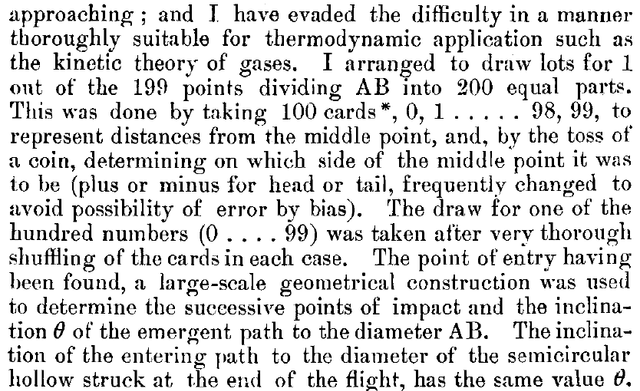
and then:
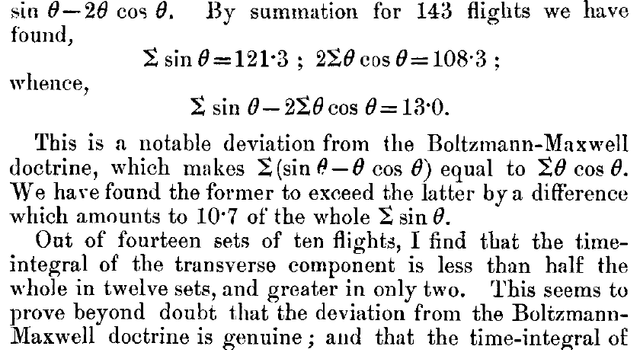
Thanks!
There is also the “shed” equal to 10^-24 barn
Yeah, there is a whole suite of “units” out there where somebody used it in jest once, and maybe it got reported as a fun anecdote somewhere, and then it continues to exist solely due to its pub trivia bona fides. “Shed” is certainly in that category. It’s not actually used.
This is in stark contrast to the barn, which is the most common unit for reporting nuclear and particle physics cross sections. Type in something like “proton cross sections” in a Google image search, and you’ll get plots all labeled in barns or prefixed versions of barns.
In fact, the only place you tend not to see “barn” for cross sections is when talking about neutrinos or dark matter because the cross sections are so small you’d need a huge (negative) power of ten anyway. So, “cm2” (mostly) or “m2” (less often) is used directly.
(These are also cases where “shed” would sometimes be close to a relevant size, but the fact that it isn’t used even there says it all about that unit’s existence.)