Back to crocodiles. Can you tell an alligator from a caiman from a crocodile? Sure, but you have to know what you’re looking for. They’re all have pretty much the same body plan. And you could go back 100 million years and find crocodyllians with that same body plan. But you wouldn’t find an american alligator or a black caiman or a nile crocodile. Despite looking a lot alike, the various types of crocodiles aren’t the same thing.
“Some 5 million people may have lived in the Amazon region in AD 1500”
How big do you think the average European city was at the time? Or how dense Europe was populated?
Also, saying “crocodiles” have been around for 100M years is as meaningful as saying primates have been around for about 70M years. We should not conflate the first saying with the idea that C. acutus (the American crocodile) has been around for 100M years (it hasn’t). Which is what Darwin’s Finch said earlier.
I wouldn’t get too carried away with this point, however. There is inevitably blurring and periods of interfertility at the nodes. Sub-populations may drift in and out of contact, perhaps sometimes re-merging rather than diverging into separate species. But there’s no evidence that horizontal gene transfer is of any great significance in eukaryotes. For multicellular life it’s a pretty close approximation to a tree.
Oh, and if anyone is still thinking about dragons, how about his passage from a medieval bestiary:
Doesn’t sound much like a Tyrannosaurus to me. How about you all?
Correct; by “it’s all scientific consensus”, I was the only speaking to the nomenclature aspects. There is but one Tree, we just have some trouble figuring out what exactly it looks like sometimes, since the data we have to work with are incomplete.
Further, up until around the mid-17th century, fossils were not recognized as belonging to previously-living organisms at all. They were thought to be either a form of mimicry exerted by geology, or stones which fell from the sky or any number of other weird suggestions. But, as there was no then-known method by which living tissue could become stone, there was no widespread belief that a fossil bone once belonged to a living creature.
The latest and greatest on that is probably not. Or, at least, the burden of evidence is on those who think they did because the available specimens say otherwise.
Emphasis added. But isn’t that because we haven’t looked all that closely for it? I mean, we’re only now untangling or own tangled history and that was not so easy a thing to do. How many species have we looked at? The kind of evidence we see in our recent lineage doesn’t just jump out at you without a lot of digging.
Lemur: The dragon was a type of snake in some cultures, but in European folklore it was more commonly a reptile with four legs and wings, no? Snakes ain’t got no legs.
Four legs?

Sure, stick some wings and some legs on, and some extra heads if you’re feeling frisky.
A dragon is whatever you want it to be. But the what ancient and medieval people imagined a dragon to be was a fancy snake. There wasn’t any consistency about it, because dragons are imaginary. But the basic idea is that you take a snake and start gluing magic stuff onto it until you’re satisfied.
So when an ancient greek wanted to paint a picture of someone fighting a dragon, this is what they made: http://www.theoi.com/image/M28.6Drakon.jpg
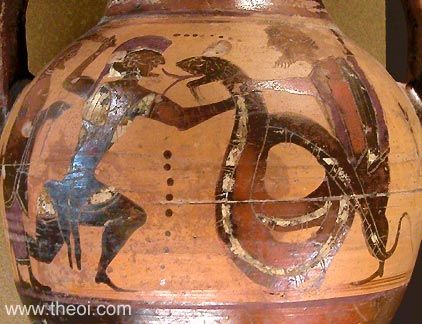
Does that look like a dinosaur? Or a magic snake?
Take a look at this 2,000ish year old description of a Chinese Dragon.
Then again, if you’ve never seen an elephant, and you’re a medieval artist, you might draw it like this:

That’s because you don’t know what an elephant really is. So if the point is that dinosaurs were running around in Europe fighting knights in shining armor and devouring maidens, wouldn’t the saps who drew pictures of them know what they were? You wouldn’t just take a snake and start gluing magic parts onto it? I mean, they could draw a snail that looked like a snail, because they’d seen a snail. They couldn’t draw an elephant, because they’d never seen an elephant.
So why can’t they draw a goddam Tyrannosaurus that looks like a Tyrannosaurus, if the knights were fighting them off every five minutes?
Sure, but if the ancient Chinese were kicking dinosaur butt on the regular, they sure couldn’t do a decent job drawing a goddam dinosaur: Chinese dragon - Wikipedia

And because the dragon is the elephant’s mortal enemy, we have to show this:
https://www.girlgrowinggratitude.com/wp-content/uploads/2014/04/Ashmole-Bestiary.jpg
He did a much better job on the elephant than the last monk.
Mostly I’m just loving medieval depictions of dragons and elephants.
But we’re talking about Medieval Europe, not Ancient Greece. This is from 1460. Not exactly Medieval, but closer in time than ancient Greece (at least on the back end of the Middle Ages).

But we’re wondering if ancient people saw a creature wandering around Europe, and they named it a dragon, and that dragon was actually a dinosaur.
Why would the depiction of that creature become more dinosaur like over time? Why didn’t the Gauls and Kelts and Allemanni have a name for this creature? Why did they give it the Greek name for a monster snake, if it wasn’t at all snake like?
Further proof: if there had been dinosaurs roaming around Europe, the Romans would have captured them and made them fight hippopotamuses.
I don’t think there were dinosaurs roaming around Medieval Europe. But I also think the concept of a dragon either changed over time, or never was fixed around “snake” in the first place. The art depicted dragons is proof that dragons were often thought of as being distinctly non-snakelike, for whatever reason (unrelated to living dinos, perhaps related to fossils of them, though).
One of my favorite book purchases of something I hadn’t seen before was T.H. White’s Bestiary: A Book of Beasts. The book is a translation of a Medieval Bestiary, with a lot of commentary from T.H. White (author of the Once and Future King, among a great many other books – the basis for Disney’s the Sword in the Stone and the Broadway musical Camelot), along with lots of original illustrations.
Although your first instinct id to laugh at the naivete of the text and their confusion about creatures well-known today (the illustration of the Cocodrillus (Crocodile) is a hoot ( http://bestiary.ca/beastimage/img4438.jpg )), you soon realize that the text is not so silly as it seems at first, with some correct and shrewd observations (mixed in with errors and a LOT or moralizing). The illustrations were best guesses by scribes who had never seen the animals themselves (so an “Estridge” ( Ostrich) – a big bird with feet like a camel – is drawn like a giant, camel-footed eagle)
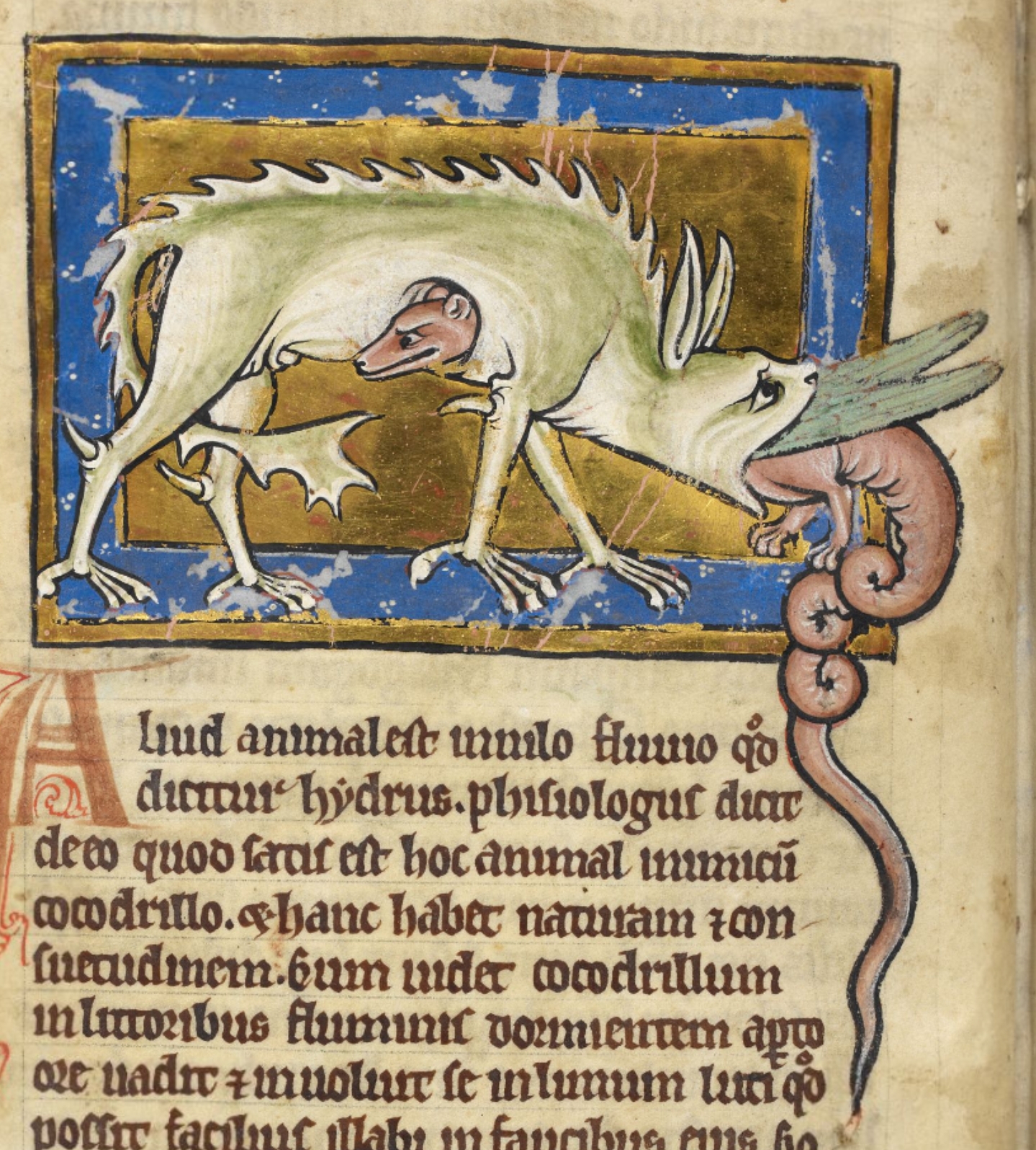
In the Bestiary, as White points out, “Draco” is simply a word for a large snake, and the illuminators even draw it as such, without the wings and other features we associate with dragons. Dragons of the sort we mentally picture don’t appear in the Bestiaries.
As for “fiery breath”, you can make a case that this is an oblique reference to poisonous snakes.