That’s really very cool.
No hypothetical OP survives first contact with the enemy, err, I mean poster.
I’ve used the same example before, even before the current scandal arose. It’s basically just a way to say that there’s such a thing as a “best move” in any given position, or at least a move that’s good enough as to be indistinguishable from best, for practical purposes.
Even that’s an underestimate, because the “winning advantage” you build up after 20 moves is enough for a skilled player to eventually work their way to victory, but our hypothetical lucky player wouldn’t know what to do with the advantage he had. He’d need more luck to hold onto and build that advantage at least to the point where his opponent conceded. Like I said, extremely unlikely.
Sure, but if you score as high as 150 one time in 100, and the pro scores that low one time in 100, that means that you have a 1 in 10,000 chance of winning, because you only win if both of those happen at the same time. There’s less of a gap in bowling than there is in many sports, but it’s still far too much of a gap for the terms of this thread.
There are formats of M:tG tournaments where a single card could cost ten thousand dollars, but those aren’t the most common formats. The most common format restricts the decks to cards found in sets released in the past two years (some of the cards themselves might be older, since some cards are repeatedly re-released in multiple sets, as long as they’ve been reprinted recently). And Wizards of the Coast (the company that makes the game) has taken measures in the past decades to cap the market prices of the most expensive cards. I don’t think it’d even be possible to build a deck for a Standard Tournament that cost more than a few hundred dollars, and the most expensive deck possible almost certainly wouldn’t be the best (some cards are effective despite a low price tag).
Answer: Hunker Hauser. Old medieval game of skill, balance and treachery. I learned it in the SCA and don’t go camping anywhere without a set–it’s minimal equipment but maximum fun and the sheer number of times I’ve seen a first time player take down someone who’s been playing for years is pretty impressive. It takes ten seconds to learn to play, a lifetime to master and is one of the very few physical games in which brute force does not by any means guarantee an advantage.
Video shows how it’s done but when I make a hunker hauser set I make the stands out of 2 x 6, about 18 inches long with two blocks of 2x4x4 inches set in about four inches from each end. Makes things MUCH tippier and therefore way more fun. Rope should be thick and soft with one big knot tied at each end, about eight to ten feet long. This is a hugely fun game for players and onlookers and gets even more fun when big drunk guys try to play against children and get soundly beaten. Makes the kids feel about ten feet tall lol.
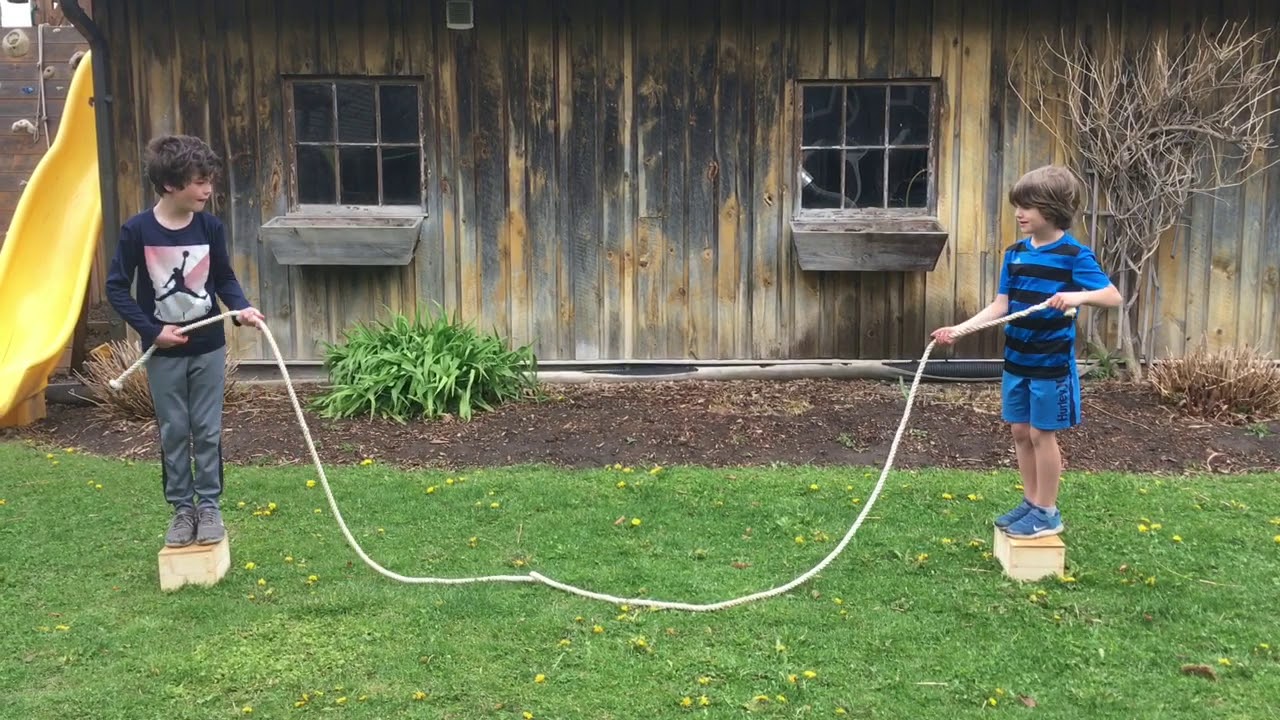
I suspect that this is largely just because it’s a relatively obscure sport. If you had people literally dedicating their lives to becoming the best they could possibly be at it, like the top players do at today’s popular sports, I imagine that they’d likewise become so good at it that average folks couldn’t hope to compete.
Actually it doesn’t. A good head to head player does not need good cards. At that level, it’s mostly psychology.
I have a friend who is one of the best heads-up players around. He has made hundreds of thousands playing people who should know better but think they can take him down. I tried it once, and he took a thousand bucks off me in about half an hour. It seemed like every time I had garbage he’d come out swinging, and when I had a good hand he’d duck. Then I’d get raised like five hands in a row, get sick of being steamrolled and call with a decent hand - only to be shown a better one. It’s infuriating, but it’s kind of an illusion. He’s just very good at knowing when to press and when to back off - in part to set up the situation where when he gets a big hand he won’t be believed and gets paid out.
I don’t think I’ve ever seen him lose heads-up.
Okay, I will concede that the ‘raise every hand’ strategy will allow you to ‘win’ once in a while. But then we’re talking about ‘winning’ in the sense of losing your entire stack many times before you win a stack once. If we define ‘winning’ as coming away with more money than you started with, you’d better win with that technique fairly quickly or you are going to dig a hole you can’t get out of. So I’m not sure that really counts as beating a pro. If you won once every 20 times you are still losing all your money. And this strategy requires no skill at all. A child could do it. It’s not really about amateur skill being almost good enough. It’s more of a trick that in the real world no one would try unless they wanted to go broke.
So I’m not sure if it really counts for the purposes of the OPs question, which I read as finding a game where the skill differential between pros and amateurs is low enough that occasionally a lightly skilled player can win.
I still think limit ring game poker is a better example. I have seen absolutely terrible players go on month-long ‘rushes’ where they just get so many monster hands or lucky draws that they just can’t lose. And when bad players get good cards they tend to make more money than good players, because they play so loose you can’t put them on a hand and are forced to call them.
Those players always lose their money eventually, but it’s surprising how long they can go on winning streaks. And on the other side, I have seen really good pros go on long stretches of being snake-bit, with people just constantly drawing out on them. Of course, a stretch like that can put a player on tilt, then they stop being such good players and the other good players start running over them as well.
But it’s really common to see a bad player join a ring game and cash out a giant stack of chips at the end of the night. And some times the best player at the table winds up leaving after losing all night long. In any single limit poker game, luck dominates over skill. The real skill of pro ring game players is to lose less than others when the cards are bad, and to extract extra bets from bad players when they have a winning hand.
It really does not. If I’m playing all in or fold every round pre-flop there is zero psychology involved. Its just about the probability of my two cards beating any other possible pair of cards.
The pro will have some advantage (they will I’m sure work out your strategy pretty sharp-ish) but that doesn’t help them all that much, certainly not a 100:1 one, I’d be surprised if its more than 2:1.
You would be wrong. It’s very common in the SCA, played a lot by everybody and especially fighters because it improves balance so much. I saw a ten year old kid take down Duke Frederick of Holland who is a founding member of the SCA and who had been playing the game for well over thirty years–it’s possible he actually introduced it to the Society in general. It is literally a sport that changes with every new opponent–I played a game against another lady and it went on for fifteen minutes with both of us using almost thumb and forefinger alone to tug and release on each other. Many bouts end in one second with a mighty yank. Many mighty yanks end up with the yanker going ass over teakettle due to a canny opponent giving literally enough rope to hang themselves. I saw one game end when a player losing balance to his front gave a mighty leap, still holding the rope, and he landed on his opponent’s board, shoving him off. Many discussions were had regarding that as a tactic but we decided that anyone who can flat footedly leap eight feet, land on a board and keep his balance has to be rewarded with the win.
Try it, get back to me.
“Common in the SCA” doesn’t mean “common overall”, since the membership of the SCA is a very small fraction of the total population, and even for the most avid members, the SCA is only a hobby, and Hunker Hauser takes up only a fraction of the time they spend on that hobby. Nobody is practicing Hunker Hauser for ten hours a day, every day, for decades straight, and that’s the kind of practice that makes someone top-tier at a popular sport.
And that would prove what? That it’s a fun sport, accessible to novices? I don’t doubt that. I’ve played and enjoyed similar sports, and I’m not even all that big into sporting. But that’s not the claim that’s being made.
From the OP:
Is there a sport or a game out there in which an average person with a weeks worth of training could beat a world top ten player in that sport or game at least once out of 100 times?
I furnished an example. It’s a good one too, being an established physical game of venerable provenance that does not rely on luck, in which a rank beginner has a very good chance of winning against a skilled and practiced opponent. At no point did the OP specify the length of time the more expert person had to have in game to qualify, nor was it specified that the sport or game in question is required to be familiar to any percentage of the fucking human race. Not sure why you’re insisting on taking umbrage at my example, nor why you’re insisting on singling me out here, but you can stop any old time now. You are being needlessly pecksniffian and completely annoying. Go bother someone else, please.
How would it not count? The minimum amount of skill you can have at poker is “bet your full stack every hand”. And that is a strategy that will win more than 1% of the time.
This reads like you don’t like that this is tarnishing the purity of the game of poker or something, but it clearly fits. The fact is that iterated enough, poker is a high skill game, but luck is involved.
A great poker player might always beat a mediocre poker player trying to play a good poker strategy but doing it badly, but they won’t beat one that’s aiming for the 5% win percentage, which is all they need for this OP.
It really comes down to defining what a ‘win’ is. In poker, the winner is the person who makes money in the long run.
If we want to be silly about it, we could say that if a weak player wins a single hand, that’s ‘winning’. But any given hand is almost a coin flip, no matter how skilled you are. I think it would be reasonable to define ‘winning’ as being ahead after a long enough time that luck is not a major factor. Poker is a game measured by how much money you make. Losing 99 times to win once may not fit the definition of ‘winning’.
In any event, it’s still easier to beat a ring game with 10 pro players than it would be to beat a pro player heads-up. I used to see it every night when I was playing.
No need to get all upset about this. Just tell us who the top 10 players in the world are.
If I were still in the SCA and active I could probably tell you–but I did bring up Duke Flieg, who’s been playing all and sundry since the SCA started in 1966 and I myself have played against probably 200-300 SCAdians, at a conservative estimate, not to mention having taught the game to literally hundreds of middle schoolers in various Sacramento school districts. I’ll bet I know more about this game than pretty much anyone on this board, which makes me the expert and you the rank n00b but sure, please carry on white knighting, it’s so much fun. I’m sure you’ll be getting your trophy very soon.
On a side note, for anyone wondering why this board is dying a choking airless, joyless death–this would be a big reason why. Bring up a fun game that’s easy to learn and fun for literally all ages and watch the fun vampires circle around to start sucking.
If any vampires show up to start sucking, I’ll keep that in mind. But nobody’s taken umbrage at your example yet. I certainly haven’t: I’ve already acknowledged that it looks like fun, and that it does appear to meet the OP’s criteria. I’m merely speculating on why that is.
And @Sam_Stone , in any game that has anything at all to it other than luck, the good players will accumulate a better record in the long run, over the course of many games. This isn’t about winning the long run; it’s about winning one game, out of 100 games. Now, precisely how long “one game” of poker lasts will depend on how high the stack of chips is the players start with, but you really can’t reasonably define a player’s entire lifetime take as “one game”.
Well as the amateur’s strategy is to go all in, or fold every hand its actually just depends the ratio between the ante and the height of the stack.
My point is that it’s not really ‘winning’ if you go all in for $500 ten times and lose, then win once. You are still down $400.
And I didn’t say ‘lifetime’. For poker or other games that involve some luck, I would probably set ‘winning’ to be defined as being ahead after enough trials have been played such that variance is lower than expectations. In some games that will take longer than others. For example, in Blackjack it can take weeks or months before ‘the long run’ arrives. In a single session, skill is likely not going to make a significant difference and a relative noob has almost as good a chance of leaving a winner as does a pro.
A possible scenario.
A sport where three or more compete simultaneously against all. It is for the championship/big money or such. One champion level player is out for some reason, so they pull a nobody in. The champion level players knock each other out. Taking out each other or simply going beyond their ability and crashing out. The novice is so far back from the action, they are just cruising in their comfort zone, past the wrecks, to the finish line.
Maybe bicycle race, the group ski/obstacle race, even auto or motorcycle race.
The champion level folks will be going to the edge all through the event. Higher chance of eliminating themselves and those near.
I could personally manage to finish most of the races I mentioned quite easily. But the real competitors might wipe out far in front of me.
I believe there are instances where top competitors have all crashed out for various reasons in a competition. Leaving very low rated winners. But maybe only a couple ones with a comparative noob.
But – maybe I’m misunderstanding. We’re doing head-to-head poker. We ante. I push all-in. You keep declining hand after hand until pocket aces show up. Then you go all-in with me. 15% of the time, you lose. The amateur takes all your money, you’re out.
That’s better than 1-in-100, defining winning as winning all your money and you’re out of the game. I’m defining a game as until someone runs out of money.
What am I missing?
No, you’re right. In a single event you still win more than 1/100. But this strategy makes this ‘game’ almost a coin toss. I’m not sure if it’s really what the OP had in mind.