I think that in the modern context Ada Lovelace would be much more appropriate.
Well then the obvious question is; Why should they be obvious?
Why not use the opportunity to bring an undeservedly lesser-known person to the attention of the nation?
It certainly brought Elizabeth Fry to the attention of at least one queue of supermarket shoppers…
obviously 
As regards “recognisability as a name and an image”, and that having been largely achieved by the Bank of England: I feel, “well, up to a point”. Without wishing to be nasty to my fellow-countrymen – the ignorance of the truly ignorant, is boundless. Be that as it may; there are a few figures in British history shown on current or recent notes – in addition to Elizabeth Fry – whose familiarity to many moderately well-educated people, I would question. Adam Smith comes to mind; and certainly Sir John Houblon (first governor of the Bank of England, I think) – on the last-before-the-current issue of the, admittedly not very often seen, £50 note. I wonder also, about the current £50 – how many folk will have heard of Matthew Boulton? – though his being shown with his associate James Watt, invites people to figure it out from the context.
An “aside” about the Elizabeth Fry £5 note: when that one was new, I happened to be talking with a friend; who is a banknote-fan, but had never heard of Fry. I explained about her role in prison reform. My friend has rather extreme views about certain matters. One opinion of his: is that penal science ought to be modelled on the ideas and practices of Hitler and Stalin, but needs to be less kind and gentle, than the way it was done by that pair of dripping-wet bleeding-heart namby-pamby humanitarians. Cue to him, for a rant about how it clearly started to go wrong when this Fry person got involved, and that the bitch should certainly not be commemorated on a banknote…
It could be worse. The new Swedish banknotes will feature:

[ul]
[li]An actress from the 1930’s[/li][li]An angst-ridden auteur filmmaker[/li][li]A singer/songwriter[/li][li]An opera singer[/li][li]An author of children’s books[/li][li]A general secretary of the UN[/li][/ul]
Shame; I was hoping that the author of children’s books would be Tove Jansson. I’d say that the Finns should swoop in and claim her, but they’re on the Euro. Personally, I’d be all for putting Dr. Seuss on the $20 as well…
Royal Bank of Scotland issued a £5 note with Jack Nicklaus on it, but I think he’s the only living non-monarch on any Sterling note.
But, but . . .the hair!
Do you object to writers being honored on banknotes at all, or is your problem with Austen solely that her books are popular with women? Shakespeare and Dickens have already appeared on banknotes, and while Shakespeare is in a class by himself IMHO Austen is at least as worthy as Dickens.
I don’t know anything about how the English select who goes on their money, but looking at Wikipedia it seems that the portraits on English banknotes are changed roughly every 10-20 years. So it’s not like this is a symbolic statement that Darwin isn’t worth anything anymore. It was presumably always the plan that after a while Darwin would be rotated off, and the Darwin £10 is the oldest note currently in use that hasn’t already been replaced or had a replacement announced. Darwin replaced Dickens, and now someone else will replace him. I see that the £20 note, which bore Shakespeare’s portrait until 1993, has since then depicted Michael Faraday (scientist), Edward Elgar (composer), and currently Adam Smith (philosopher/economist), so apparently the Bank of England likes to mix it up. In fact I don’t see that any of the portraits have ever been replaced by a person notable for work in the same field. Now that Elgar is off the £20 there’s no one representing the arts on any of the notes, so it seems an obvious choice to make the Series F £10 an artist of some sort.
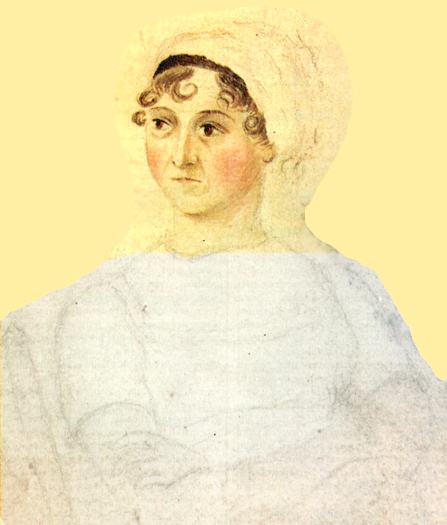
One objection is that apart from one not-very-good watercolour by her sister, there is no agreed authentic likeness of Austen.
Off top of head, and I may be wrong: but I have the impression that the same goes for Shakespeare – as regards his personal life, very much a man of mystery.
I’ve heard it said that Shakespeare has one of the most widely recognized faces in the world, although ironically nobody knows what he looks like.
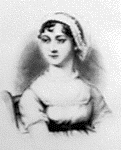
Since no one alive today ever saw Jane Austen, I’d think it would be more important to use an image that would be recognized as Jane Austen by the public than a totally accurate depiction of what she really looked like in life. The unfinished Cassandra Austen portrait of Jane Austen has been used as the basis for a number of other images of Austen (like this one and this one), and while it’s impossible to know how much these really look like her they are pretty well-known and bear at least some resemblance to the woman depicted by Cassandra Austen.

The Chandos Portrait, and, more so, the Droeshout Portrait, while not demonstrably taken from life, are the most common depictions of Shakespeare and, at any rate, fixed the poet’s image in the public mind to the point that a comedian coming on made up like this is recognised as Shakespeare (and the latter portrait probably served as the model for the Westminster Abbey statue reproduced on the banknote).
The engraving of Austen, done for the Austen-Leigh Memoir from the watercolour, is thought to flatter her considerably.
Ok, I’ll admit–whatever his failings as a statesman, Ol’ Hickory did have one hell of a 'do. But if that’s all it takes to get on our money, I think Don King deserves a spot on the $1. 
So what? Why is this a problem for you?
For the same sort of reasons people object to photoshopping top model’s pictures to ‘improve’ them today.
So you’re saying Jane Austen should not be honored on a banknote because this image promotes an unhealthy and unrealistic standard of beauty? Really?