I finished What Stalks the Deep by T. Kingfisher. Not as gruesome as some of her other works, but a good story, great atmosphere and an explosive climax. Literally.
The first of the “Sworn Soldier” series I’ve actually liked, I couldn’t finish the first one and didn’t much like the second, but this one had the missing spark.
Started three books, finished one:
Murder on Sex Island: this is not my normal kind of book, but I picked it up on a lark, based on Stephen Colbert’s blurb. It’s a mystery satire of tawdry reality TV–but it loves tawdry reality TV at the same time, and I really really don’t, and so it just didn’t work at all for me. Between that and the main character being a giant sack of cringe, I noped out of it after about fifty pages.
Cold Eternity: Space horror set on a decrepit ship full of cryogenically-frozen celebrities, where something is super creepy. I picked it up, got distracted and picked up a different book, then came back to it. I’ll probably finish it, but it’s not sucking me in.
Red Sonja: Consumed: This is what distracted me. Gail Simone is pretty funny on Blue Sky (where she specializes in trolling the shit out of Well Actually guys), so I figured I’d try it out. It was an entertaining read, very swords-and-sandals, but nothing I’ll remember in a week.
Finished Cibola Burn (Book 4 of the Expanse) - just as good as Book 3, by which I mean superb.
Started Nemesis Games (Book 5) - unfortunately this is the one part of the TV series I hated, so I’m going in with prejudice. It’s about Naomi’s stupid son. I’m hoping the book does it better.
I think James SA Corey are two of the best science fiction authors of our generation.
But gosh it’s awkward trying to figure out how to describe them. Is there a standard rule for two authors writing under one name?
Nearly finished with Enshittification: Why Everything Suddenly Got Worse and What to Do About It by Corey Doctorow (based on his hugely popular article in Wired, “The Enshittification of TikTok” which struck a nerve with so many people.) This book is part of my journey to learn about economics, and it’s a fantastic primer on anti-trust, anti competitive monopolies and dirty business practices of tech companies. The book is very accessible and Doctorow’s anger is palpable (and infectious.) But the final section is dedicated to why he thinks it can all be made better. Doctorow has over 25 years experience in the digital rights arena and is clearly knowledgeable and nuanced in his approach.
Highly recommended.
I’ve given up on Pierce Brown’s Dark Age and subsequently the rest of the Red Rising series. There is a such thing as too much grimdark and this series has gone down that path. I’m now reading The Cat Who Had 14 Tales as a palate cleanser. I need kitties after all that death and torture.
I finished The Collapsing Empire by John Scalzi. It took a bit to finish because, based on the back cover, I was expecting an adventure space opera type of story, not a bunch of diplomats and a potty mouthed noble or two playing 3D chess.
I’m giving up on Hatchet Girls. It’s a dumb thing to say about a Lansdale novel, but it’s too gory and implausible. Anyway, it’s overdue at the library.
Next up is Kingfisher’s What Stalks the Deep (finally!) I almost dread picking it up because what with the weekend and the holiday coming, my reading time is the first thing that falls by the wayside. If I get started and then can’t come back to it, I’m a-gonna be mad!
I’m reading this right now. I’m maybe 3/4 done with it. I’ve read several other books by Joe Hill in the past, too. I’m not sure what to make of him as an author. He clearly has fully absorbed his dad’s writing style. King Sorrow is more ‘Stephen Kingesque’ than ever-- the epic scope of the story; the well-drawn but slightly corny characters; the foreshadowing that keeps you turning pages (made-up example: “character A said “see ya later, gator” to character B. It was the last time they would ever see each other again”); the bloody mayhem described in full gory detail; the mix of horror and fantasy / fairy tale elements. And yes, so many winking references and Easter eggs.
Don’t get me wrong, I’m enjoying King Sorrow quite a lot. I just wonder where the line is crossed between ‘homage’ and ‘being a copy cat’ 
I’ve read the novel Flatland–my brother recommended it to me when I was in high school. (My older brother and sister gave me some awesome recommendations!)
Still reading, and enjoying, Who Is Dracula’s Father? And Other Puzzles in Bram Stoker’s Gothic Masterpiece, by John Sutherland.
Finished Living and Dying in Brick City: An E.R. Doctor Returns Home, by Sampson Davis with Lisa Frazier Page, which was okay, and Wonder-Makers: An Anthology of Classic Science Fiction, edited by Robert Hoskins. Of the stories I’d read before, “Surface Tension” by James Blish was the best. Of the ones new to me, “Killdozer!” by Theodore Sturgeon was my favorite.
Anyone who reads Wonder-Makers should be advised that the plot of Jack London’s “The Unparalleled Invasion” is just…unspeakable. I can’t decide if it’s the most racist thing I’ve ever read, or if London was just trying to show how racist people can be. Some of the other stories have language that didn’t age well, either.
Next up: Nicked, by M. T. Anderson, and In Search of L.L. Bean, by M. R. Montgomery.
Good news is that it reads really fast. I finished it in 2 days.
My fellow T. Kingfisher fans, next summer: Dagger Bound: Swordheart 2
You’re right, it’s not very thick. I’ll give it a shot!
If you liked Abbott’s Flatland you might want to have a look at Dionys Burger’s Sphereland, which carries the metaphor further and ties it in to General Relativity, or at A.K. Dewdney’s The Planiverse, which far beyond peopling the 2D universe with geometrical figures, and creates an entire physical universe of believable biology with 2D physics – definitely worth a look.
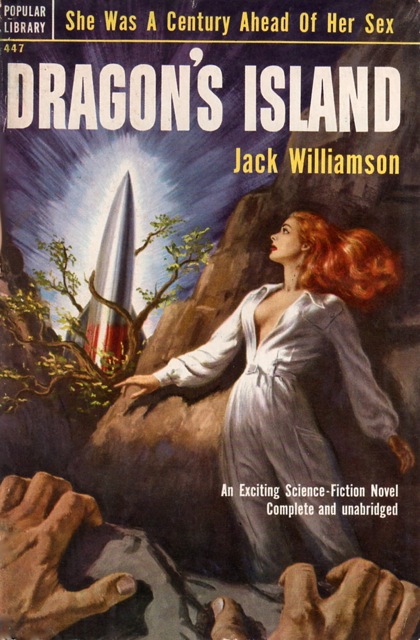
Just finished Dragon’s Island by Jack Williamson. Williamson was one of the original Great SF writers, who ought to be remembered for the short story With Folded Hands, later expanded into the novel The Humanoids, but he wrote plenty of other works in his almost century long life.
I hadn’t heard of Dragon’s Island before. It came out in hardcover in 1951; I picked up the first paperback publication a year later. It doesn’t look like a modern paperback – the four end pages are green, and there’s no price on it (although isfdb says it sold for a quarter). The cover looks misleading, but it’s pretty close to something in the story. What’s annoying are the blurbs they tried to use to “sell” the book “She was a Century ahead of her sex” says the front cover “Passion…out of this world!” screams the back. There’s no sex in the book, or even a suggestion of it.
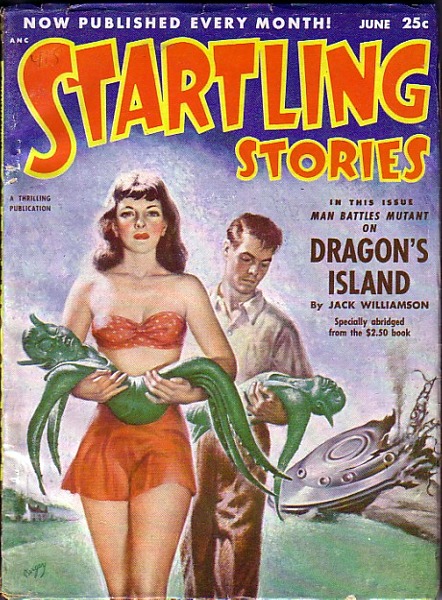
The cover of the excerpt in Startling Stories shows a man and a woman carrying what appear to be small aliens in their arms, and a crashed flying saucer is in the background (flying saucers, having debuted five years earlier in 1947, were still “hot”). There’s arguably a connection, but the tory doesn’t involve crashed flying saucers or aliens. A 1968 paperback reprinting changed the title to The Not-Men in an effort to make the story seem strange and mysterious. There’s a connection, but it’s not what you’d think.
The book is actually about Genetic Engineering, and uses the term repeatedly. I found that pretty surprising for a 1951 novel, even a science fiction one. Some internet sites seem to think Williamson invented the term with this novel, but a quick search showed that the term had been used in the 1940s in scientific literature, and had appeared at least a decade earlier. But I think this may be the first use of the term in fiction.
It’s a nicely paced novel, with enough mystery to keep you going, and enough gee-whiz speculation and ideas to make it good SF. My main complaint is that the products of genetic engineering – mutant humans, diseases custom-made to be scattered around in spore form to protect an area, bio-engineered encephalitis to cause memory loss (and insects to act as vectors), a plant that “grows” desired metallic structures as fruit, and a complete race of creatures that act as laborers, made from algae (!) – seem far too complex and time-consuming to be made by the small crew of bioengineers in the time available (and they complain about how long it takes to make even small changes). Definitely worth a read. The book was republished through 1984, then there was a hiatus until it was published in the present century three times. It’s available on Kindle and the Internet Archive.
One other interesting thing about the book that makes it seem very modern – A character says “I’ll relax when I’m dead.” As far as I can tell from ac search through Google N-gram and Google books, this is the first use of the phrase.
I finished What Stalks the Deep. Perhaps this was the best read of 2025? My only complaint is that it was too short, but then again, if it wasn’t I wouldn’t have been able to fit it in to my busy schedule. 
Some good quotes in this one, but I’ll leave them to be discovered by other readers. T. Kingfisher always puts me in mind of that old George Carlin bit about, “these words have never been used in this particular order before.”
I’ve mentioned this before, but one of her books contains my all-time favorite simile. In a passage about a character on a long horse-ride, hating every second of it, she writes, “Time passed like a kidney stone.”
Finished The Murder Book by Thomas Perry. A retired LEO, now a private detective, is hired to investigate an extortion ring in a series of small towns in northern Indiana. He learns that the crime goes far deeper and he finds it necessary to mete his own version of vigilante justice. Pretty good read.
Next up: I’m going to try Daisy Jones and the Six by Taylor Jenkins Reid.
“That sounds horrible and I want to go home,” I sid but I pronounced it as “Ah, I see.” is going to not only live in my head but build a cute bungalow there.
Finished Who Is Dracula’s Father? And Other Puzzles in Bram Stoker’s Gothic Masterpiece, by John Sutherland, Nicked, by M. T. Anderson, and In Search of L.L. Bean, by M. R. Montgomery, all three of which I enjoyed.
Next up: Worlds of the Imperium by Keith Laumer and Mathletics: A Scientist Explains 100 Amazing Things About the World of Sports, by John D. Barrow.
Finished both.
The Shattering Peace is a worthy installment in the Old Man’s War series, and ended with a satisfying twist which I like even more, the more that I think about it.
Sharpe’s Trafalgar gets better in its final third or so, with a blow-by-blow account of the huge battle from the perspective of the protagonist and the crew of a (fictional) Royal Navy warship, and a mostly-happy ending.
Traitors? Pictures? Mistletoe?
I liked TCE, but as I recall there’s more outright adventure (and explosions, kidnappings and assassinations) in the next two books in the series.