Public kindergarten is usually free in the US.
OK got it.
Yes: southern Europe lags behind northern and have much lower birthrates.
However, my comparison was more pointed towards the U.S. where the discourse seems to be "if we only had benefits such as in [insert country of choice] we’d have higher birthrates. My argument is that even in countries with these benefits birthrates are falling.
Aside - I’ve lived in Spain, with a Spanish woman, No woman in Sweden would hesitate to have a child due to economic or social consequences. In Spain (with a youth unemployment rate at 25 %) women know that having a child often means a one way ticket to being a “trad wife.”
ETA: Maybe some confusion on my part @puzzlegal. Is kindergarten mandatory? I did a quick wiki check and I get that impression. What I’m referring to is pre-school, from about 18 months of age to five years.
Let’s see if i can embed this image

Nope. Oh well, it’s from a study comparing birthrate in a county by income in a county within the US.
The US isn’t really comparable to Europe, because we have a lot of poor people who don’t have many options in life that compete with “having a kid”. As you might guess, there’s a negative correlation between fecundity and wealth in the US. This paper grouped counties into 20 buckets by average household income in the county. The birthrate number they looked at isn’t either of the above, it’s the raw birthrate per thousand women age 15-44, which they called “natality”. And the 20 buckets (“ventiles”) were selected to have equal numbers of women age 15-44.
The data runs through 2020, but let’s skip that because of the pandemic. In 2018, natality for the richest ventile was about 55 and for the poorest ventile was about 68.
Oh, preschool is different. Sorry for the confusion. It’s so hard to compare these things across countries.
You can find free government-funded pre-K and preschool programs in the U.S., but only in certain cities and states.
Ah, thank you. You’re saying there’s a limitation on the fee for children attending early childhood education. But there’s no requirement for parents to pay that fee if they don’t use those services.
General reminder that there are very few nationwide education programs in the U.S. For example, the Headstart program is a federal preschool program. Almost all other education programs and policies are at the state level, and often delegated to cities and counties. It’s very hard to make useful statements about education across the whole U.S.
So what, ultimately, is the end game of demographic collapse? Presumably entire populations don’t simply go extinct. Presumably whatever fraction of the population that bucks the trends and continues to procreate at the replacement rate at least, and somehow passes on either the genetic or cultural patterns that make that happen. But what exactly does that look like?
-
An abandonment of many of the tenets of modern life and at least a partial return to a preindustrial existence? Especially if entire industries collapse once there simply isn’t the mass of population necessary to support them?
-
A “Handmaid’s Tale” re-relegation of women to obligatory reproduction? (will the Taliban and the Quiverfull movement be the ones to inherit the Earth?)
-
Artificial mass reproduction and institutional child rearing ala’ Brave New World?
-
AI taking over the industrial infrastructure and existing for itself, with humans a remnant in the cracks like stainless-steel rats?
They do on occasion, Easter Island being an example. And nations that refuse to solve their issues with immigration are likely to suffer an actual collapse into a failed state in a somewhat less extreme self inflicted version of the Easter Island scenario.
But on the worldwide scale it’s unlikely to do more than put a short term dent in the population before something else happens. Which could be anything from climate collapse and nuclear war rendering everything moot, to social changes greatly increasing the birthrate until we’re back to facing collapse from overpopulation, to anything in between.
Projecting current trends indefinitely into the future consistently fails because the world isn’t static and the trend isn’t going to go on forever. The problem for places like Japan and South Korea is that their demographic issues are bad enough to be an immediate issue, not one that will become a concern in the far-off unpredictable future. And that they refuse to use the only solution that will actually work in that time frame.
Its hard to predict what the world will be like in the year 2100. In theory, places with low birth rates like China, Japan, etc will have a population about half what they have now. But humanity can easily survive with far less people. Around 0 BCE I think earth’s population was about 250 million.
I assume a big part will be AI and robots taking over the majority of jobs will make any population decline seem fairly irrelevant.
i think artificial reproduction will be a major factor.
The thing is, even if a nations population is cut in half in 100 years, you can in theory reverse that with one generation. If every woman has 4 kids, the population of China doubled again back to 1.2 billion or so.
My assumption a big part of why reproduction rates are so low is due to things like economic factors, people not wanting their potential children to suffer, people not wanting to put in the time and labor of child rearing, a highly competitive society meaning people invest more heavily in a couple of children rather than have multiple children with less investment.
But again, we really can’t predict what society will be like in 50, 100 or 150 years. Within 50 years we could have bipedal robots powered by AI that do 90% of human jobs. Artificial wombs. Genetically engineered babies (1 genetically engineered super-intelligent person will accomplish more than 100 regular people).
A world of 400 million genetically engineered humans and billions of robots would function fine, even though world population would be 95% lower.
Easter Island suffered a dramatic ecological collapse and subsequent population collapse, but the inhabitants did not become ethnically extinct until post-European contact. Perhaps you were thinking of Pitcairn Island, which was uninhabited at the time it was discovered by Europeans but retained evidence of prior occupation by Polynesians. Pitcairn being smaller and even more isolated than Easter Island, it would have been much harder for a population to sustain itself there.
Here’s an instructive graph of the US birth rate starting with the beginning of the 20th century:
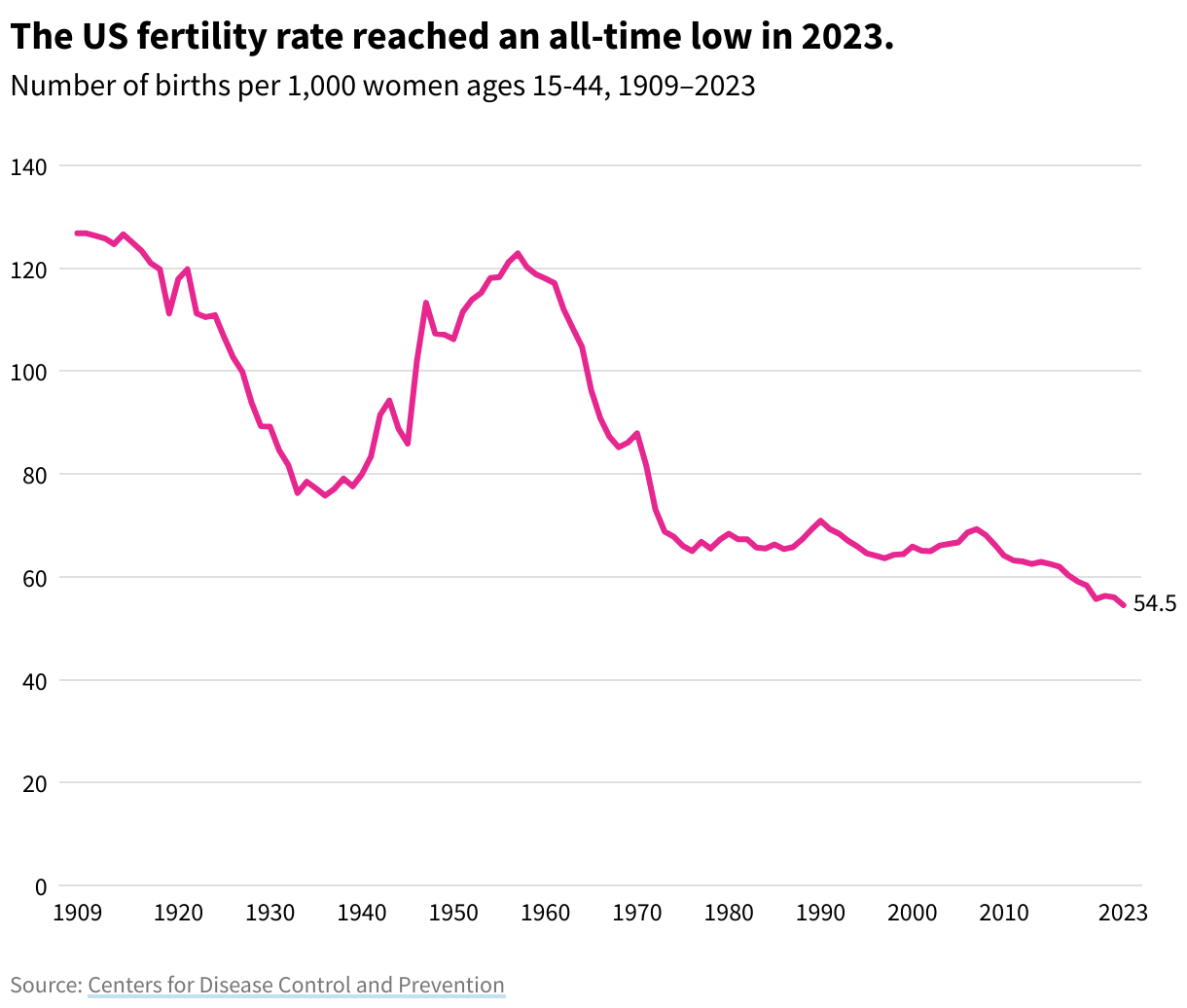
What I’d like to draw your attention to is the steady decline after about 1910; this was long before the Great Depression which would seem to refute the theory that the economic hardships of that era were what had suppressed births. The later WW2 Baby Boom (it apparently kicked in at the start of WW2, which would seem to refute the “couples having long-deferred families” hypothesis) was a temporary return to what birth rates had once been, before declining again and interestingly at about the same rate, before bottoming out at a slightly lower level than before (the introduction of oral contraceptives, and then legalized abortion?).
So if the issue could be crudely reduced to a handful of specific causes, what kicked in about 1905, continued steadily until 1940 and then after being interrupted for about twenty years resumed and continues to the present day?
Urbanization, I suspect. 1920 is generally considered the tipping point where most Americans were now living in cities.
The progress of women’s rights. Women being allowed to say no is obviously going to affect the birth rate.
That’s it. Women’s choice is everything.
I notice also that the graph flattens around the early 70s. So yeah, general sociodemographic change (urbanization, womens’ rights) seems to have been what really drove it down massively (and had been doing so pre-WW2 at a similar rate) and then it had a sort of “floor”. The Baby Boom then looks like a result of an acute disruption and once everyone got back to normal, the steep decline resumed.
Alex Nowrasteh opined on this topic the other day:
I bumped into a conservative acquaintance in the green room at Fox News several years ago. He was obsessed with falling fertility. Knowing that I worked on immigration policy, he said that immigrants assimilate too rapidly to America’s “low-fertility culture” and we have to find a way to slow assimilation to boost the birthrate. I disagreed. “They’re not assimilating to America’s low-fertility culture,” I said. “They’re assimilating to high opportunity cost in the United States, which is the reason why they’re here in the first place.” He asked what I’d do to increase fertility if that were the only outcome I cared about. After clarifying that I don’t support this policy, I suggested a new economic policy that would reduce the opportunity cost of having children. Then the producer came out and hustled me on set.
IME, this is just wrong. Yes pregnancy and birth are hard, messy, and can turn out negatively, However, it is a very strong instinct, and pretty damn joyful minus complications. I had 3 kids. If I could have had more I would have, but it was financially not a choice. I probably should have stopped at 1, but I did not. All things being equal some women will choose more children, some fewer, or some none at all. I think that the decision is complicated and individual. If you have specific health reasons to not choose more children, more often you wont choose more. Finances have some of the same considerations.
Parental leave, free child care, etc. give women one less thing to limit their freedom to choose however many children they choose to have.
An interesting side issue you’ve raised.
Of all births, how many are the result of a conscious decision to make a baby that month, and how many are simply the statistically inevitable consequence of unplanned sex followed by an unwillingness or inability to abort?
Said another way, if 95% of births flow from conscious decisions deliberately taken, then societal changes that help make the “yes” side of that decision easier will have a big impact on births.
OTOH, if 95% of births are simply the result of willy-nilly pregnancies that don’t get aborted, then the leverage of societal changes is tiny, since it can only influencing the 5% of pregnancies that are decisions.
I surely don’t know which it is. And it varies by society and era.
We have cited statistics upthread that much of the reduction in US birth rate in the last 40 years has been a relative cratering of unwed youth motherhood. Which young women are sorta the poster kids for willy-nilly pregnancy, not calm deliberate decision making.
That would seem to suggest that in the modern USA at least, the culturally “natural” rate of deliberate childbirth is well below replacement and we need a bunch of oopsies to approach 2.1. Or else we need some alterations to the social contract that are truly huge in scope (and probably expense).
I’m sure not cheerleading for unplanned pregnancies, and especially not to underage mothers.