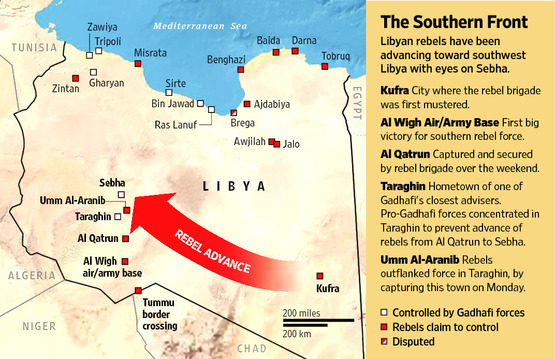
The Libyan war has been called a “stalemate” so often by the media that they’ve now stopped paying attention, for the most part. But this facile label isn’t entirely true. The rebels have been quietly building up and training their forces, and have had both major and minor victories in the meantime. Holding the western city of Misrata has been the most spectacular of these to date, but in recent weeks the rebels have opened up a corridor in the mountains southwest of Tripoli, and have been advancing towards the capital in fits and starts. These pockets of resistance in the western part of Libya may eventually be the most important militarily (if they manage to advance all the way to Tripoli’s outskirts), but the eastern half of the country may prove to be more important to the rebels’ overall chances of success, in strategic terms. Because whoever controls Brega will control the oil the town can ship out. Which would be a huge source of income for the rebels. And this war may wind up being one of attrition, in the end.
Reports from the battlefield are sketchy, at best. Wild claims by both sides are made and then quickly refuted. The rebels claimed they held Brega after the first day of fighting, and that they had routed the loyalists who were in retreat towards the next coastal town to the west, Ras Lanuf. The Libyan government claimed it had killed over 500 rebels, without any sort of proof. After the dust settled on the battling propaganda, it seems that the town is now still held by government troops, but they are currently under siege by rebel troops which have surrounded the town. The government forces have pulled off at least one successful ambush of the rebels, by either (reports are sketchy) dressing as rebels in a vehicle with rebel markings to get close enough to attack the rebel forces, or by spies infiltrated into the rebel ranks who broadcast their location via satellite phone to the government troops. The rebels have also run into minefields laid down by the loyalists, which have been brutally effective.
The initial attack by the rebels was reportedly made by both sea and land (and, one assumes, N.A.T.O. air cover as well). If true, this is a more complex and coordinated military operation than the rebels have so far shown the ability to carry out. Which shows the improvement in the rebel forces, and the effect of training. It also shows that the rebels now have access to a military supply chain which did not exist in the heady first weeks of the war. Pictures of the advance on Brega show heavy artillery and other modern weapons, instead of ancient rocket launchers hastily attached to pickup trucks with what seemed to be nothing more than bailing wire. The unspoken assumption is that the rebels’ friends in the rest of the world have found a way to get such equipment to the battlefront. Which, again, could be key in the longer war.
<snip>
The other logistical problem Gaddafi may be facing is a shortage of military supplies. He is cut off from the world by land and sea, but may still be bringing in supplies overland from the south, from other African countries. He may also be bringing in mercenary fighters via the same route. This is mostly speculation, as (once again) facts are hard to come by in the midst of a war, it should be admitted. But even if Gaddafi does have this conduit open to him, it depends on a dangerous (for him) equation. Because in order to receive shipments of ammunition (or of foreign fighters), Gaddafi’s got to ship out an equal amount of money. Since his money’s not going to last forever, this will not continue indefinitely.
Taking the long view strategically, the rebels seem to be in much better shape than Gaddafi. The rebels are being resupplied with ammunition and equipment, they just got diplomatic recognition from the United States, and they may soon be able to tap into the tens of billions of Libyan dollars frozen in Western banks since the war started. The rebel troops seem to be better trained and more serious these days than the “ragtag band” which raced across the desert to the west (and just as quickly retreated east) in the opening days of the war. Plus, they seem to now have the momentum militarily, even if it is a slow momentum to watch unfold.