Thanks !
My pedant friend has actually visited South Africa, more than once; but managed to return home without committing either suicide or murder.
Thanks !
My pedant friend has actually visited South Africa, more than once; but managed to return home without committing either suicide or murder.
I’d venture to say: this does seem to be a combination of sounds which many people – perfectly able in many departments of life – have a problem with: i.e. they default naturally, to “nucular”. Seems strange to those of us for whom it isn’t a difficulty; but for plenty of folks, it does appear to be one.
Most of a half-century ago, in a bad period of the Cold War, I recall being a bit surprised at hearing a work colleague – a thoroughly articulate and intelligent woman – remark on “how near we are, to a ‘nucular’ war”. This would seem to be a quirk not only of Neanderthals…
Do you folks pronounce the middle “l” in colonel?
It’s “DEP-yew-ty.”
Here in the Western US, where ranchers have used barbed wire since time immemorial, there is a long-standing tradition of calling it “bob wire.”
You know, I have to slow down and force myself to say the first “r” in “turmeric,” otherwise, in spontaneous speech, it just naturally comes out as “TOO-mer-ic.” I don’t have any explanation for it, other than “TUR-mer-ic” feels slightly “odd” in the mouth. Not as bad as the word “rural,” which just stops me in my tracks every time I try to pronounce it, but weird in a similar way with the placement of the "r"s. But I’ve been using that word since the late 80s, and “TOO-mer-ic” is what comes out naturally for me, and it has been reinforced by my peers who usually say it that way too. And it’s not just a US English phenomenon. I’ve heard “TYOO-mer-ic” from UK speakers and I believe antipodean ones, as well.
I don’t know, maybe the "r"s in a language have to be conserved, so when I add the “r” to “sherbet” and say “sherbert” it’s got to come out of another word, in this case “turmeric.” You will also note that very, very occasionally “turmeric” will be misspelled as “tumeric” on packaging reflecting the common (mis)pronunciation. It’s not super common, but I’ve seen bags of imported turmeric with that spelling. Here’s one example (also containing the misinformation that it’s “saffron.”) Here’s an example of a non-imported product with that misspelling. For whatever reason, that actually grates on me more than simply not pronouncing both "r"s.
OK, I’ve got a pet peeve.
There’s this mythical figure, who is so famous that his name is used to describe any quest that is absurd or pointless. His name is Don Quixote, and pretty much everyone pronounces it as Key-Ho-Tay, which is reasonably close to the actual Spanish pronunciation. However, when a person embarks on a futile mission, it is called “Quixotic,” and pronounced “Quicks-otic.”
Shouldn’t it be “Key-Ho-Tic?”
But it’s not pronounced NEW-CLEAR. It’s three syllables, NEW-CLEE-AR.
In the spirit of correct-use-of-English pedantry, a pedant is someone who is (in some sense) technically correct. So, to be pedantic, the term pedantry is misapplied to someone who seeks to impose invented rules that they pull out of their backside.
There are no hard and fast rules about when and whether the prevalent pronunciation of adopted words tends to change. But it’s certainly likely when a word is so securely adopted that it starts taking the grammatical inflection of the adopting language. I mean, are you equally peeved that we don’t pronounce the vast number of English words with Latin or Greek roots based on the way that Romans or Greeks would have pronounced the original root words?
Similar to the common mispronunciation “Duck Tape.”
Bogota, New Jersey has no accent over the final “a” until BO-ga-ta Columbia.
It’s pronounced BA-go-ta, and I’ve heard newscasters make this mistake.
And don’t me started on mun-AU-chee. It’s MOON-au-kee, dammit. Moonachie, NJ.
I probably would be if they were brought to my attention…
(Actually, I had a funny conversation with the owner of a local Greek restaurant, about the pronunciation of “gyro.” His take was - since we don’t pronounce “gyroscope” yeer-o-scope, the same thing should be done with the sandwich, and that it was unnecessary to try to pronounce it closer to the original Greek.)
I thought of that one, too, but that’s a bit of a special case, I think. I mean, first there is a brand name “Duck Tape,” but other than that, unless you really enunciate or make a clean stop between the two words, “duct” just runs straight into “tape,” so the tendency in spontaneous speech, at least for me, is not to double tap those "t"s but to just elide them. So while I know it’s “duct tape,” when I’m talking, you’ll most likely hear it sound like “ducktape.”
Unless it’s malk. Its a good source of vitamin R!
But seriously, my pet peeve is the mispronunciation of the word supposedly. No, it’s not “supposably”. It’s not even “supposively”. It’s supposedly, dammit!
A couple:
An acquaintance’s wife, while warm and friendly, always seemed to have this speech pattern that sounded quasi-snobby…stiff mouthed somehow. It was like all ( or most ) “short” vowels had a short “u” sound: She would pronounce “Wet weather” like “whut wuther”. Or “chicken” like “chuck-un”. WTF?
Years ago, I recall trading friendly jabs with a co-worker. He was from Brooklyn NY, me from just outside the NYC suburbs. A debate was over the pronunciation of the word “wire”. I say it’s, well…“wire”. He said it’s “WHY-ya”. It was funny how he saw what was being categorically non-rhotic as conventional and normal. I was like “Dude… you show me any dictionary that shows the “r” in that word as silent.” He retorted back ( phonetically ) with “Look…it’s WHY-ya…not WHY-YuuuuRRRRRRR”. Still cracks me up.
Obviously he’s right. I mean, the vast majority of the English language can be traced to other languages, and the pronunciations of adopted words usually change sooner or later; sooner when the phonemes are absent or unusual in the adopting language. As I said earlier, I think to some degree people’s claims of pronunciation “errors” in adopted words are based on a misconception similar to the etymological fallacy (as well as an excuse to brag about their knowledge of pronunciation in the original language!)
I think rather than treating this as an exercise in urging people to correct their “mistakes”, it’s really interesting to observe when, and try to understand why, adopted words sometimes preserve their original pronunciation and sometimes do not.
The catch is that you have to have at least a rudimentary understanding of these pure vowels to even get close to properly pronouncing romanized Japanese. Without it, karaoke becomes carry-o-key as shown in this video: https://www.youtube.com/watch?v=VpjSH1BKo_c. To my ears, the second speaker’s pronunciation is the closest to a native speaker, but still not exactly like a native speaker would say it.
Yes. And, just to be clear, when I say the “JIE-roh” pronunciation grates a bit on my ears, it’s not so much because I consider it “wrong,” but because it’s not a pronunciation found in my dialect, so my initial exposures to it were “what the hell are they talking about? Oh, yee-ros!” After meeting enough New Yorkers from my 20s onward, I got more used to the pronunciation, just like I got more used to idioms like “standing on line.” Now, I’m sure it’s more than just New Yorkers who say it that way, but I most strongly associate that pronunciation with the East Coast.
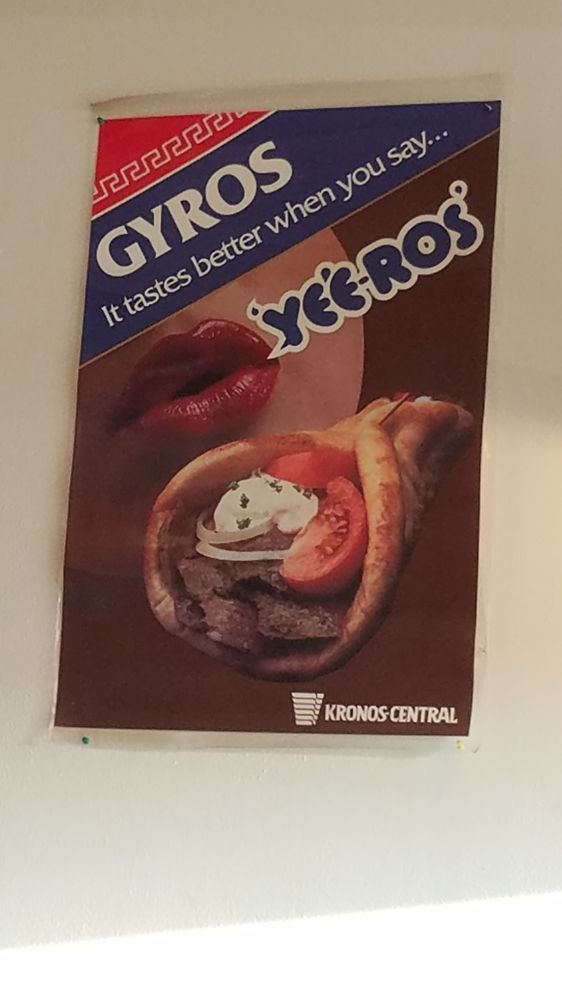
I really can’t think of any local friends I know who pronounce the foodstuff “JIE-roh.”* Now, they will say “JIE-roh” for the short form of “gyroscope” but for the food, it will be “yee-roh,” “yih-roh”, “ghee-roh,” or “gih-roh.” I can’t think of anyone local that says “JIE-roh,” except perhaps tongue-in-cheek. I guess Kronos must have done a good job getting the it tastes better when you say YEE-ROS posters out. I wonder if that may have something to do with why that particular pronunciation is favored here. And Kronos were the folks who brought the gyros cone to the masses, AFAIK (though Wikipedia does say there seems to be a bit of an argument about who was the first, with other possible Chicago gyros purveyors claiming to be the first.)
*For the IPA folks:
“jie-roh” /ˈdʒaɪɹoʊ/
“yee-roh” /jiːɹoʊ/
“yih-roh” /jɪɹoʊ/ or the same as above except with /i/ instead of /i:/ Might even be more middle or back–sometimes sounds almost like “euro”
“gee-roh” /giːɹoʊ/
“gih-roh” /gɪɹoʊ/ or the same as above except with /i/ instead of /i:/
Intensive purposes makes me homicidal.
Your overreacting, don’t loose your temper.
+!
I have no issue with appropriated forms of words. But I do take umbrage with the appropriated form being regarded as true to the correct word. I know people who pronounce Chanukah with a a hard Ch sound and have no problem with it. I do have a major problem when they insist their pronunciation is correct.
I worked with a woman who insisted Tao (Chinese, usually translated a “The Way”) was pronounced with a hard ‘T’ and would correct people who correctly pronounced it as dao - Mandarin (roughly sounds like Dow (Jones) or dou -Cantonese (roughly sounds like dough).
Even worse was when I was I was taking a Chinese history course and two fellow students were arguing about the pronunciation of Tao Te Ching because she pronounced it (correctly) in Cantonese and he was insisting the Mandarin pronunciation was the only correct form. I stepped in and told them they were both correct and she smiled triumphantly and he sulked.
I’m perfectly fine with “The Kah-rah-tee Kid” since it’s a Hollywood movie, but please don’t insist that kah-rah-tee is the correct Japanese pronunciation.