Yeah, Gravity was far from the worst portrayal, but it made it way too easy to get from one orbital object to another. They were all much too close together, and the path you take to get from one to another is far from intuitive: You don’t just point your fire extinguisher in the opposite direction and zoom over.
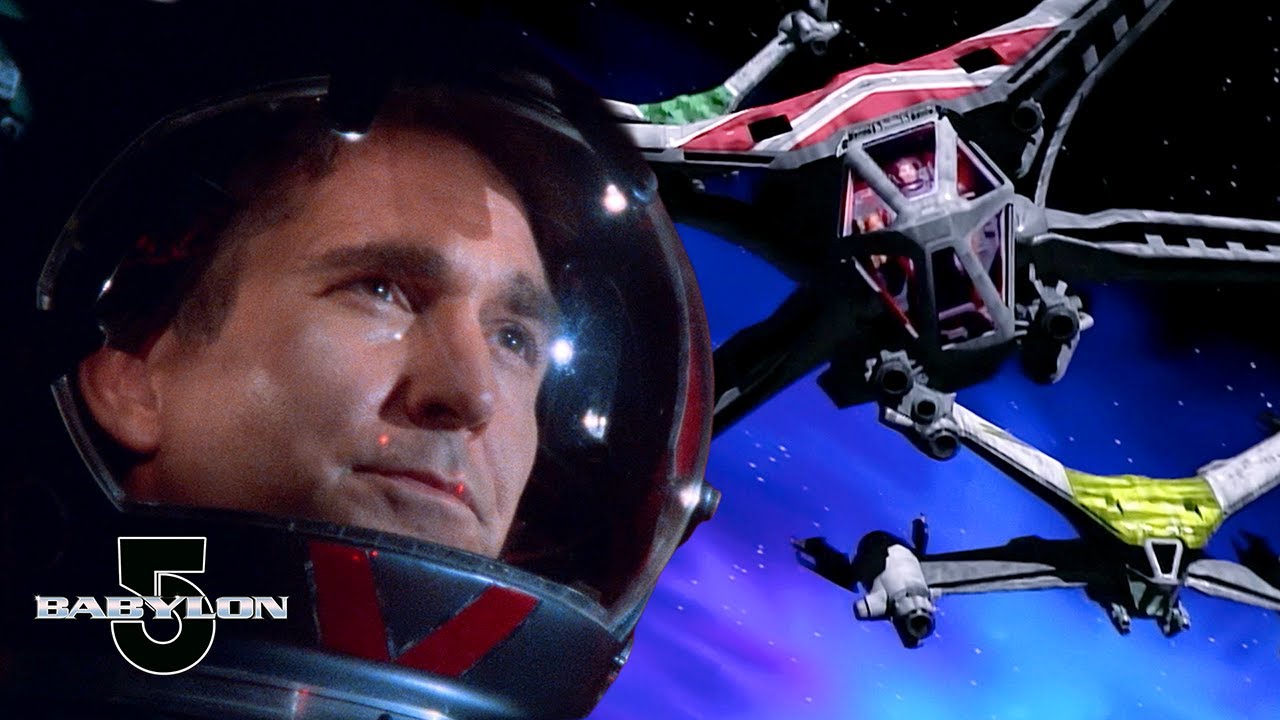
If you accept the premise that the future of warfare involves manned craft maneuvering around each other, Babylon 5’s Starfuries are relatively reasonable. You’ve got a small cockpit capsule, with multiple engines on the ends of struts to rotate that capsule around various axes.
I generally did not like Babylon 5, but the fighters would reverse direction by rotating the shut down engine 180 degrees around the center of gravity, where the pilot sat, and firing the engine again.
I’m not sure what you man by “rotating the shut down engine”, but generally Starfuries rotated by firing all four thrusters simultaneously, two in the aft direction and two in the forward direction. This would be quickly followed by another thrust of all four thrusters in the direction opposite to their original thrust to stop the rotation.
I agree with both of those. I found Gravity especially impressive because I saw it in a theater in 3D on a really big screen, and the 3D effects were awesome.
Now that you post that, I’m also reminded that relative to the direction of largest accelerations, the pilots are “lying flat on their back”, which is the best position for humans to take g-forces.
20+ years ago, I played a fan-made Babylon 5 PC game that was a starfighter sim along the lines of Wing Commander, but using B5’s realistic space physics. If you flew past your target, turning around meant rotating your fighter and slowing down to zero before starting to accelerate towards them again. Turning off the engines didn’t mean you slowed to a stop, it just let you coast and rotate in the opposite direction. You could accelerate indefinitely in hyperspace, but if you got too fast you wouldn’t be able to slow down in time to catch your jumpgate and you’d go hurtling off into the void.
It was maddening and I never made it very far in the game. I can see why the space sim genre has kinda died off now that people are generally more aware that space combat wouldn’t work like a WWII dogfight.
Does it, though? The centrifuge section of the Discovery can only be turning about the long (roll) axis of the ship. When the crew in 2010 arrive, it’s tumbling over its pitch axis. I think I asked about that once before here, and someone said that a long, thin object rotating about a long axis is unstable, like trying to spin a pencil on its point. So I’m not sure what axis it would be on after nine years.
However, I think the amount of spin and momentum is incorrect. The centrifuge was not spinning very fast, and was pretty small. If the bearings seized, angular momentum would be maintained, but the whole Discovery would have a much larger moment of inertia so the speed of rotation would be correspondingly less. I’d have to watch the movie again to be sure, but I seem to remember it was tumbling too fast.
That’s exactly what would happen. a roughly cylindrical object rotating about the long axis would be metastable – it’d much rather be rotating about the shorter axis, so if you give it enough of a chance it will flip to end-over end, given enough perturbation.
They might have the rotation rate wrong, but I’ll give them a break on it. They don’t actually show you how fast the centrifuge was spinning.
By the way, it’s unlikely that the Discovery’s centrifuge section could be spinning fast enough to give the equivalent of 1 g. In a space that small the coriolis force would be pretty high, and it would have disorienting effects on the crew. There’s evidence that people can get used to large coriolis forces, but it’d be smarter not to have to. I didn’t realize, as a kid, that Werner von Braun’s 1950s space station designs were never meant to spin fast enough to give a full gee of artificial gravity. They just wanted to have enough to give a useful sense of “up” and “down” and not having things float around and get caught on the air filters (like they do in our zero-g space stations). as I understand it, the minimum size for the diameter of a rotating space station without unacceptable Coriolis forces is about a kilometer.
Plus, all the science and engineering were as close to reality as they could get. No “reconfigure the discombobulator” stuff. Key bits like making the carbon dioxide scrubbers work in the lunar module really happened.
Would it be a perfect end-over-end as seen in 2010? From what I remember, the tumble is perfectly along the pitch axis (relative to the Discovery’s flight deck). There’s no remnant of the original roll momentum. There’s also no yaw, which is also a short axis.
Ah, but they do. I remember one scene in the original where Bowman and Poole are seen entering the hub of the centrifuge and climbing down the ladder.
Watch that scene with a stopwatch and you could get a decent estimate of the rotation rate.
ETA: Kubrick was such a stickler I wonder if he (or Clarke) did the math on spin rates and forces.
There’s a scene where the crew do a course correction burn without computer assistance. I kinda wonder how accurate that was; not that it happened, but the details of it. It felt to me like the difficulty and drama of the moment might have been dialed up a bit.
I wondered about that, too. Seemed exaggeratedly hokey for dramatic effect.
Going back to the OP, and the talk of Babylon 5, how about the Interceptors in UFO? They looked like space fighters, but they weren’t. They were true interceptors, in that they met the incoming UFOS at some high closing speed and had one shot. Then I assume they took a lot of time to circle around and come back. They couldn’t turn and chase the UFOs. A bit of subtle unspoken realism from a somewhat fantastical show.
IIRC from Lovell’s book, he actually validated that procedure in the simulator. It was sort of a backup to a backup. A very simple technique of sighting on the Earth and using it to direct the vector of a course correction burn, and not something they thought would actually be used. Kind of like how today’s pilots are still sometimes trained for NDB approaches, which is a barely used technology these days.
But Lovell found himself having to do it for real. I don’t remember him describing it as anything so dire as in the film. He was quite specific that the crew didn’t yell at each other or argue as depicted on screen, so I’m assuming that maneuver was performed professionally.
Also, that scene in Apollo 13 where we see the ground personnel seemingly inventing the carbon dioxide filter… Not true. There was a procedure for that already in their manuals because the incompatible CO2 cartridges were a known issue. Again, it was the sort of thing they considered very unlikely to be used in actual practice. But when it did become necessary, it was a matter of finding the procedure, practicing building it on the ground again and communicating it to the crew in space. But it was not “invented” on the spot.