Star Trek transporters, where you maintain your memories and personality are impossible.
That’s a VERY specific situation. The plausibility of text hovering over live video being a daily use interface just seems silly. Contrast exists, and will, for a reason. Besides, given my example, your students can see everything you are writing from the back of your monitor. You just need a lower profile monitor if things “gon get craazay” on the other side of your LCD.
I’ve got Photoshop Jockeys salivating over this tech, but one of my students said they’d read that Tom Cruise could only do a few sweeping UI gestures before he had to rest his arms.
I just had to say: “Cite?” and “Who here is in better shape than Tom Cruise?” No hands went up.
I agree. The daily office worker should not have to ( though may very well benefit from) make sweeping gestures for simple tasks. But, if we take gesture controls to their practical extremes, we have Stephen Hawking like blink and wink gestures. Something that subtle could devolve us into something awful.
The big problem with gesture-based input systems is lack of haptic feedback. When I press a well-designed physical button I can FEEL that my input was accepted. I don’t need to wait for my visual system to filter the confirmation out of all the other noise in my visual field. The small but real feedback lag inherent in pure gesture systems will always limit their utility in high-performance situations. I’d hate to try to drive a car using gesture inputs, for example.
When I first saw Star Wars I mentally hand-waved this away as the precognitive force moved the light saber to where the shot would be.
Cross some Lytro cameras with a panorama ball and presto. It’s not quite to the “look around the corner” level, but damn close already.
When I saw the video for the panorama ball, I instantly thought about how cool that would be in a military application. Imagine firing a few miniaturized versions of those from grenade launchers to scout ahead.
Plus, I would hate to delete several hours of work when it “saw” me taking a drink of coffee or stretching.
It was my understanding that “blasters” are not laser-shooters, but fire a short blast of charged particles.
Wouldn’t errant bullets be a bad thing in a spaceship? :dubious:
I dunno. I saw a lot of Stormtroopers missing their shots but none of them blew a hole through the hull.
How about portals? If it was even possible would there be any use for such a thing?
The people who predicted flying cars forgot about all the crazy drivers out there.
I was under the impression that the main problem with teleportation was the amount of data storage it would take to do it.
That’s how wonderfully bad a stormtrooper’s aim is. He’ll miss the the hull of a spaceship — even when he’s inside it.
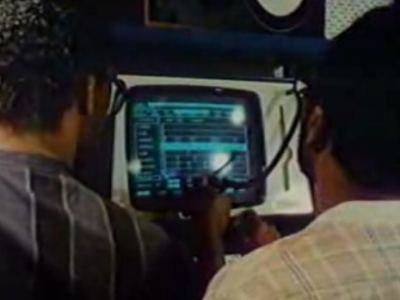
Back when light-pen interfaces were all the rage, like on the Fairlight CMI, people suffered from “gorilla arm”. Touch screens only came back in personal devices because they are used at chest level or below.
Didn’t Doug Adams has a bit about trying to operate the radio with a wave your arms interface, the user having to remain frozen in place to listen?
Religious/ritual basically, it marks the user as a force sensitive at the least. Why do people still train in sword fighting when machine guns exist?
Regarding lightsabers (and as pointed out on tvtropes), the audience’s willingness to suspend disbelief is greater if something looks really cool.
I can see the possible logic of training in sword fighting. The training could teach skills that would be useful in real combat.
The real question is why the Jedi actually fight with swords in real combat.
Religious significance basically, remember that before the clone wars the last full scale war was thousands of years in the past and that war was between jedi and sith both force sensitive.
Also, if you’re taking video, rather than single still pictures, and add a little jiggle to the camera, then by averaging over a bunch of frames, you can get better resolution than any single frame.
Works better with things that aren’t moving, of course.
Could be solved with some kind of haptic glove. Could be solved in a really cool way by haptic gloves hooked up to some kind of fancy magnetic field generator that could actually physically resist movement rather than just providing internal feedback.
I think flying cars will definitely become more common and practical. You can already see the air travel industry branching out into smaller regional airports, more direct flights with smaller jets, and the democratization of chartered flights. As long as technological progress continues and standards of living rise, aircars will become more and more reasonable. I expect that they’ll become quite popular to rent once they’re self-flying and don’t require a pilot’s license or a pilot.