Maybe it is. Depends on how the laws are written. The members of a farmers’ market cooperative aren’t legally allowed to get together and set minimum prices for all stands at the market. (At least, not in NYState; I’m not sure whether that’s federal or state law.)
And how the laws are written tends to depend on who writes the laws, and how they were thinking at the time.
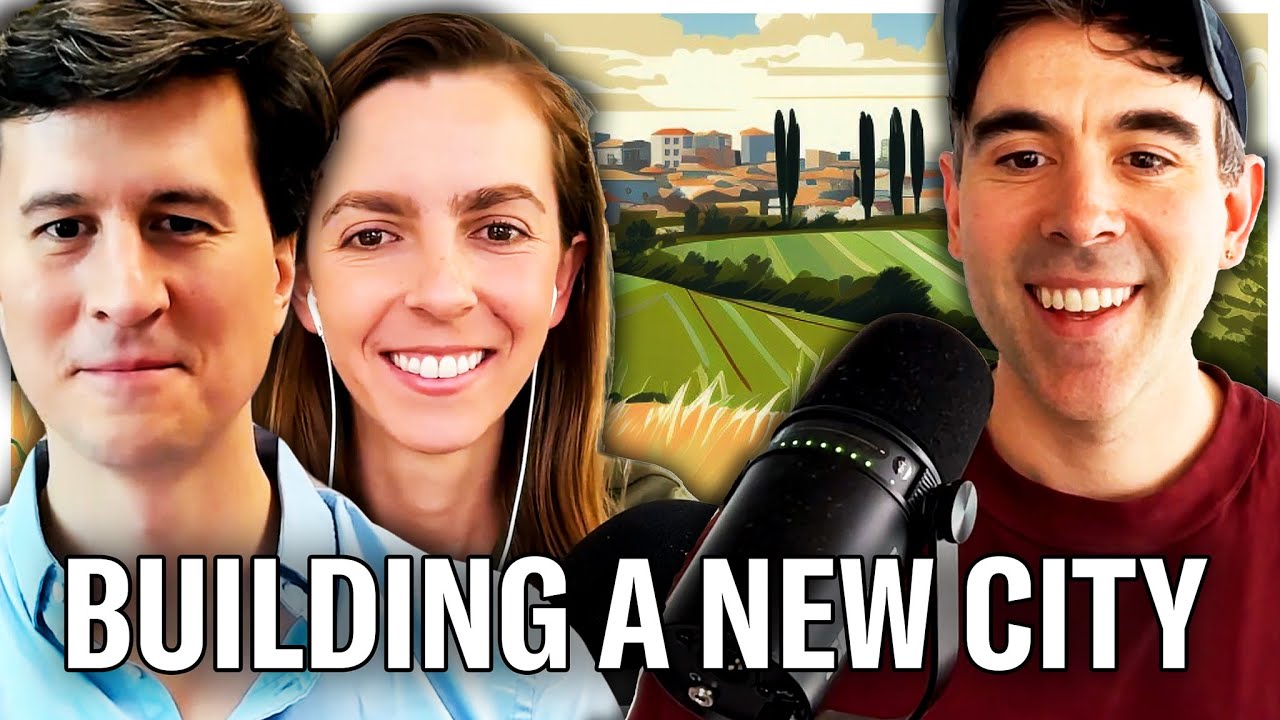
Saw this podcast with the founder and another person involved in the project:
Regarding water–they don’t go into it too much, but they do mention one specific point. There’s currently a 2500 acre almond orchard on the site (which is barely profitable due to the poor soil). That single orchard uses enough water for a 100,000 person city. So net water use will be negative until the city gets to a decent size.
He also points out that cities only use ~6% of the state’s water, saying the problem is 50% optics, 40% politics, and 10% reality (which sounds about right to me).
They repeatedly make the point that there’s nothing really complicated here. They’re building housing. They want a dense, walkable city with lots of open space (in contrast to the usual suburban sprawl), so it’s a little unusual compared to many developments, but this isn’t some weird utopian thing.
Travis AFB is apparently supportive (after certain boundary issues were addressed) due to the lack of affordable off-site housing and jobs for spouses.
They do find it weird getting pushback from the same people that said investors should stop putting their money in stupid social media apps. Now that they’re putting money into actually building physical things, they get the same pushback. Oh well. Reactionaries gonna react.
I think the idea is questionable because it will pave over new land that is not near anything. Why not densify one of the existing cities nearby, like Fairfield and Vacaville, that are already plugged into public transit and utility infrastructure? This new city will have to build it all up from nothing, which seems wasteful, and people will still have to hop in their cars to go anywhere, so I am not seeing the point of doing this. There are plenty of parcels of land closer to civilization that can meet the developer’s vision of a dense, walkable community without having to pave over more farmland, but it’s probably not as cheap. I’d prefer more infill development and less expanding the urban footprint.
Could be they aren’t zoned appropriately. Both places look to me like endless single-family home suburbia–exactly what they don’t want. Even convincing the nearby residents to allow high-density housing is probably untenable.
Greenfield projects have a lot of advantages, with avoiding NIMBYism being a prime one. And I’ll always support ripping out an almond orchard.
Not exactly IMO. I believe the nature of NIMBY changes, but it doesn’t go away.
If some outfit wants going to built a WAG 5mi x 5mi town on a greenfield site, anyone enjoying the currently rural area within 15-20 miles of the site is easily recruited into a NIMBY effort to stop 100,000 new residents on their roads, the corresponding tax and political changes as the area slides from rural-ish to yuppies, etc., etc.
Sure, some degree of NIMBYism is inevitable. But it does weaken with distance. And it’s not like they’re paving over Yosemite here. It’s low-value agricultural land.
The founder claims that the project has reasonable support. It’ll require a ballot measure, so we can judge then if it’s actually supported by the public.
“What if they made a city and nobody came,” are the first words in this item, about a planned city in Ontario, Canada that nobody wanted to live in. Well, a few did, but it never became what its planners had hoped it would be. Other established communities could fill the residential needs of industrial workers in nearby factories, and the new community would have to build from nothing.
Take it from someone who has been working in Fairfield for the past 20 years:
First of all, Fairfield and Vacaville’s “public transit” is pretty much non-existent.
Second, I can’t speak for Vacaville, but Fairfield can be divided into four types of land: places where housing has already been built, places where there are signs promoting new housing developments (and good luck finding anything under $600,000), hills, and marshland.
The one major flaw I see with the idea is, the only road that goes anywhere near it is one lane in each direction. Maybe the planners can talk their way into getting it expanded somehow, but the response will almost certainly be, “Who’s going to pay for it?” On top of that, it’s still quite a distance from where I would expect most of the people who live there would be working. There is an existing bridge not too far away that could be connected by road to the city, but (a) it would involve building additional roads on what I believe is quite a bit of privately-owned land, and (b) the road it would connect to on the other side of the bridge is already notorious for traffic problems.
By the way…yes, there are California Forever billboards, and pretty much everybody in the county has already received at least one mailer from the company touting the plan.
While that may be true, my point is it will be much easier, more efficient, and less wasteful to infill and densify an existing city, and fortify existing transit than to build it all from scratch. And what’s to keep this “New Community” from becoming as expensive as any of the surrounding communities?
Are they going to cap how much someone can sell their home for? IMHO it wont take too long for the cost of housing in any new community in Solano County to come up to par with the rest of the county, especially new stock.
I am not totally against this concept, but I am having a hard time understanding how this will end up any different from any other stretch of suburban sprawl along any other stretch of highway in northern California.
It probably will be, since it’s a relatively small project and the demands for housing in California are very large. Still, there should be some downward pressure.
One of the points that the founder makes though is that people seem to be confused or in denial about supply and demand. Housing is expensive in California because there’s high demand and not enough supply. And yet people seem to have this weird mental block about addressing the supply side. We need this community and a lot more, but very little is getting done.
Well, again, it’s just a housing development. So it’s nothing special in that regard, contrary to those talking about some utopian whatever. But they are addessing the sprawl aspect by actually designing a walkable, dense community. Compare to the nearby land of a ten thousand cul-de-sacs.
Agree. I wonder what their plan is now. They say there are just changing-up the order of steps in their plan. With the deep pockets of some of their donors, I don’t see this thing going away. But, there is now more time for the opposition to get organized and energized for when it finally does get to the ballot. They will probably look for a low-voter-turnout election to try again (not a significant Presidential election).
Or maybe just that the odds of losing were too high. EIRs are insanely difficult anywhere, and nowhere more so than in California. Getting the EIR first makes the initiative more likely to succeed.
We need to make it easier to build things in California. And yet people will believe anything but the obvious, which is that to make housing cheaper you need to build more housing.
California Forever, the new Solano County city proposed by a group of Silicon Valley tycoons, was technically not on the agenda at the packed Suisun City council meeting on Tuesday night. But the controversial billionaire-backed plan was on the top of everybody’s mind.
After a heated three-hour hearing, Suisun City’s City Council voted 4-1 to give City Manager Bret Prebula the green light to explore whether the 4.2-square-mile, cash-strapped city could expand its tax base by annexing unincorporated land to the west or east of the current municipal borders… the property to the east is owned by California Forever, which is hoping to build a transit-oriented city of 400,000 in east Solano County.
Critics of California Forever contend that by annexing territory the group owns, Suisun City could be allowing the developer to make a partial end-run around the California Orderly Growth Initiative, which stipulates that any development in unincorporated parts of the county must be approved by voters.
This city wants to expand. Critics worry it’s how California Forever will take root
Today, California Forever is charting a new course to restore an industry that once defined California: high-tech manufacturing. We’re unveiling the 2,100-acre, 40 million-square-foot Solano Foundry, the nation’s largest, most strategically located, and best designed advanced manufacturing park – and a blueprint for the bipartisan build agenda…
In recent years, American industry has experienced a renaissance, but the lack of entitled, available, ready-to-build land near Silicon Valley, coupled with a critical housing shortage in California, has pushed new factories to other parts of the country. This reshoring to distant states has been a partial solution, but it comes at a cost: it slows down American innovation, as R&D teams based in Silicon Valley are forced to spend days traveling back and forth to remote factories, hindering collaboration and rapid iteration.
The Solano Foundry offers the solution: a space for state‑of‑the‑art production facilities just an hour north of Silicon Valley, so American innovators can iterate at a pace that outperforms our adversaries, keep intellectual property at home, and strengthen our national security.