I disagree. It is a statement about the power of militaries and politics when it comes to religion.
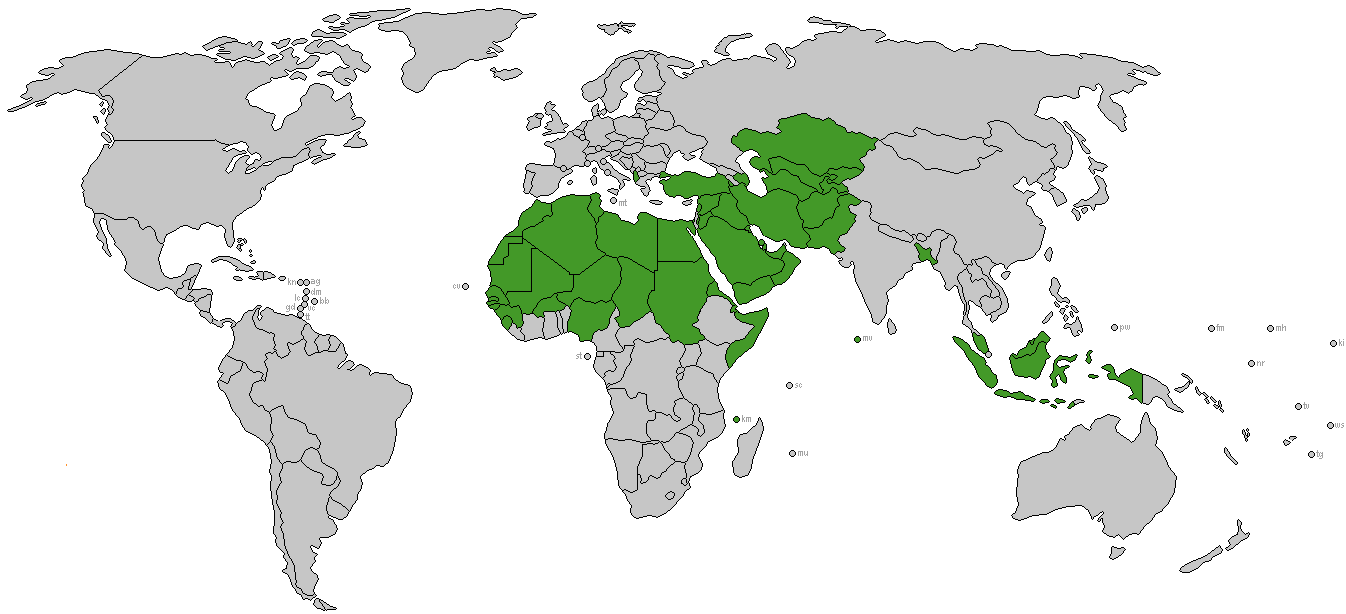
Islam is the religion of the middle east because Mohammed and his children forcibly converted those regions. If you look at a map of land conqueredby Mohammed and his offspring vs a map of modern Islamic nations, its a pretty good overlay.
Christianity is a major religion because Constantine was converted, and he then converted the Roman empire. The remnants of the roman empire (aka western Europe) then expanded into the Americas, southern Africa, etc. A big reason for the expansion of the roman empire was military tactics, mainly the phalanx. That let them conquer a lot of land. So the only reason chrsitianity is the one true faith to 2.4 billion people is because a couple thousand years ago some generals discovered military tactics using spears and shields that allowed them to conquer a lot of land.
Also Abrahamic religions and Hindu religions are incompatible IMO. I know some faiths like Sikhism and new age attempt to combine them, but the idea of eternal reincarnation is at odds with a single life followed by an eternity in the afterlife.
If you view each religion as a culture and concurrent cultural identity rather than simply a belief system then it’s not. The loss of that culture and diversity is sorta sad.
I fail to see how that follows. Even if one presumes that there is a particular true religion, there’s no good reason it would need to be one of the two main surviving varieties (which as has been pointed out themselves are incompatible). What if animism is actually true?
I don’t necessarily think a presumption of “one true religion” is necessary, though a presumption of universal and immutable truth is definitely necessary. Though Christianity and Islam are mutually exclusive in many ways, they also have some striking similarities.
If mankind can progress in terms of scientific knowledge and social dealings with fellow humans (and I think it’s undeniable that we, for the most part, have), why can’t we also progress in terms of the spiritual and religious?
If animism is true, then we are obviously moving in the wrong direction. Since we seem to be moving in the right direction in so many key areas, doesn’t it follow that we should be moving in the right direction spiritually? If not, why such a disconnect?
The purely human reasons for why one religion may have dominated are so abhorrent (genocide, torture, militarism, etc) that using that as a evidence of the divine is horrific.
Anyway, this is getting way out of General Questions territory. Let’s stick to the subject of what might be the oldest religions. If you want to discuss this further, open a new thread in Great Debates.
From comparative religion 101 one was taught that there was a progression “sophistication” from animism all the way through to mono-theistic religions. This of course was very much a one eyed view, since of course the dominant religion was clearly the most sophisticated." But there is a point that religions are subject to evolutionary pressure, and a religion that is both ecumenical and evangelical is going to have a huge advantage, and will tend to out-compete the memes from other religions.
But the very nature of religion has changed vastly. Again one might argue that the strongest memes outcompete the others. Leaving a few crumbs of food as an offering to the forest spirits in the hope of having a good day hunting is a far cry from devoting and risking your life to spreading the word to the unbeliever. But religions that encourage the latter have more chance of surviving.
One suspects that the adherents of the vast majority of old religions could not have cared less about whether the guys in the next valley worshipped the same gods. Indeed they may have assumed that they didn’t. After all, their gods lived in their valley and looked over their bit of the Earth. OTOH, the fundamentals of what the worship was may well have been very similar, and the rules of engagement with their gods across many of the same peoples of the same general flavour. Whether those rules and assumptions included the local gods in the creation mythology, or there was any idea of hell, heaven or afterlife is another matter. One does suspect that it didn’t take long for some idea that life after death might be a winner in terms of a religion’s success. But that might have taken the advent of larger civilised groups.
It’s hard to answer definitively because ancient religions often evolved slowly over centuries. It’s perhaps best to ask the question concretely in terms of major religious texts that were composed during the Bronze age in which case I think Hinduism is the best answer. The Bronze age ended around 1200 BC in the main centers of civilization. The Rig Veda, the most ancient text in Hinduism, was composed around 1500 to 1200 BC.