I was going to mention these because there were plenty of pre-ww1 coastal batteries that were still operation in world war 2. (However, world war 2 is not today.) With that caveat, in the Battle of Drobak Sound, a pre-ww1 coastal battery (granted, containing secret torpedo tubes) turned back an entire German invasion fleet and delayed the conquest of Norway for several hours.
I’d be amazed if there was a single operational shore gun battery anywhere. By the time a hostile modern navy gets within 5-10 miles of your coast the war ended a few hours ago. And you didn’t win.
OTOH there may well be an anti-ship missile emplacement set up in what used to be a gun battery. Or at least on the grounds of what was once a network of gun batteries.
An RE sergeant of my acquaintance has this discussion with some buddies some years ago and he won, having done a blacksmith’s course and subsequently indenting for a set of blacksmithing tools. They arrived in a fitted wooden crate that hadn’t been opened since the 19th-c. and covered in pitch to preserve them, with dates in the 1880’s, I think.
The Noon Gun in Cape Town is said to have the oldest artillery pieces still in regular use (and that’s daily use - except Sundays and holidays) and they were cast in 1796.
Since they would have to reverse engineer the thing, and I’ve never met an engineer that didn’t have a “better” idea, you’d wind up with an improved B-52 like the B-1 or B-70 or some other overpriced boondoggle. Carbon copy of an existing device is not in their realm of possibilities.
I love it - a cannon with it’s own Twitter account.
BANG!
The Royal Citadel in Plymouth was built in the 1660s, and is still in military use, although possibly not for much longer.
Yes, it can be harder to restart production of an existing aircraft.
In the case of the B-52:
- Boeing’s remaining facilities that were used for B-52 production are now being used to produce other aircraft, and have been for decades. The BUFF is a large aircraft, and would require a huge production facility to accommodate multiple airframes under construction & assembly at the same time. I doubt Boeing has any dormant facilities/real estate big enough to accommodate restarting BUFF production, so they would have to source & build new facilities.
- Boeing destroyed the production jigs & tooling, and the production drawings, at some point between the 1960’s and today, by order of the USAF. Storing all that stuff costs money and takes up space, and at some point (probably coincident with one of the “replacements” for the BUFF that were fielded in the past), the USAF decided they weren’t going to pay for that storage anymore.
In the case of the A-10:
- The original manufacturer, Fairchild-Republic, no longer exists, and the company it eventually became is now a part of Israel’s Elbit Systems.
- Just like the B-52, the production jigs & tooling and production drawings were destroyed long ago. The “fighter Mafia” of the USAF never really wanted the A-10 anyway, so it’s likely that they ordered the destruction maliciously, cloaked as a cost savings.
There are still operational fixed coast artillery batteries in a few countries. The no longer operational Finnish 152/50 T guns (with parts of their carriages dating from the 1890’s) were discussed above, but the 130/53 TK type Finnish coastal guns are still operational and planned to be till at least the 2020’s, per same book I cited above. However these weapons aren’t at all old, dating from the 1980’s. Sweden and Norway also emplaced new coast defense guns as recently as the 1980’s/90’s but they are already retired. In those countries missiles developed for anti-tank use have been employed as coast defense weapons as well as larger ‘true’ anti-ship missiles.
In the Far East a few countries have older (though not very old) operational, or probably so, coast defense guns. North Korea has AFAIK no strictly speaking purpose built fixed coast defense guns, but plenty of field guns still emplaced in bunkers/caves as along cliffs for essentially permanent static use v ships, similar to the many German batteries set up with older or captured field guns all along the coast of Norway in WWII (in a few of which the guns still exist, though not operational for decades). NK propaganda also features Soviet towed/relocatable SM-4 type 130 mm coast defense guns (whose continued use couldn’t be ruled out in other countries). ROK 90mm fixed coastal guns (removed from M47 tanks) still exist and some may be operational. Taiwan’s M1 240mm howitzers on semi fixed mounts appear to still be operational, though there are reports they haven’t been live fired in many years; some lighter guns may also still be operational.
This is almost surely not an exhaustive list. And this is aside from completely mobile systems, like the modern Russian Bereg 130mm self propelled gun, intended primarily for coast defense, and operational with their forces.
NK
http://image.isstime.co.kr/photos/2015/05/WPHOTO_2015051322196803466.jpg
ROK
http://www.donga.com/e-county/data/sssboard/udata/03015/20101129/150/1-1.jpg
Taiwan
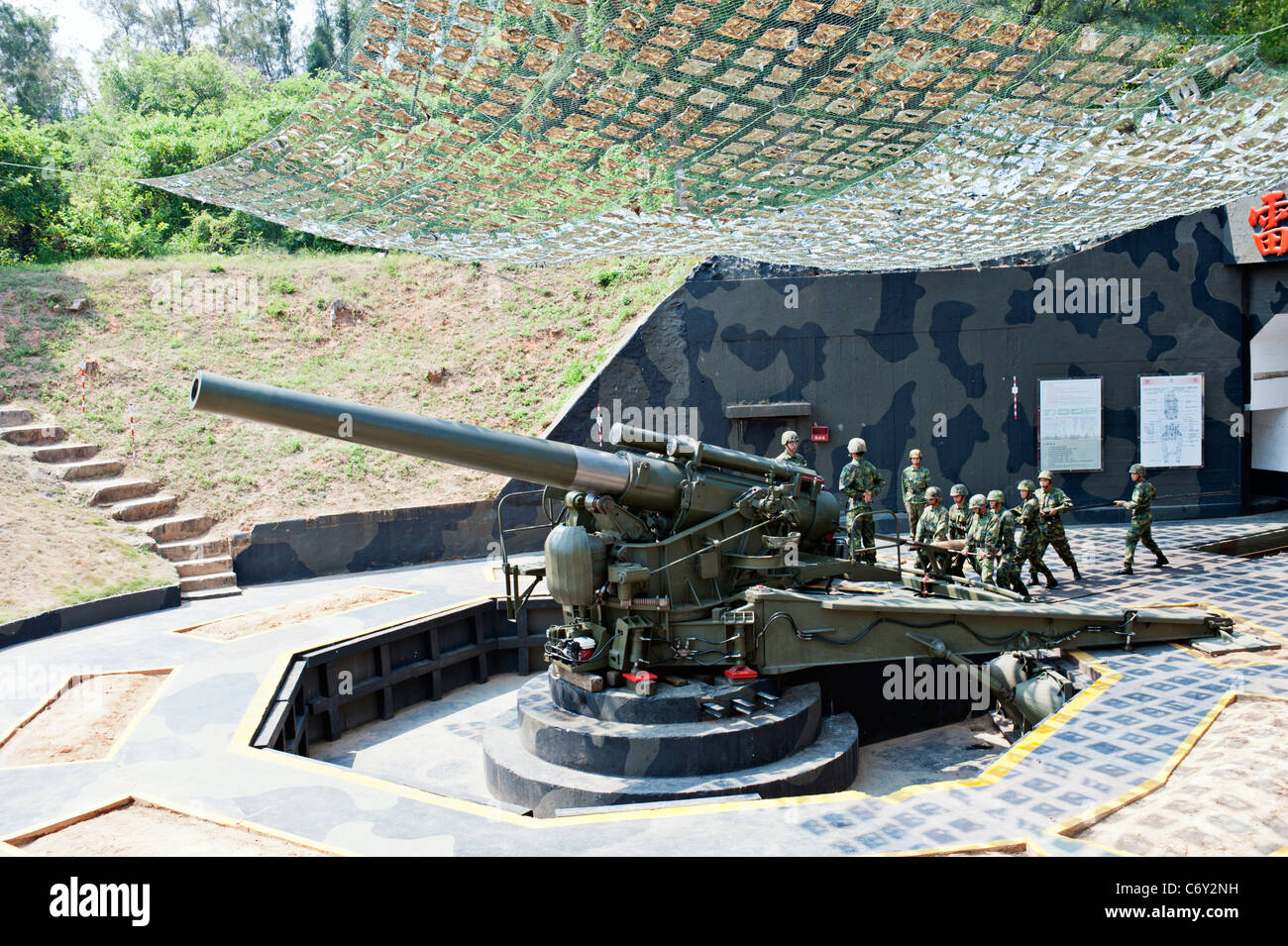
Cool. Thanks.
Although the NK stuff looked like a bog-standard 105-ish mm howitzer; totally unsuited for aimed fire at ships. It’d make an effective harassment weapon, but little more. Especially against a modern navy with long range weapons.