They are both solar panels & heat radiators.
Allegedly.
If TIE fighters weren’t built out of tissue paper, you might argue that the panels provide protection to the pilot and the core systems of the fighter.
But I do agree that the canon explanation has always been solar panels. TIE fighters were meant to be cheap and numerous and to operate dependently on large star ships like Imperial Star Destroyers. By dropping the hyperdrive and the shields, you have a much lower power requirement and can therefore also drop your fuel and reactor. Since the Empire has a large fleet of capital ships, this is a viable strategy. TIE fighters would be almost useless to the rebellion, so they stick with alternate designs that are self-sufficient.
Of course, a lot of this is missed by the movies themselves. TIE fighters don’t appear in overwhelmingly large numbers. They don’t show much more maneuverability than much heavier enemies.
So… in the end, they did it because it looks cool. That’s always the answer in Star Wars.
Look, TIEs have no shields, no armour, no missiles, no hyperspace, no life support system, no targeting system beyond eyeballing it and guns that might as well be firing BBs. Their only strength is that they’re very cheap and replaceable. The pilot not seeing just how boned they are at any given time is a feature, not a bug 
“Ooh, butterfly!”
How 'bout a fanwank? The rebels have to base their fighters on planets (or moons, of course), so they need ships that can take off from the ground and fly through atmosphere to get to space. The Empire bases their fighters on larger ships and space stations where they fit into some sort of docking clamp. Without the need for landing gear, or to operate in an atmosphere, of course the design is going to be different.
And I wonder if something like that didn’t happen in real life. In the first movie, there are scenes in the rebel hangar before and after the Battle of Yavin. The designers and model makers had to create ships that could land on a flat surface, the canopy had to open, and the pilot could climb down and rush into Leia’s waiting arms. The movie doesn’t show a hangar full of TIE fighters, and so they didn’t create a design that could do that.
Unfortunately, this and this put the kibosh on both the “Don’t need a hangar,” and the “Doesn’t work in an atmosphere,” parts of your fanwank.


Except that essentially identical TIE fighters do operate in atmosphere in SW:TFA
ETA: ninja’d
And this puts the kibosh on “no landing gear”. The parts on the lower right tree, above the “Star Wars Model Kit Gallery” are the landing gear parts.
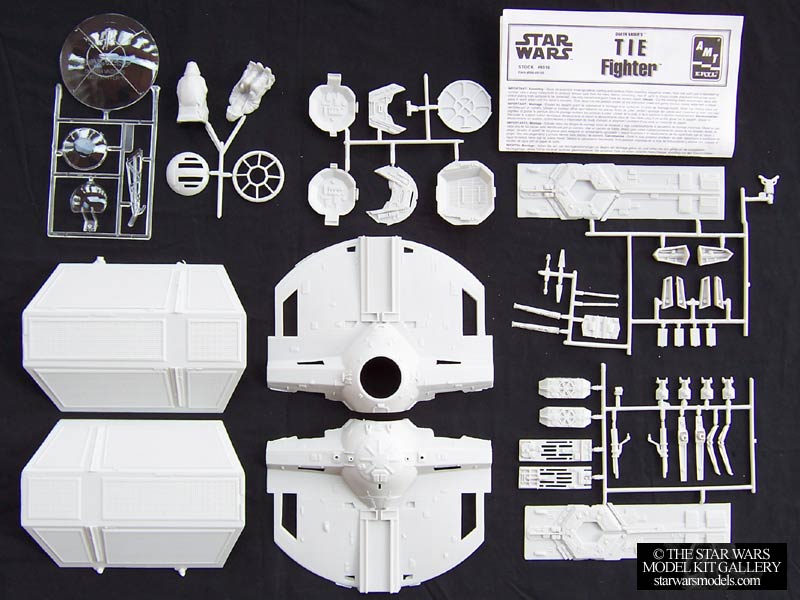
And I know MPC wouldn’t lie to me!
It might have made some sense if the big panels were some sort of grav repulsor that made TIE fighters extremely maneuverable; but
Which is the only explanation for BB-8. Even if you could build a droid like that, what would be the point?
If they’re going to call them “tie fighters” they need to make them look like a bow tie. It is all very dapper.
Yeah, I was pretty sure they’d have done those at some point during the franchise, but I still wonder if that was part of the thinking back when things were being sketched out for A New Hope. Plus, as someone said upthread, they needed to be easy to tell apart so the audience would know what was happening during the battle scenes. And the rebel fighters look somewhat like actual fighter aircraft (pointy at the front, etc.) so we’d identify more with them.
I’d highly, highly doubt it. I cannot imagine that Lucas, McQuarrie, or the ILM team were giving much, if any, thought to anything other than the story at hand when they were making their design choices.
There’s no way our, current* ion engines could propel a ship as fast as a TIE fighter. They’ve obviously solved that problem.
*Note the comma here.
One of the weird things about the Star Wars universe. Nobody wears bow ties, and their alphabet doesn’t have Xs or Ys in it, so what are their spacecraft really named after?
TIE stands for Twin Ion Engine. They may not have X and Y in their alphabet, but surely they have a phrase to denote the shape of structures such as X, Y, T, etc. And that, of course, gets translated into our familiar letters.
Easily fanwanked.
The easy fanwank for that is that there are sensors on the outside of the panels that relay necessary information to the pilot’s HUD. There is no need to visually detect things when the sensors do it better.
Well, Vader’s personal fighter is considerably more advanced, in many ways, than the typical ones that operate in swarms of thousands, so it doesn’t necessarily mean anything that his has landing gear. And the TIE hangar we saw in The Force Awakens didn’t have them just sitting around on the deck like X-wings do; they were mounted in special racks on the walls. So that’s still consistent with the “no landing gear” idea.
I can’t just brush off their atmospheric operation in that movie, though.
Does SW canon provide for some kind of antigrav system? That’s the only thing that could keep Star Destroyers up in a planet’s atmosphere, too, I’d think.
Absolutely. Repulsorlift tech is the SW “antigrav”; it’s used in speeders (landspeeders, airspeeders) and floating droids, as well as for non-aerodynamic flight by starships in atmosphere.
I have to admit I enjoy these ‘fanwank’ threads, though its usually obvious more thought has been put into the explanations than the creators of the original movies ever did. 