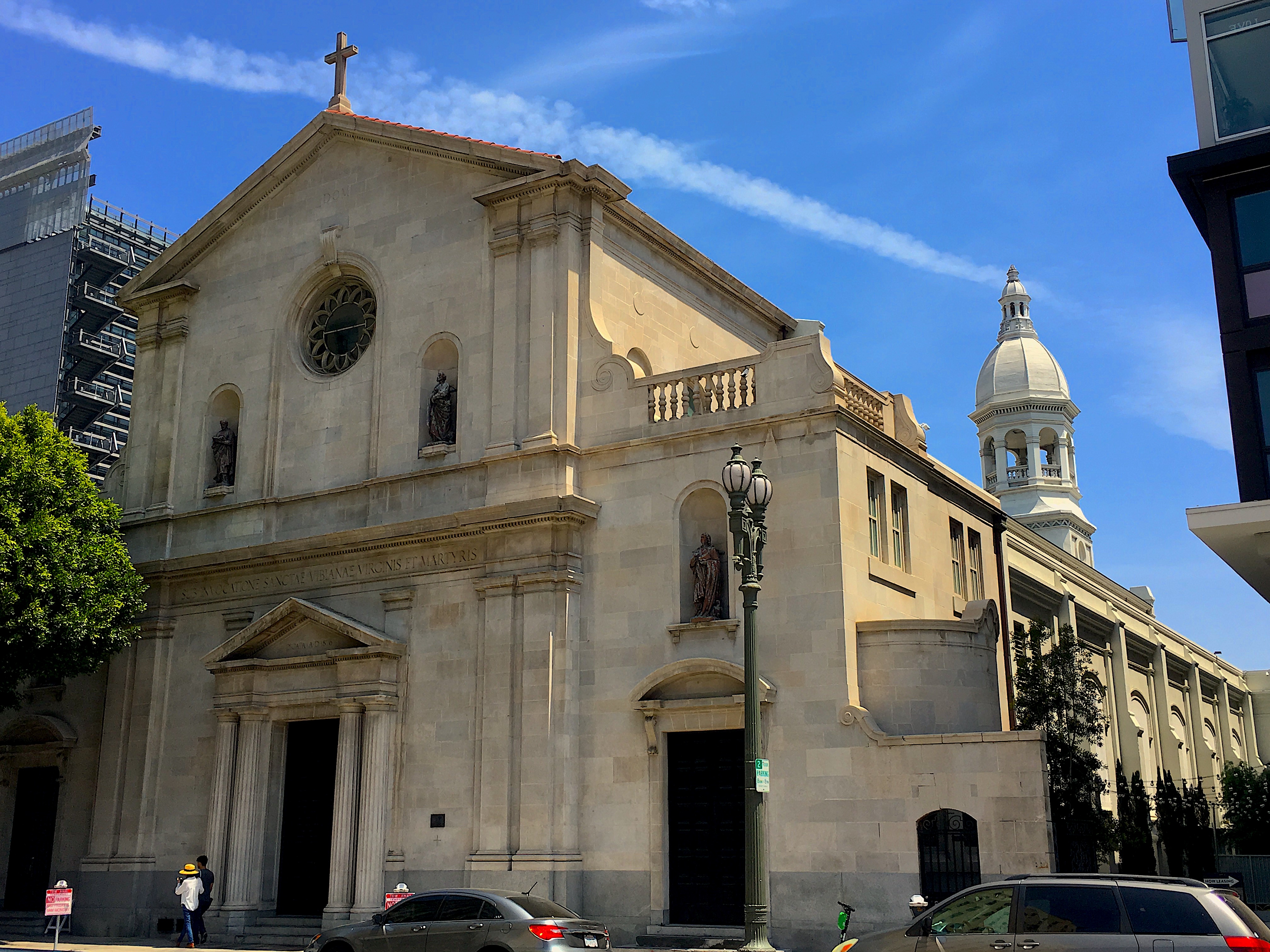
Okay, but you originally said they “must” be shaped like a cross. I was going to comment on this but he beat me to it. “Typically,” “commonly,” “conventionally,” sure. Must? No.
Thanks for mentioning this. The cathedral in Aachen is gorgeous, absolutely spectacular (and with a genuinely interesting historical pedigree to boot). Well worth a visit for anyone in the area. Town’s pretty cute, too. Nice Christmas markets.
Now that you mention the YMHA (Young Men’s Hebrew Association) I’ve heard of those too. Yes, nowadays the Y is a secular organization, which is why it’s been renamed just the Y.
I do remember the old YMCA and YWCA buildings that had housing, usually for single people who were new to town at one time, or in many cases more recently just got out of prison or who would otherwise be homeless.
I asked if this Y would have any housing, and they said they wouldn’t, although they would certainly refer people to local agencies if they needed that service. They also told me that there was a hard-to-access quasi-apartment that at one time was occupied by a caretaker, who lived there rent-free in exchange for doing that. There was no way they could bring it up to current codes without spending more money than they could ever recoup, and decided the most likely future use for it would be long-term or archival storage.
Me too. In fact in my experience the answer to ‘what’s that weird-shaped building over there?’ often turns out to be ‘ohhhh, it’s a Catholic church/cathedral’
Houses of worship in general seem to be the same way nowadays, and a lot of it is to be in compliance with modern building codes and ADA regulations.
The synagogue-turned-Y is on 3 levels and had to put in an elevator. TBH, I was surprised they didn’t already have one. It did have ramps, both inside and out.
My BFF, a lifelong Catholic, recently mourned the destruction of the church he attended as a child. However, inspectors found black mold, and even if it hadn’t been for that, retrofitting it would have cost more than tearing it down and constructing a modern building. They did offer fixtures for sale, and I think the HFH chapter in a nearby college town took some copper pipes, doors, and other things they could use or sell.
It was very controversial when the design was made public, and when under construction. But in the 20 years that it’s been around, people have gotten used to it.
The Archdiocese of Los Angeles specifically wanted a modern design to indicate the Church was with the times.
The cross design for cathedrals (and indeed, many churches) was a mostly medieval tradition. The cross motif is obvious. The assorted parts of the ceremonies and their participants was determined in part by the fact this was a common layout. (Choir off to the side, altar in the nave, altar rail, tabernacle to the right, two towers surrounding the entrance, etc.) Churches such as Haiga Sophia (a cathedral before it was made a mosque) are more in the round tradition and Orthodox seem to follow a different tradition.
But it’s a tradition, not a fixed rule. There’s a similar tradition for mosques, with facing Mecca, the steps to the pulpit(?) for the imam, etc.
Which brings up the question - is there a traditional pattern for synagogues, or was it simply any shape of meeting hall? The cathedrals are huge and ornate because this was the crown jewel, so to speak, of official state religion in the middle ages and so something where much money and effort was spent.
(As someone remarked about touring historical Europe, “it was an ABC tour - Another Bloody Cathedral, Another Bloody Castle…”)
The orthodox synagogue my grandfather was president of was built in 1927 in a traditional Sephardic style:
The men sat down stairs, the women on the balcony. The bima is raised in the centre of the congregation.
In stark comparison, my Reform synagogue was built 10 years later and modeled on Temple Emanu-El in Manhattan but known derogatorily as the Church on the Hill:
In my city one of the original synagogues, built in 1870, was converted into a nightclub. For a decade or so it was called simply “The Synagogue” and sported a neon Star of David. It changed its name more recently but is still a nightclub. The building itself is heritage listed. The current interior is described as “decadent”.
Back when it was still The Synagogue I saw some pretty good music there. I was never into the nightclub scene, but the occasional touring band would play there. Saw Charlie Hunter there, which was pretty fabulous.
AFAIK Catholic churches have to be “deconsecrated” by a ceremony with the local bishop(?). Not sure how involved it is. Do other sects have similar ceremonies? I don’t see some of the Protestant sects being anywhere as organized or dogmatic…
I find this for example, about the Hagia Sophia in Istanbul (not Constantinople…)
It became a museum in 1935 after the decision of the secularist Turkish government under Kemal Atatürk in 1934. In July 2020, the Islamist Turkish government under Tayyip Erdoğan ordered the Hagia Sophia to be turned back into a mosque following a supreme court annulment of a 1934 presidential decree that made it a museum.
Seems all it took was a government decree each way?
The Temple in Jerusalem (the Beis HaMikdash) was not a synagogue in the sense that we have it today and calling it an “ornate” Temple as compared to today’s is misleading.
It was a place where sacrifices were brought and other religious rituals were performed, but it was not a regular place for prayer, community meetings and other functions that synagogues and temples perform today and have for the last 1800 or so years.