Why is there a shortage of doctors? At least UK and Canada? Where it months waiting list for knee or hip surgery? Why does it take month, some times many months to see a specialist.
Why only 2 or 3 doctors working in the ER? With 60 people line up to see a doctor?
Why is it when doctor order tests it could be some weeks before you go for the tests like CT scan or blood work so on and than some weeks after to you go and see your doctor.
But world leaders get this all done in the same week.But the public has to wait to see a specialists, than wait for when opening comes for the test like CT scan or blood work:eek::eek: than wait some weeks than see the doctor for the test results.
What up with putting people on stretcher in the hallway of the hospital.Where some people have been like that for day or two. What is up with hospitals that go on critical care bypass for the EMS crew unless you a code 1 patient.
There was a story some time ago, I think it was in Toronto a guy got shot he was close to a hospital and the hospital was on critical care bypass and the EMS crew took him to other hospital way far out and he died. Than the government ruling after that the hospital cannot do it any more if you a code 1 patient.
There was other story guy had waited two days in ER.
Why is lung cancer survival rate much worse in the UK than the US?
Hah. Thanks for helping me find yet another way to put off re-designing my poster for a conference next week…
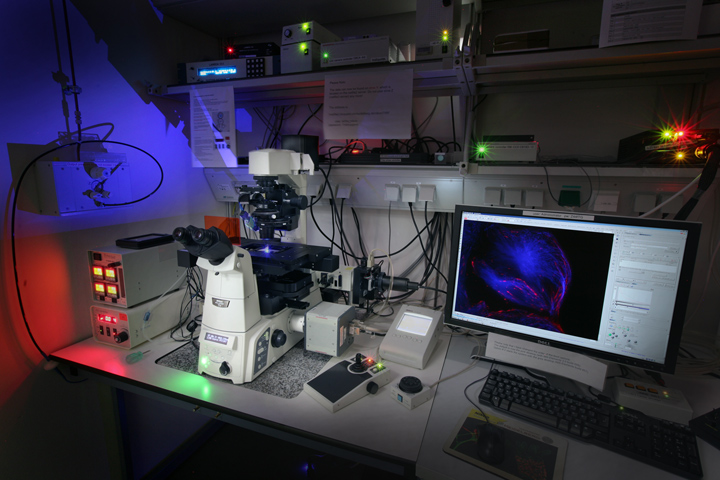
I’ve spent many quality hours in dark rooms filled with microscopes like this, lit only by flashes of laser light scattered by the sample, blinking indicator lights, and (hopefully) a pretty image of the sample on monitor. It’s one of the few things that even slightly resembles the movie lab aesthetic. However, there are only zombies in those rooms when I’m catching up on Walking Dead episodes during an hours-long imaging session.
(Though I usually I go for lighter entertainment when alone in a dark room…)
HHMI does have their own research facility at Janalia Farm (cue angelic choir). Wiki sez there are about 500 people working there, which probably means there are a few dozen principle investigators, each running their own lab.
But is that not the problem is it is too specialized? example analogy, would be in movies car maker scientist would make a car but in the real world you have guy work on door, other guy work on trim, other guy work on window, other guy paint, other guy work on the electronics, other guy work on the brakes, other guy work on the spark plugs so on.
If you do that with research and drug design bringing new drugs to the market to cure disease and illness you going to need millions of people. And this approach may not be good.
Specialization can be taken too far, but without specialization we’d have absolutely no hope of advancing modern science. Biology in particular is far more complicated than any single person can comprehend.
A car is a device designed by clever people, using tools and knowledge passed on by other clever people. There is not a single part of a car that is impossible for a person to understand. All the parts work together in complicated ways, but clever people have figured out how to manage complexity through a mix of specialization and good engineering practices so that no one person needs to know every detail about how the car works.
A single cell is far more complicated than any device that humans have ever invented. Cells arose by processes that have absolutely no regard for making it easy for clever humans to understand them. Without specialization we couldn’t even begin to figure out how a cell works.
As I remember seeing in one scene, you had a lab that had the isolation stuff, test tubes and blinkenlightenmachienen and then there was a side area of desk farm. It would make great sense to me to have said lab area surrounded by the record keepers, “paper researchers”, logistics secretaries and such in proximity to the high tech test tube pushers area. I could see this in clumps on floors - cancer has 4 or 5 research groups, influenza has another floor with a cluster of research groups, and the top floor with no labs is reception and shipping/recieving and other administrative with no lab needs.
I still believe there are more than enough people with undergraduate and graduate degrees who would be willing to work in R&D, there just aren’t the jobs. There are also people who don’t have degrees in those fields who would be willing to be trained in them if they thought the jobs existed. The problem isn’t a lack of human talent, the problem is a lack of high quality jobs.
As far as doctors, here is a list of physicians per capita.
Canada has about 21 per 10,000 people. That is on the lower end for wealthy nations. That may be part of the problem, but I’m not sure why. Canada should have as many talented, educated people as Iceland or Spain, who have 2x as many physicians per capita. There is probably something about the medical school system and residency system that limits physicians there but I don’t know. I’m certain Canada could find an extra 1-2 people per 1,000 who are talented and driven enough to become a physician. If they could, they’d go from the low end to the high end of OECD nations in per capita doctors.
I was told by Canadians that the main problem with their system is that people opposed to it in politics try to cut funding for it. I’m not sure if that is why there are all the problems you are seeing.
As far as US vs UK statistics, you have to consider in the US we spend way way more on health care. We spend about $9000 per person per year. in the UK they spend about $3600. So if there are better survival rates for some kinds of cancer, the fact that the US spends over twice as much could be part of it.
According to this article part of the problem could be that because of how our system is run we overdiagnose cancer. So yeah we have more cancer survivors, but that could be because we are more likely to label every abnormality as cancer.
If so, I wouldn’t call that a success story. Technically, by the time a person is in their senior years a large percent will have abnormalities that you could label ‘cancer’, but much of the cancer will not cause problems before the person dies of something else. Doctors who insist on treating every abnormality aren’t doing anyone (but themselves and the companies they work for) any favors.
As I noted above, something like “lung cancer” is not a single disease. It’s too general.
The movie researcher doesn’t design “a” car but all cars, trucks, tanks, trains, etc of any kind running on any fuel running anywhere in the world at any fuel economy. That’s what you are expecting with your “lung cancer researcher”. A very general, generic situation.
To expand on it, you are expecting the real world automobile engineer to design the engine. And also the electronics (which includes several hundred chips and the programming thereof). And also the hybrid system for those models if such exists. And to handle running on ethanol or gasoline equally. And the frame, including the materials compositions. And also be able to deal with the company’s SUV and minivans that aren’t really similar to the existing car but hey, an automobile engineer should be able to engineer everything in every type of vehicle, right?
There’s no “single” lung cancer. There are several types.
There’s a reason why design teams have multiple different engineers. Each is going to have their own function. Somebody who can program electronic components isn’t going to be expected to work on fuel injection and vice-versa.
But that’s what you are expecting of “lung cancer researchers”. You want each one to be so generalized they can do all these different things that may involve chemists, biologists, computer programmers, and who knows how many other disciplines.
As I mentioned above, that’s basically expecting every “researcher” to be MacGuyver. There’s an expression “jack of all trades, master of none”. Rather than that, you are expecting researchers to be “master of all trades”. That’s hardly realistic.
With conditions like skin cancer or thyroid cancer, a tiny minority are really deadly but the majority are not. Not all cancer is the same. Someone saying you have ‘skin cancer’ could mean you have malignant melanoma (the bad kind) or it could be one of the fairly non-lethal forms which make up the majority.
Cancer is complex. Treating every lump or abnormality as a life threatening issue does more harm than good since there is a lot of physical and psychological damage that comes from being diagnosed and treated for cancer.
Canada is not AFAIK actively discouraging doctors. One problem is that doctors and nurses here can move to the USA, where the job is somewhat different but the pay is higher. (A fellow who lived down the street from me told me his 3 daughters graduated as nurses, went to the USA, and came back within 10 years because they couldn’t hack the job of telling sick people to go away because they had no coverage).
research - pure science, the thing that makes breakthroughs - AFAIK in medicine is like in the rest of science. A very bright person with PhD has an idea or wants to check something that is still unknown. (“If pancreatic cells from another person are attacked by the local antibodies, perhaps we can use this scheme to implant but protect them…”) They devise an experiment, then sell the idea to a governing body to get a grant. This pays for salaries, lab equipment, lab space, etc. to perform the research. A scientist might have several of these on the go. I had a relative researching for Bell labs back in the day, and this is essentially what she did.
For the “development” side of things, the area of study may be assigned. “We want you guys to look at a lighter, but stronger frame made of steel wrapped in carbon fiber” or “theoretically this chemical should bond to this receptor and reduce pain. test this, and see if the benefits outweigh the side effects.” The same process applies though - “here’s our project, you guys figure out what meets our need for this piece of it and then we’ll figure out if that is practical to manufacture in quantities.”