I once volunteered for a research project at our Transport Research Lab, looking at Dutch-style roundabouts incorporating a dedicated cycle path. It never occurred to me to do anything but go round clockwise (i.e., on the left), but then I tend to assume road/lane discipline means “If you wouldn’t do it driving a car, don’t do it on a bike”. Even so, one of the researchers told me several bike users would go round the other way if they were told to use the right-hand exit.
Nonsense! That rule applies only to 4-way stops. At a stop sign facing a busy street where the other traffic has no stop sign, you stop and watch the oncoming traffic on the left waiting for a break in the traffic flow. A roundabout is exactly the same – the traffic in the roundabout has the right of way, and traffic entering the roundabout faces a “Yield” sign.
Since a roundabout doesn’t legally require a full stop if it’s not necessary, but only a yield to traffic, they’re more efficient than stop signs or lights. My neighbourhood has some roundabouts although they’re seemingly placed at random. Their disadvantage is that they take up more space than a normal intersection, and something has to be done with the space at the center. In our case, that space is landscaped with plants and shrubs, which is pretty but costs money to maintain.
Please don’t put links to paywalled articles. Anyone who doesn’t view FB can’t view things there, just like one can’t view articles to a newspaper they don’t subscribe to.
No, not all the time. I can think of at least two where the main road has the right of way, which means cars already in the roundabout have to yield to those entering from a certain direction.
Those two also have multiple lanes & are both uneven entry/exit points, meaning not 90°. I never know which lane I should properly be in. If I want to take the third exit if I’m in the inside lane in the beginning to not be in the way now there may be a car in the outside lane that I need to navigate around to exit, & if I’m in the outside lane & wanting to continue maybe the car on the inside lane wants to exit. There are no standards which makes for chaos.
One of those two also has a traffic light approaching it from either end of the main road; there is no intersection at that traffic light but there is a sign on the light about “Light controls flow into the circle” What is the point of having the ‘efficiency’ a circle if they still need a traffic light to maintain that efficiency?
The main objection to rotaries in this household (by Mrs. J.) is that idiots don’t know how to use them, increasing the risk of accidents.
There seems to be a municipal fad for installing them, even in places where intersections have not proved a particular hazard.
It’ll be the roundabout
The trip will make you out-and-out
I spend the day that way
Call it morning driving through the sound and in and out the valley
- Yes
I don’t dispute your claim, but that directly contradicts what I wrote which is the clear policy here in Ontario. Requiring vehicles in the roundabout to yield sounds horrendously unsafe and it’s probably a case where a roundabout was a very bad idea.
Indeed. But roundabouts work fine when there are consistent standards, and because of the landscaping at the center, are actually quite pretty.
The one rotary near me that had those in the rotary yield to the outside traffic has recently been replaced by a light-controlled intersection. That one always sucked, and was a bad choice for a rotary.
I was living in the small town of Port Townsend, WA when it got its first roundabout. The very vocal opposition began before construction was even started. A Victorian hardware store on one corner lost two of its thirty parking spaces to accommodate the roundabout. They voluntarily devoted four additional parking spaces to accommodate a huge, ugly sign decrying the injustice of it all.
True. There’s a roundabout near me that I use all the time, and I always keep a careful eye out for oncoming idiots who may not know I have the right of way or don’t see the “Yield” sign.
Also true. The one near me is at the intersection of a residential through street that has fairly little traffic and another street that has hardly any traffic at all. The roundabout really seems to be there mainly for decoration, and an excuse for the city to plant shrubs and flowers and raise property taxes.
Parts of Missouri are going all-in on alternative (for lack of a better choice of words) traffic management systems. Rolla, for example, is installing roundabouts hither and yon. At least one town near me has instituted the Diverging Diamond Interchange.
These things can be tricky for drivers who didn’t grow up learning to navigate them.
Oh yeah, I was going to ask what all these roundabout haters will do when they meet a diverging diamond. After driving through it once or twice, it turns out to not be a big deal, just follow your lane, like you do anyway. If you want to go left, then get to the left, and it so happens that your eventual left turn does not need to wait at a light.
Roundabouts are very common, particularly in new residential construction, in these parts, and they seem to work fine. I suspect part of that is because Boulder drivers natural instict is to yield to everything, regardless of who has right of way.
Agreed, but it goes against everything I’ve ever been taught to drive on the left while opposing traffic comes at me from the right. It feels just so, so wrong.
Ha! I wonder how roundabouts would work in Boston, where drivers yield to nothing!*
* I do not live in Boston, but I have many times had the misfortune of having to rent a car at Logan and then had to engage in warfare with Boston drivers simply to get to my destination. A particular nightmare from the airport was a merge to get into the lanes for the Callahan tunnel. None of these fuckers will let you in. No one. I’ve never seen anything like it, not even in Montreal where all the drivers are insane.
In Edmonton back in the ‘50s, we had a City Traffic Planner from the U.K. who championed traffic circles (that’s what we call the two-lane intersections with a roundabout) and at one point had about 20 of them. Over the years most have been converted into conventional intersections and there are only about 6 left. This is because of the number of minor accidents caused by drivers not knowing the rules.
The main problem is the rule that the car on the right always has to yield to the car on the left. That isn’t always observed and fender-benders result.
The rules (with signage on the road, and in the Provincial Driver’s Guide) aren’t prescriptive enough: they should require the right lane for cars intending to leave at the first exit, and the left lane for cars going half-way or three-quarters. This way there is no crossing against traffic leaving and traffic continuing.
But really there is no restriction for right lane traffic continuing past their first exit… you can do so but you have to yield to a car on the left that wants to leave at that exit… you may have to slow or even stop (not good, rear-ender!) to allow that. And, of course as I said above this rule isn’t known or is forgotten all the time.
We’ve found fewer injuries because it’s less likely for completely broadside or head-on collisions to occur. Collisions are mostly sideswipes. Fewer injuries are a nice statistic to have.
Of course, a driver who decides it’s a good evening for a joyride, who discovers a roundabout where they weren’t expecting one, can do some amazing fixed object collisions. Unsafe speeds and roundabouts do not mix well, even with no other traffic.
Good for people too. Not just statistics. We had a very dangerous intersection around here (West side of the Hood Canal Bridge, for those in the area). Dozens of serious accidents. They finally put a roundabout in, over the objections of the locals. It will save a lot of lives. Personally, I don’t enjoy roundabouts, but they do have use.
I like them ok, though the 3 in short succession is a bit much, luckily the ones around here (and there are quite a few) are reasonably separated. Wisconsin is building lots of these.
Brian
And keeping everybody moving effectively increases the capacity of the road without adding more lanes. During the time the light is red, the street downstream from the light is being underutilized. People assume you need a bunch of lanes to handle more traffic, but really on a street with traffic lights the purpose of the lanes is to hold all the cars that collect at the red light. Then when the light turns green all the cars travel down the street together, traffic engineers call these clusters of cars “platoons”. If you get rid of traffic lights and replace them with traffic circles you eliminate the platoons and traffic just flows continuously, which means you don’t need as many lanes to handle the same number of cars.
Well, Road Guy Rob probably explained it better than I did.
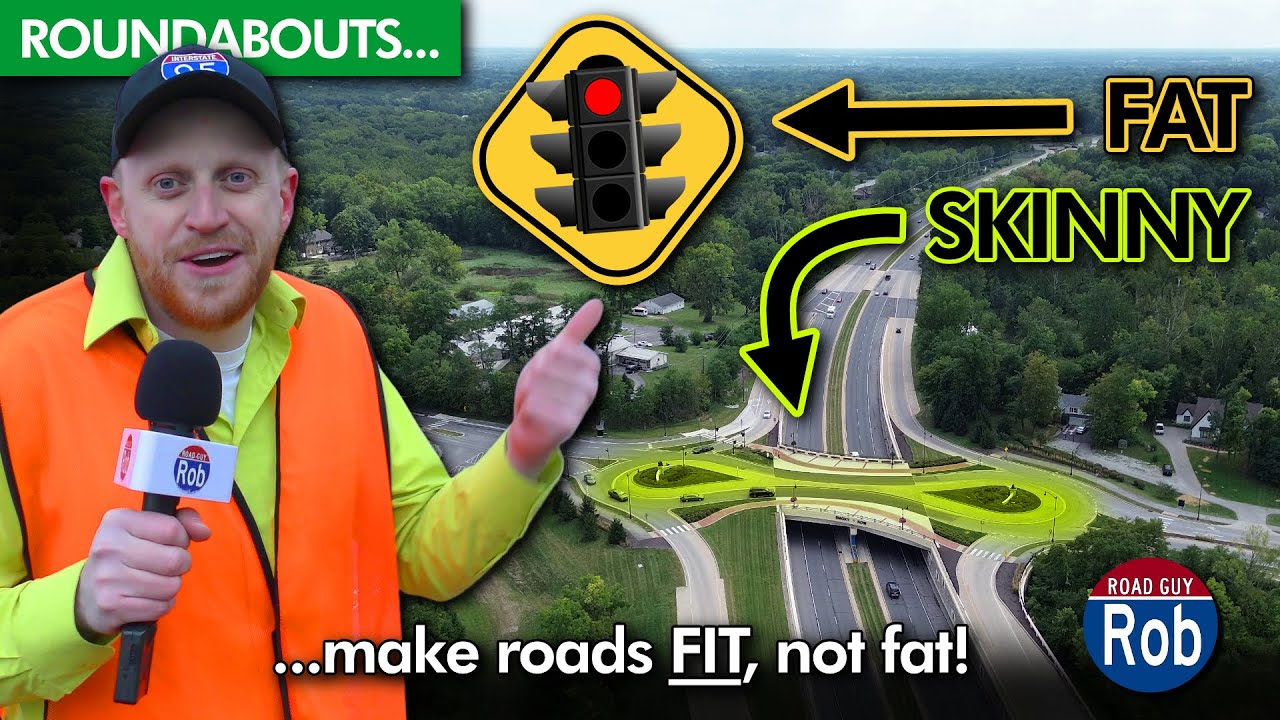
My dad was a traffic engineer for our state’s transportation agency, and he LOVED roundabouts/traffic circles/rotaries. He always said they served many purposes: maintaining flow and maximizing throughput, controlling speeds without undue consequences (unlike speed bumps or installation of stop signs to slow traffic down), reduce collisions, and especially reduce the frequency of head-on collisions. He railed against communities that would install them but didn’t fully understand how to implement them by also installing stop signs on entry legs. The only downside he would admit to is the learning curve of the public at large.
I worked on the land-side of the agency, and we had to deal with the property owners who lost some property to convert conventional intersections to the New Way. That wasn’t always fun.
As an aside, since I grew up with a traffic engineer father, the first time I saw a Diverging Diamond, I almost creamed my jeans. Talk about an elegant solution!
One of the side effects of putting roundabouts on the sorta main roads through subdivisions is “traffic calming” = speed limitation.
e.g. if you put up 25mph signs, pretty soon people are driving 40 through there. Especially folks who don’t live in that subdivision, but use it as a bypass around crowded boulevards leading towards their own subdivision where they drive like they live there.
One way to slow them down is to put up a stop sign every couple of blocks. Another is to install speed humps / bumps / tables every couple of blocks. These moves all but prevent significant speeding. But at the cost of greatly reducing road throughput for people who’re obeying the speed limits.
Roundabouts stop the serious speeders without (much) slowing the honest drivers. Jerks lose; good people win. What a novel and refreshing concept!
We have a few where I live. I like 'em.
If you really want to practice your roudabout skills, visit Sedona, AZ. Good grief, they went crazy with them there on the main drag! I thought my stepmom was going to stroke out navigating them. She really struggled with the right-of-way.