This does seem to be the perception. I’ve found no actual, official NATO statement/assurance they wouldn’t ‘expand eastward’, though as you say they did informally promise this would be the case. The issue, however, was that there were several former Warsaw Pact and former Soviet territories such as the Baltic States that were putting tremendous pressure on NATO to allow them in. It’s not like NATO put a gun to their collective heads and forced them in, quite the contrary…all of these countries requested entry, and they all had pretty good reasons for doing so.
Yes, I missed this one, and it’s definitely an important point. There is definitely some truth to this claim, though the context that NATO intervened in these cases was humanitarian in nature and limited in scope. But I think this is one of the more valid points on the justification for Russia’s concerns about NATO expansion, so thanks for bringing this one up.
Dealing with other points that haven’t received so much attention –
It is true that the USA has conducted wars and occupied several countries in relatively recent decades. I would argue this was not justified but let’s not get bogged down on that point because it’s irrelevant - so what if the USA has done that? Two wrongs don’t make a right. And further the region most directly affected by the invasion of Ukraine is Europe - how the fuck does the USA’s behaviour justify threatening Europe? It’s beyond silly.
As to the NATO point, there are a few things.
the expansionist rhetoric confuses the meaning of the term - expansionism is when a power works to expand its control by coercive means. When neighbouring countries want to join a powerful alliance, that is not expansionism. The more so when they want to join that alliance as protection against the very entity that is accusing the alliance of expansionism. It’s absurd.
there is no evidence whatever that NATO is a threat to Russia. I don’t think a single member of NATO has ever so much as expressed a vague desire to invade Russia since the conclusion of the Cold War, and not much even during the Cold War. NATO has always been a defensive alliance
Overall, it’s just the usual crap trotted out by someone itching for a fight, trying to justify their aggression by baseless allegations they are being threatened by their intended victim. Putin is a dinosaur who spent his formative years fighting the Cold War and can’t get out of that paranoid mindset. He’s like a kid at a birthday party hiding in a cupboard waiting to leap out and clobber someone, long after all the other kids have finished the pillowfight and are downstairs having cake and drinks.
I think it’s simpler: If you believe that nation X is, or once was, part of ‘one people’ with yourself, is it ever right to try to reunite them with bullets?
Well, just in the spirit of devil’s advocacy already established in the thread — there is, in fact, a perspective from which NATO can be perceived as a threat to Russia. A military threat, with the potential for invasion? Of course not.
But a cultural threat? Certainly. As Western countries increasingly press upon Russia’s borders, with all their “freedom” and “prosperity” and “happiness,” the Russian way is undermined, and the Russian people will yearn for something different and better.
This, to me, is the proper frame of mind for understanding the Russian interest in “buffer” zones at their boundaries. It’s not just about having extra land around themselves to force potential invaders to march through an extra couple of hundred kilometers, though that is part of it. It’s also about keeping the pernicious corruptive influence of foreign cultures at a greater distance.
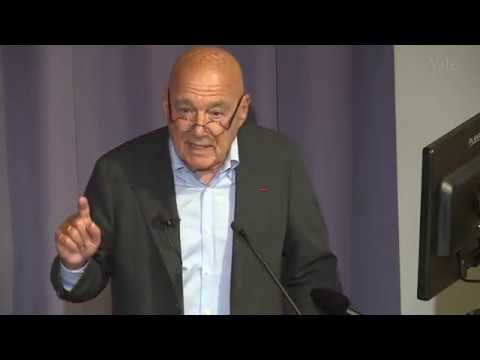
This talk, given at Yale University in 2018, is the best serious view of this topic I’ve seen.
It doesn’t justify current events in any way, and Pozner is very definitely anti-Putin, but he gives a different and thoughtful view of how we ended up in this situation.
It’s genuinely interesting and worth watching.
Vladimir Pozner: How the United States Created Vladimir Putin
(The video is not as long as it looks. The actual talk starts at about 6min and ends at about 40min. The rest is questions from the audience.)
And these sorts of arguments are usually dependent on where you want to draw your historical line. One could argue that one of the Scandinavian countries would be justified in invading Ukraine and Russia, if you go back far enough.
Or that the Anglo-sphere is due reparations for what France did to us in 1066.
Damn those Vikings and Normans for their foreign adventures!
Entire books and academic panel discussions have been devoted to the question of exactly what James Baker verbally offered Gorbachev in 1990 with regard to NATO expansion.
There’s a good argument that he was referring only to NATO expansion into East Germany.
But in any case, the point is moot, because signed agreements will always supersede verbal discussions.
And Russia signed the 1997 NATO-Russia Founding Act, which specifically says that Russia gets no veto over NATO actions.
Moreover, the Soviet Union (of which Russia is the successor) signed the Helsinki Final Act of 1975, which establishes that every state has “the right to be or not to be a party to treaties of alliance.”
You can’t cite informal conversations and ignore signed agreements that say the opposite – that’s a bad-faith argument. But Russia apologists do that all the time.
That might be the emotional reason why some Russians may see it that way but it makes no actual sense. The factors that may be driving places like Ukraine away from “the Russian way” are cultural not strategic. NATO is a strategic alliance not a cultural organisation.
I suppose it could be argued that Russia is justified in invading Ukraine because NATO is a threat to Russia’s ability to impose the Russian way by invading Ukraine. But that is just begging the question.
For the record, I don’t think it makes much sense either. Nevertheless, Putin sees Russia (in the traditional sense) as coming out on the wrong end of a Cultural Victory in a real-world game of Civilization, and he sees NATO as one of the key vehicles with which the West is pressing its advantage. To whatever degree we may think that’s right, wrong, or nutty, that’s where he’s coming from.
Let’s start with the principle that any invasion of a sovereign nation is bad and wrong. Maybe, just maybe, it would be necessary for TRUE defensive purposes? Putin knows this, hence much of his rhetoric. To me, all of the other arguments are false, lame, and/or frankly irrelevant.
He wants to remake the old USSR, or even better the Russian Empire, and install himself as Tsar. Putin the Great!
I was going to link to this in the OP. Thanks for linking to it here. I watched this video a while ago, but it’s still a pretty decent one that gives a different perspective on what’s going on, something I’m always trying to get.
Just for completeness, here is an article that goes into detail about all the assurances given to the (late, pre-collapse) USSR by the Bush administration. There were very explicit and repeated assurances, there can be no disputing this.
To be fair, there never was a formal treaty on this matter. Arguably, any treaties with the USSR would be void after its dissolution, but that same argument would nullify a lot of USSR treaties that the US wanted Russia to continue honoring. So if we see this purely in terms of broken promises, then Russia has a point here.
Then there’s the question of whether Russia’s request was reasonable. Germans wanted reunification, it was already underway, and Russia couldn’t have done much about it except to make it messy and unpleasant. Russia wanted assurance that East Germany wouldn’t participate in NATO, which is silly on its face - how can half a country join a treaty?
Likewise, as the Warsaw Pact countries slowly broke ranks with Russia - they wanted to ensure they’d never again be overrun by Russia. Again, why does the aggressor nation get a security veto on countries it’s already invaded once? These countries are entitled to defend themselves, and it’s silly Russia to argue otherwise.
The stuff about historical rationalizations of Ukraine belonging to Russia doesn’t even bear mentioning. By that reasoning it could be argued that Russia should actually be owned by Kiev, since Moscow was a mere village when Kiev was a regional power center. As I said it doesn’t bear mentioning, but OP addressed it.
After accounting for all that, the only rationale remaining is who swings the biggest stick when trying to enforce their worldview. It’s just pure power politics. From that point of view, NATO’s only culpability is in overplaying its hand. And they did. They lacked the power to make all of their expansions stick. But that’s just strategic reasoning. It’s not really moral reasoning, unless we want to argue that great powers have a responsibility only to make moves when they have overwhelming power to make those moves stick (otherwise, destabilization). I don’t really have a position on that; I’m just saying the argument exists.
Make better TV, movies, fast food and sodas than they have been making, rather than invading their neighbours. That’s the way to equal the little hegemony the US still has.
No, that’s a ridiculous argument that speaks to an archaic authoritarian and imperialist mindset that holds the nation state above all. Ukraine (and for that matter Belarus, Georgia, and the Baltic States) are populated with people and those people have a right to self determination. Countries choose to be part of NATO. Mostly because they choose not to be part of Russia. Russia has no claim over those countries based on some thin historical precedent any more than Great Britain can hold claim over their former colonies United States or India.
That NATO “provoked” Russia into invading Ukraine is about as valid as slapping your wife because she “provoked” you by burning dinner. Of course, people who believe in a “might makes right” sort of philosophy probably would support the aggressor in both instances.
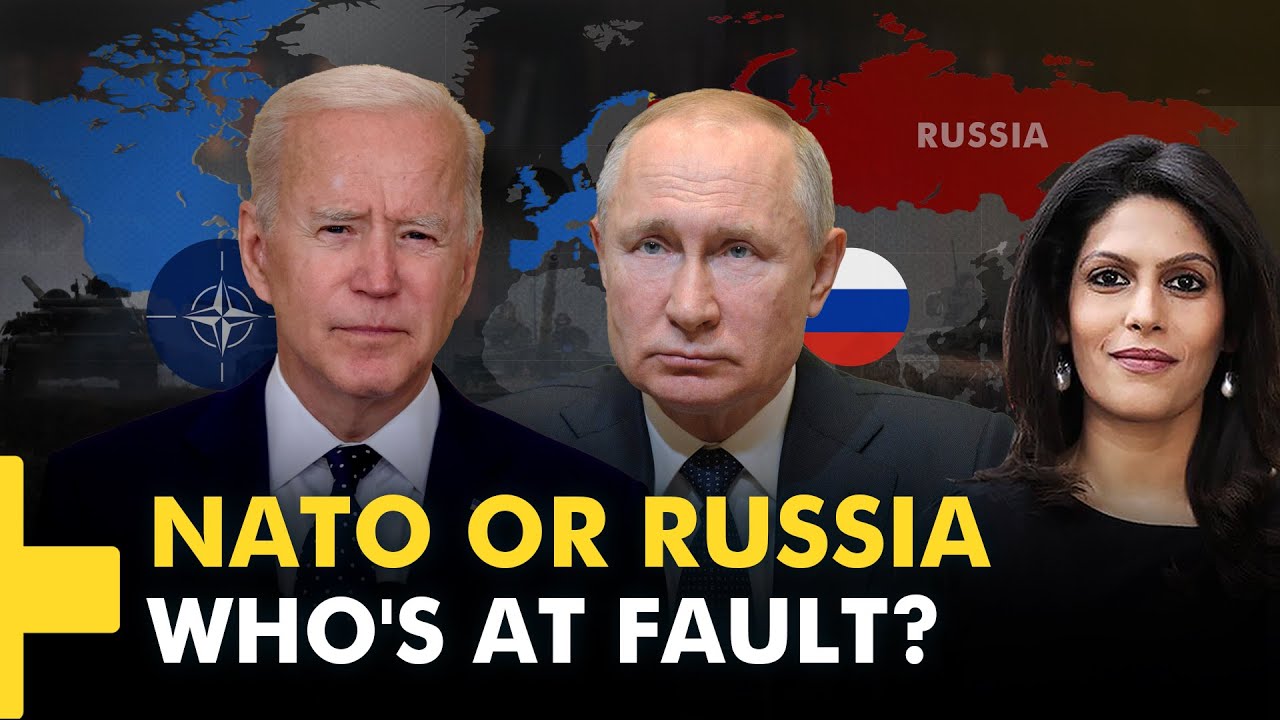
This is a video from WION, which caters to a mainly Indian audience that actually hits a lot of the points I made in the OP. Since I’m being bombarded with Ukraine videos from YouTube (from their algorithm presumably), I’ve been watching a variety of channels lately.
Clearly, WION at least thinks NATO is at fault, though they do start the video saying nothing justifies an invasion. They then proceeded to lay out all the reasons it’s NATO and the US’s fault. I should just link MrDibble’s reply into the comments section, though it would probably be removed.
Just in purely physical terms, Russia is less secure when NATO can base military assets closer to it. The closer nukes can be deployed to Moscow, the more feasible a decapitating strike. Or, setting nukes aside, Moscow is only about 600 miles from Vilnius. Now that the hollowness of Russia’s ground forces has been revealed, Moscow seems obviously vulnerable to invasion, especially that Russia has committed so much of its ground forces to Ukraine.
So it’s understandable that Russia would see itself as encircled and vulnerable. But whether they consider themselves “threatened” depends on how they choose to see Western intent. If they choose to see Nazi Germany as “the west”, then they have strong cultural memory to be very terrified by this. And the US has never shied away from rhetoric decrying communism and Russia as an existential threat.
Plus, the confident assertion “NATO is a purely defensive alliance” collapsed when NATO made its (fully justified IMO) attacks on Serbia, a Russian ally, in 1999. As I said, that intervention was fully justified in a humanitarian sense. But Russia sees Serbia as an ally and a sister-Slavic country. Russia is very accepting of the kind of historical grievances Serbia used to justify its internal oppression. We see this rearing its head in the historical claims of Russia to… well… everything surrounding it.
So to Russia, the Kosovo intervention smacks of the worst sort of hubris and hypocrisy, especially considering some of the atrocities America has been involved in. I have to admit that Russia has point here. America’s strength was built on a genocidal extraction of land and labor that has no historical comparison, especially given that its wealth and strength still sits atop a mountain of that plundered wealth. For it to be credible as an international force for good, it has a steep hill of hypocrisy to overcome.
So, while Russia has some colorable “security concerns”, and the West ought to have made more of an effort to accommodate them, I strongly believe that none of those concerns rise to the level of re-invading countries that it invaded 100 or 80 or 60 years ago.