I dunno. Pre-planned media hoax is much closer to the top on my list. It seems to me that you have to believe either:
a) these two dimwits were actually on a boat in the open ocean for 5 months and never successfully used any of their six communication devices or used the emergency beacon at all. Whether they knew where they were or not, whether they knew how to operate and fix an engine, whether they knew how to use sails, etc., you have to believe they were actually on the open water for 5 months.
or
b) they were not on the open ocean for five months, so a major part of their story is made up.
There are several problems with “a”. Despite what some say about the food situation, I find it incredulous that the two women and two dogs look as they do if they just spent five months on a small boat. I admit I haven’t followed this as closely as some, but what about sunburn, injuries, rashes, muscle tone? But the real question is would anyone not use an emergency beacon within a couple days of losing both your sail and engine propulsion? Also, even if they thought they couldn’t dock at whatever island they said they came to, would anyone then just continue out to sea again? It makes no sense.
And I’ll grant that the author of that detailed take-down got some of the details wrong, but he lists a lot of details. Are they all wrong? For instance, he says that there were no major storms anywhere near them at either of the times when they said they were in a major storm-- Is that accurate? If so, then that alone is enough to cast some serious doubts.
Thats about where I am. 45 ft is not really a small boat though, not easy for one person to sail, unless heavily autorigged etc… You could perhaps drift around the Pacific ocean staying out of the sun, and not really sailing anywhere.
Luffing (pun intended)about, just trying to stay OUT of trouble, but not really with any intentions. Sailing in general, is “fairly” difficult even in sight of land in a light breeze, I mean, ropes and sails?
Sometimes problems pop up quicker than you can solve them, even for the best sailors
haha…seems primitive…
Im remembering a nice beginners mistake, our improperly tied anchor line, over went the anchor…never to be seen again!!! :eek: (short day trip at least…)
I don’t doubt that they will at this point get some kind of media deal. But much of what they’ve said since being rescued has probably devalued that deal. “Plucky sailors who were the victims of bad luck and survived through courage and ingenuity” would have sold a lot better than “Incredible fuck-ups who were responsible for their own situation but managed to survive through blind luck.”
Let’s examine this hypothesis. If not at sea, where were they? It’s been confirmed by the Coast Guard that they contacted their boat shortly after they left Honolulu, and they definitely showed up 900 miles off Japan five months later. (The Coast Guard also says they were in contact with a boat that identified itself as the Sea Nymph near Tahiti in June. But let’s assume for the sake of argument that this was a different boat.) Sailing steadily at 5 knots westward, it would take them over a month to cover that distance in a straight line.
As I’ve already pointed out, surviving on a small uninhabited island would present many of the same challenges as surviving on a boat. One thing we know for sure is that they are incompetent. The main advantage they would have on an island is not having to worry about sinking.
And despite the many islands in the Pacific, there really aren’t that many places you could hide out for five months and expect that you wouldn’t be seen by anyone. About the only land directly between Hawaii and where they were picked up is Johnston Atoll, which is a US Wildlife Refuge. I’m not sure if rangers are posted there permanently but there was an environmental team there in June. There are lots of other islands farther south in Kiribati, the Marshalls, and Micronesia but I doubt there are many that are both uninhabited and would have a reliable expectation of not having any visits by locals or yachters for four months.
This hypothesis requires Appel to have some knowledge of where she might find an island with these requirements when she has never been sailing away from Hawaii. It requires her to navigate to the island and sail there successfully with a single crew member with no experience. When she doesn’t know the difference between Kiribati and Kiritmati, I doubt she has the knowledge to manage this.
Certainly there are parts of their story that are blatantly untrue, like the “force 11 storm.” Other aspects appear to be implausible mainly because it’s difficult to believe anyone could be so stupid and incompetent. But alternative explanations, like they hid out somewhere, require them to be more competent than they appear to be.
Your punch line is at the end. As long as you’re trying to make their behavior make sense, you’re already barking up the wrong tree. They did random shit for random reasons for several months. Attempting to apply logic to their inputs or their outputs is nonsense.
I agree that it’s safe to say they didn’t do anything physically impossible. Like teleport, or sit out in the sun for 5 months with no sign of sunburn. Or live 5 months on one can of tofu.
But so far nothing they’ve said is non-physical. It’s non-sensical, but that’s about what we (or at least I) would expect from woo-driven losers setting new records for Dunning-Krugerism.
Note I’m not saying it cannot be a pre-planned hoax. I’m merely saying now that it takes more skill to plan and execute a hoax than it does to stumble about blindly for 5 months doing random shit. Skill these idjits seem to utterly lack.
Basically, they were lucky losers - they did a lot of dumb, stupid stuff, any one of which could have ended in death, but managed to squeak through. It’s not a hoax, it’s a pair of clueless idiots existing on dumb luck. And six months worth of stored food.
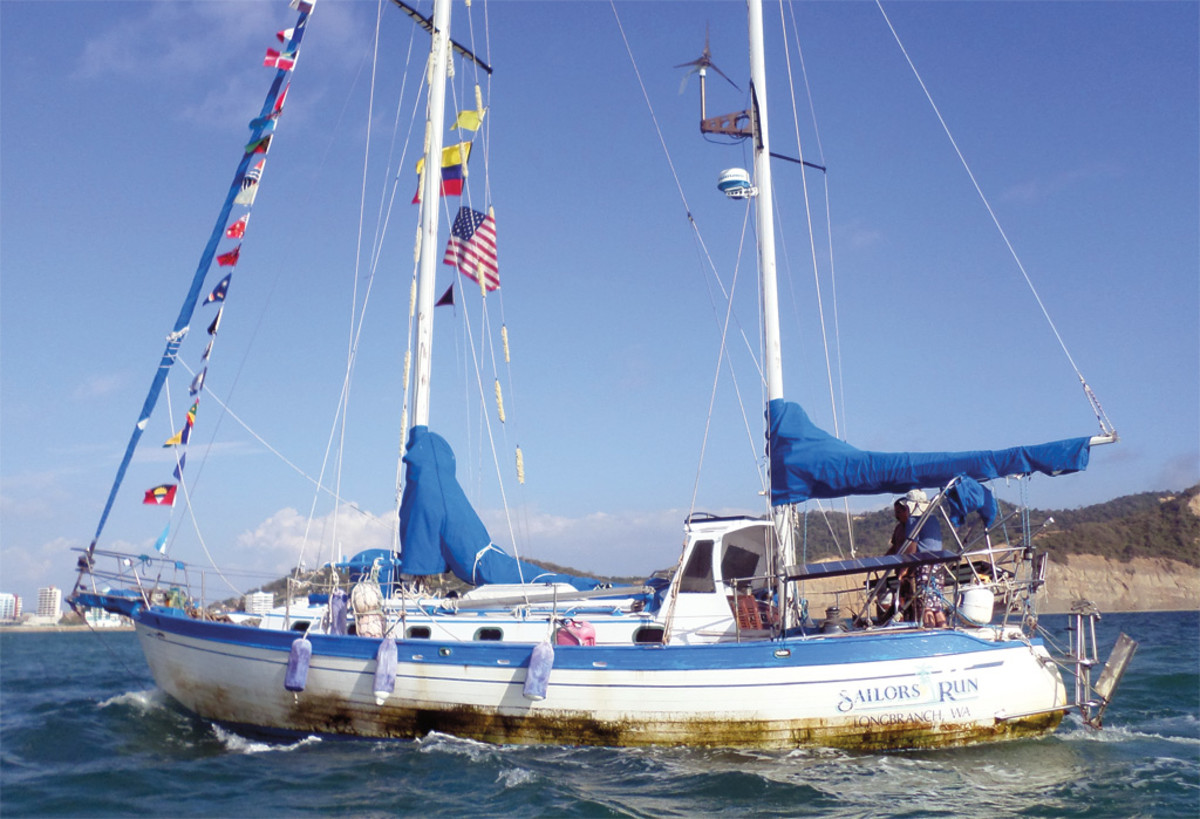
The thing that instantly made me suspicious is the condition of the hull on the profile photo of the boat. There was a lot of seaweed well above the water line and relatively little below it. Now, at and below the waterline, anti-fouling paint would discourage growth of plants and sea creatures. That’s well and good. Above the waterline, on the gel coat surface of the hull, there was quite a bit and it looks like it was well attached and thriving. Much like a stone, a moving hull gathers no moss. So this tells me they’ve been bobbing around somewhere with little to no relative hull speed. Additionally, that somewhere would have to be thick with sea vegetation. Could just be that they were trapped and carried along with the current in a large bed of seaweed, as they claimed per lack of working engine and sails. But it could also be that they anchored somewhere sheltered with a large colony of seaweed and a regular tide that would cause rolling waves when it came in and out.
Disclaimer: While I’ve sailed for many many years and have been a boat owner for a number of those years, I’ve never done an extended ocean voyage, so this may be a normal occurrence in warm waters. But nothing in my general awareness of sailing leads me to believe that anything but a very static hull would experience that amount of macrofouling.
I don’t see why this would be true. Once it gets hold, algae isn’t going to be washed away by seawater. As long as an area is at least intermittently wet, it should be able to support algae.
This doesn’t follow at all. The algae that grows on hulls is not necessarily the same that grows in beds. Objects far out at sea will be colonized and overgrown by algae.
The blogger suggests the algae far up on the side indicates the boat was at some point floating much lower in the water due to added weight. This doesn’t make sense either since in that case the top of the fouling should be more even.
Like I said, I’m suspicious, but far from certain. St. Brendan seems to have been in the water long enough for the anti-fouling paint to start failing.
The amount of fouling on the boat above the waterline appears to be entirely consistent for a boat that has been moving at sea for a long period without maintenance.
You’re correct. It’s used below the waterline. I mentioned it earlier because Sea Nymph’s hull below the waterline seemed in better shape than St. Brendan, for example.
Which only indicates that the Sea Nymph may have had a fresher coat of anti-fouling paint than the other boats and may say nothing about it’s C.O.G. history.
With not much ability to sail the boat is going to only cover a few miles per 24 hours relative to the water surface while underway = mostly drifting. Contrast that with being anchored where every 24 hours it’ll cover a couple miles across the water surface despite the anchor simply by current and tide going by the mostly fixed boat.
IOW, there’s a negligible difference in whether/how fouling will grow. So there’s another “smoking gun” that’s IMO really a mirage.
Yeah, the very first thing I noticed was that the dogs and the women were fat, shiny, and well-groomed. None of them looked at all like they’d even been to sea, much less adrift living on oatmeal.
People who spend a lot of time on the ocean in a small boat, lost or not, tend to look rather crispy. These people looked like they just got out of the hotel shower and were on their way to the pool.
I didn’t need the later information to not feel sorry for them.
Actually, after seeing what the boats of other long distance sailors looked like after months in the water, I suspect that the kind of algal growth seen on the boat tends to confirm that they were moving for much of the time rather than moored. If a boat is moving, even at low speeds, there will be continual splash against the sides which will keep them moist and promote algal growth. A moored boat will rise and fall with the waves so there will be little splash and the sides will dry out, inhibiting the growth of algae.
It wasn’t a particularly small boat. People have been criticizing their appearance as if they had spent five months in an open boat with no shelter from the sun and the elements. Actually it was a boat with a cabin, certainly including bunks with foam mattresses, and an inside bathroom (as Appel has mentioned). I’ve spent time on such boats and they are not that uncomfortable. They would have been able to get out of the sun and the elements.
And anyway, what is your alternative hypothesis? Did they just materialize near where they were found from some other dimension? One way or the other, they spent five months either on a fairly large sailboat or on a small uninhabited island. Considering where they were found, they had to have spent at least several weeks at sea even if they had been on an island. Would they have looked any less “crispy” if they had been on a small island for several months and then at sea for several weeks?
It’s all well and good to say aspects of this are implausible, but then you have to propose a more plausible alternative. I haven’t really seen one. The idea that they were on an island is itself implausible and doesn’t really resolve many of the issues with their story.