I think the Slate compares well to my 1986 Toyota Truck. The one thing the Slate lacks is a long bed option. 7 feet versus 5 feet is a big difference in utility for a work truck. I completely understand why that is a much more difficult option than adding a top or a back seat.
One of the reviews I saw specifically looked at the front suspension with AWD/4WD in mind and concluded it will likely be a future option. The design appears to allow room for a future motor and axles. Perhaps a second motor will arrive in a few years, along with a four door version.
It appears to me that they are emphasizing add-ons and upgrades that can installed at some point after the vehicle has been purchased. Am I wrong to suppose that switching from RWD to AWD would not be an after-purchase sort of modification? In other words, factory options are really not part of their strategy.
That’s the thing that makes me wonder how successful the Slate will be. Lots of people say they want an inexpensive, no-frills vehicle. But then in order to hit that price point they have to leave out features people have come to expect nowadays. Maybe 30-40 years ago car companies could get away with omitting power windows, air conditioning, a stereo, etc. on a base model (I’m not sure if the Slate has these or not; I haven’t looked at the specs. This is just a generic example). But I doubt many people would want a car like that today.
And oftentimes low end cars end up getting a stigma as “cheap cars for poor people”, to the point where people who are car shopping on a budget end up choosing a used car over a basic new car. That was why the Tata Nano wasn’t successful in India.
But EVs, even trucks, are generally not light in the rear. Their batteries are usually placed so the center of mass is in the middle of the vehicle, not the front end.
Personal update: I cancelled my original $50 reservation today, which will be refunded within 10 business days. The soonest I could have gotten one is about a year from now, and I would have to lock in the purchase (but not the accessories) within a few days. I just can’t justify buying a vehicle that I can’t even sit in beforehand. If it’s still around in 2-3 years, I’ll probably take another look.
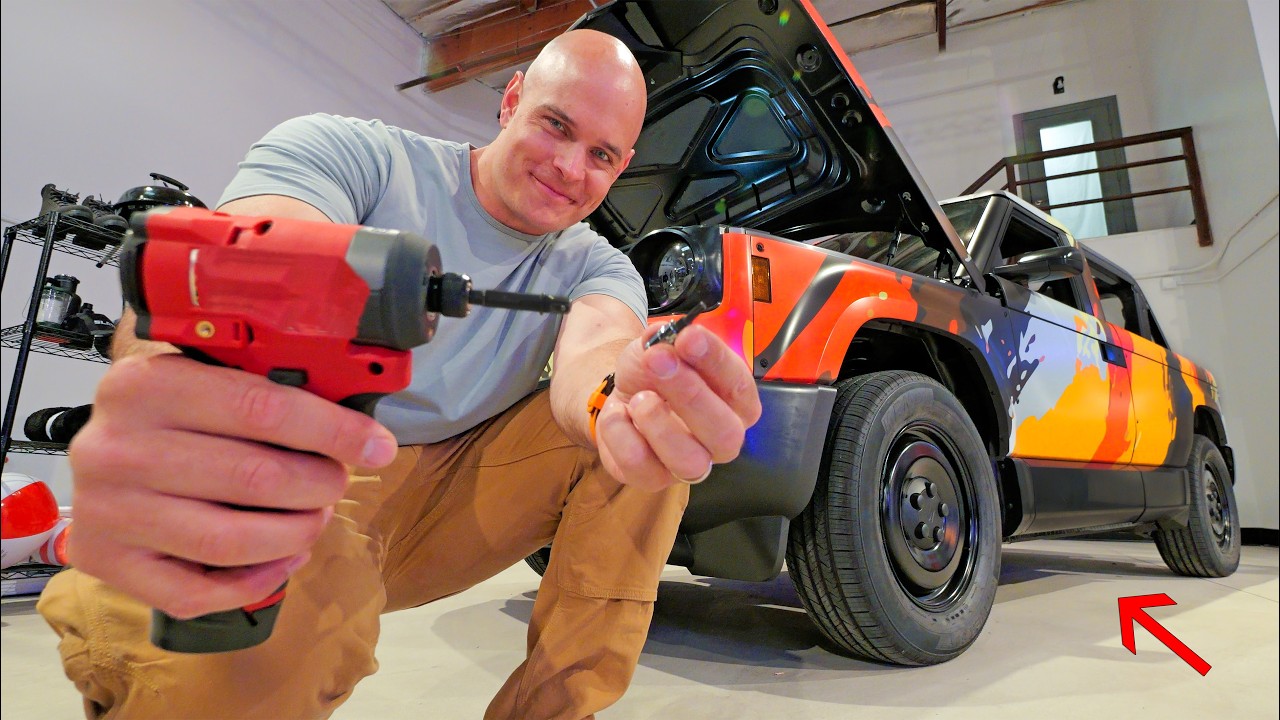
JerryRigEverything has a video out on Slate. He mentions the exposed body fasteners and talks about how easy it makes doing your own repairs or even swapping out body panels and other exterior features with your own, in some cases with 3D printed parts.
I’d be concerned about parts getting stolen off the car. If body panels can be removed with nothing more than a torx bit, people are going to remove them.
I haven’t watched the video, but I’d assume that all of the body panels have one or more fasteners hidden under locked surfaces. Is that the case? Like, almost all cars have easy removable hoods, it’s 4 bolts on the hinges and off it goes. But you have to pop the hood first, and if the doors are locked you can’t access the hood release with breaking something.
Likewise, most car fenders are trivial to remove, but there’s a row of bolts you can only access with the hood up, and another set of bolts that you can only access with the front doors open.
So I guess the question is, can you just walk up to a locked Slate and start unbolting stuff? Or would you need to break into it first? If it’s the latter then I wouldn’t be concerned, because every car can have parts stolen off it if you break into it first, and it’s not a huge concern for anyone.
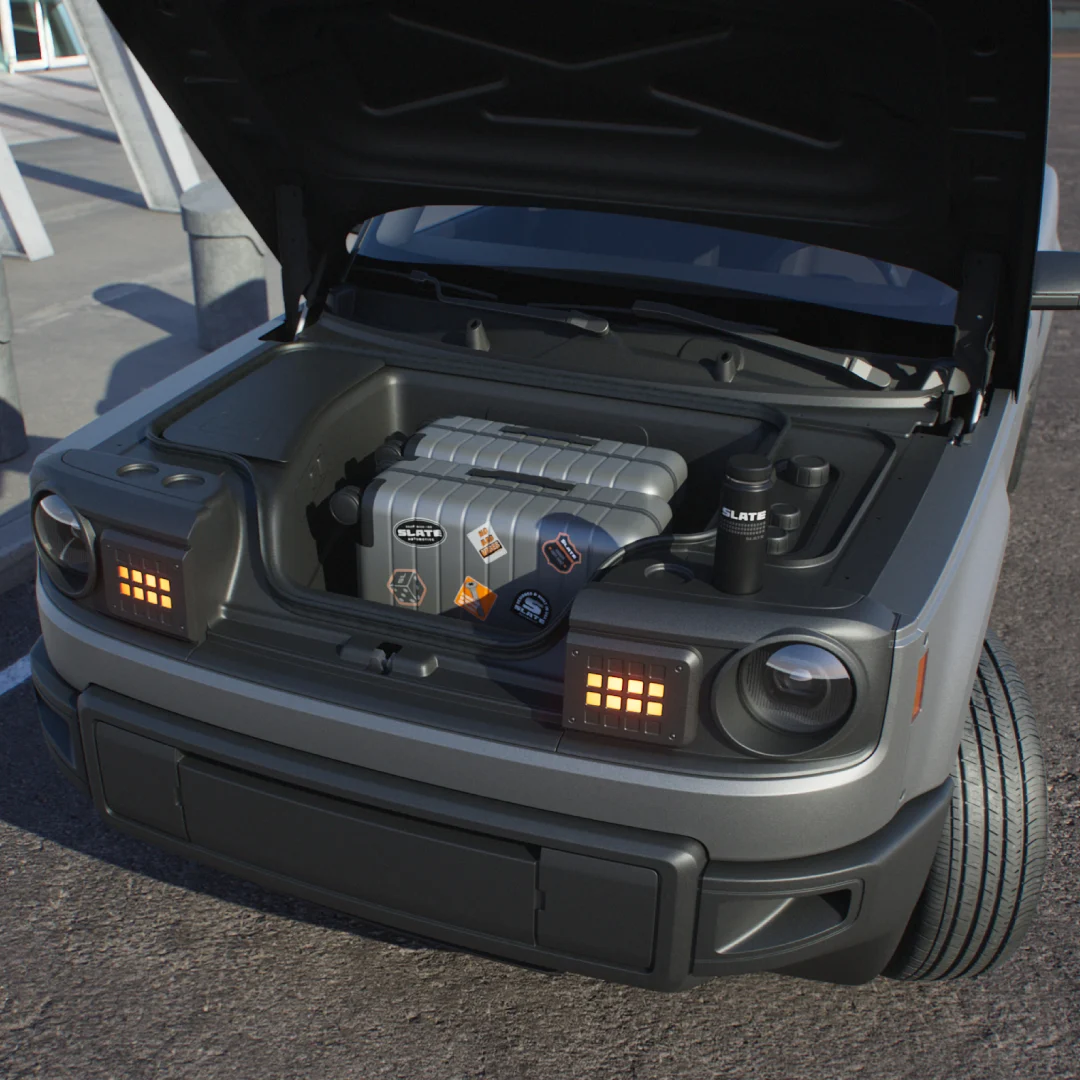
At no point did the video show removal of a body panel. It did show changing out trim pieces (e.g., interchangeable front turn signal masks), but with the frunk hood already open so not informative of whether the hood needed to be open. (I watched with sound off, so maybe it was mentioned in the narration?)
My frustration is I can’t find A/C mentioned anywhere. And that’s a must-have where I live. For electric cars it’s a big range sucker, so I get not including it when they are already range challenged, but at least make it an option!
Someone above pondered why they made it RWD. I think they are hoping to replace the Honda Civic as the “Tuner” vehicle of choice. The 500HP version would certainly be the weight-to-torque ratio winner. It may not become the next Camry/grocery getter, but this has all the makings of a cult car.
Go to the three minute mark. The fasteners are exposed and the body panels can be swapped with little more than a T30 bit. They’re designed to be easily modified. Here’s the best still image I could find.
Except for the theft potential, I really like the idea of easily removable body panels. The exposed screws wouldn’t be acceptable on a luxury car, but on a low-end utility truck I think it’s just fine and wonderfully practical. And plastic panels that don’t rust are a plus.
From what little I can tell, the whole thing seems well thought out, and though I was initially skeptical when I posted back in April of last year, I hope it’s successful.
As an aside, my recently acquired new-to-me car is the first one I’ve ever had that has anti-theft wheel nut locks. I guess at least in some places theft really can be a problem.
If you look at this picture you can see that the fender extends at the top under the hood. There’s a black plastic trim piece with 4 holes that you can see in the picture. I’d speculate, based on how other cars are put together, that there’s additional torx fasteners under that plastic trim.
Well have to wait for a teardown video I guess. The 4 exposed torx fasteners on the fender are usually hidden under the front bumper cover and the front door, respectively. Moving them inward so they’re visible almost seems like a stylistic choice.
That very well could be the case. I can’t find any videos of the panels being removed (other than the bezel around the headlights) and I also couldn’t find a copy of the owner’s manual that, I assume, explains how to do it.
I asked at an event as well and they also confirmed all the panels with exposed fasteners also have hidden fasteners so they can’t just be walked away with. Assuming you lock your doors I guess.
And
Slate confirmed in a video there are hidden fasteners that can only be removed with access to open the vehicle. Example: under hood or behind the door bolts to stop theft.
That’s good to know. I wonder if they’ll be cheap enough that people won’t bother anyways. I mean, I’ve seen instances of regular cars getting body panels stolen, but that seems like a bit more of a specialized talent. I also wonder how many damaged panels we’ll see before thieves realize it’s more than just the external bolts that need to be removed.
I asked at an event…
That’s part of the issue right now, as far as lack of information. That reddit post is from a year ago, at an ‘event’, which I assume means they only got the information Slate wanted to put out there to get people excited about the car. Even that video from JerryRigEverything, if you watch it, it’s also from an event and you can see quite a few other, what I’m assuming are, youtubers in the background making their own videos. In fact, when I tried to find videos of the panels being removed, just about everything I could find was from that same event.
At least I won’t be needing a new car any time soon. By the time I’m in the market for one, we’ll have years worth of information and real world experiences and reviews on this one.
I figured out what these are reminding me of. They’re the modern Model T. One simple, cheap model, but they can be modded into whatever vehicle the buyer needs.
Or as I said earlier, reminds me of the Volkswagen Beetle (coincidentally my first car). A notable feature of the Beetle was its high build quality, reliability, and easy maintanability. Man, I loved that car! The four-speed manual stick shift was as smooth as melted butter!