Even experienced programmers can be wrong, but they are better at it than most.
During my career I was usually both subject matter expert, architect, and major programmer. For my last project which was a system to collect manufacturing data where the users had no idea of what they wanted (it was the first time they were doing this) I often got requests for small chunks of code to do a specific task. This was 10 years ago, AI could do it today but the ones I did were so similar that I could write them in my head before I made it down the corridor to my office. But what I found was that the users, who were skilled engineers, never thought about the corner cases.
Most users of things think about their use cases, not what can go wrong and how to handle it.
Requirements are definitely important, but most people are awful at writing them. That’s one problem with formal verification. The requirements you are verifying against are sometimes flawed.
You verify the design of a microprocessor by throwing code segments at a model of it in a simulator. We’ve found that the best tests are not carefully constructed tests against the requirements, but pseudo-random code segments which often find problems no one thought of.
Sounds like fuzzing, which is often (usually?) automated these days, sometimes with AI/ML assistance to generate pseudorandom inputs, states, and behaviors.
LLMs have generally gotten so good at finding new undiscovered security issues (zero-days) that it’s making supply-chain attacks a far more dangerous vector now, and puts open-source software at particular risk. There’s no clear indication yet about how to best deal with all this…
That’s why quality and rigorous methodology is important at every stage of the development lifecycle, not just for design and coding. If the requirements are flawed, the system is almost certainly flawed, too.
The optimum testing methodology depends very much on the nature of the system you’re testing. I can believe that pseudo-random code segments might be an effective way of testing microprocessors, or at least should be part of the test suite. Just like how memory tests, while usually not exactly pseudo-random, generally consist of a large series of different dynamic bit patterns.
But complex application software is generally best tested with formal methodologies referencing the requirements and functional design. Competent testers will also create scenarios to test boundary conditions – the “this should never happen” and “no user would ever do this” edge cases. This was something that DEC was very good at and Microsoft has always been notoriously bad at. The beta release of VAX/VMS 1.0 was far more stable than anything Microsoft could ever dream of doing. It’s never been in their culture.
Memory tests, especially for memories within the processor, are never pseudo-random but are based on well know memory test algorithms, and usually generated by built-in self test hardware within the processor (or ASIC.) For yield reasons larger memories have built-in self repair, implemented with extra rows or columns which get swapped in during chip test (and sometimes in the field) when a bad bit is found. I know how often that happened for our processors, but that is kind of proprietary.
A lot of people talk to AI’s. I tend not to, being more of a “AI is a tool, so let’s use it to solve problems” person myself.
But I had a few minutes to kill and I decided to ask Claude (Sonnet 4.6, Adaptive) the following:
Claude responded:
To which I responded…
Claude responded:
I then asked my final question:
(Well, I guess that was more of a statement)
Don’t really know if this means anything, but it was interesting nonetheless.
It doesn’t really mean much. I asked Claude before if I should use please and thank you and it responded saying that (a) it didn’t care or have the capacity to care, (b) it was (nominally) wasting resources processing tokens that weren’t related to the request and (c) didn’t hold any memory into the next conversation/session anyway.
Honestly, I find it easier to use those terms just because it’s how I communicate with anyone else than to make the effort to not use them. I often expend that effort anyway to maintain a degree of separation from the tool that’s designed to be fairly obsequious and try to keep me engaged, using it and returning to it.
A profound interchange… I wonder what would be different if you run Claude locally and offline… Without forgetting?
Asked for fitness clubs with indoor tracks near me, and got a partially Bengali answer! It’s quite a pretty script.
That was Bengali (also called Bangla).
The word “বিশ্ববিদ্যালয়” (bishwobidyaloy) literally means “university.” It must’ve slipped in by accident instead of the English word.
I asked Claude if running locally is an option and how he would respond to you… and here is what he said:
Clockwork Orange comes to AI.
I just had a (facile) look to see if AI would help me with a problem, and nope. It appears not.
It’s a straightforward problem to describe. Equivalent to converting an object-oriented c program, built using user-defined dispatch tables, to c++. But using VBA eval to VBA objects. (That kind of program was standard in BASIC before object oriented languages became widely available.)
Two problems: It requires a deep and wide knowledge of the language, and it requires some actual intelligence. Both seem to be missing.
Most coding AI just seems to be pattern matching. Some of it’s very good, and does pattern synthesis as well as analysis, but still just pattern matching. No understanding of what code is trying to do – the step between analysis and synthesis has to be bridged by prompts.
And even there, the most intelligent AI seems to be narrowly defined for Java, Javascript, c, c++ etc. For VBA, all I can find is code generation and cleanup.
This is a perfectly ordinary project for a competent VBA programmer. It should take a couple of weeks, but it’s a “big bang” project, because at each level, all the objects have to be converted at the same time, and the framework has to be converted at the same time as the objects: there is no incremental re-write.
It’s a 3-tier project, but I’d place it as significantly easier than converting a front-back project to a 3-tier project.
Out of curiosity, which AI tool did you use specifically? There is a large difference in ability among the various options.
Yeah, that seems like a task any paid agent should be able to do (Claude Code with Opus, Antigravity with Gemini 3.1 Pro, Codex with GPT 5.5, or open source models).
If you’re just pasting into a chatbot you won’t get very good results. Try the coding agents if you haven’t already?
They very much do understand codebases and intent and have a deep and wide understanding of many languages. I’d be surprised if VBA weren’t among them, given the amount of training data available for it. They also tend to be polyglots and porting between computer languages is one of their strong suits, like translating between human languages.
In my experience, at least, the paid harnesses are like 50-100x more powerful than the basic free chatbots. You install them locally and they grep and upload your codebase into the context and forensically examine it for many minutes (or hours in some cases) to plan the work before they do it, then iterate through the features and bugs one by one until it matches both the specs and intent. It’s gotten very good at one-shotting most coding demands I’ve asked of it in recent months.
I’m wondering if AI could help design the landscaping for my property in terms of plant types and their location. I suspect that inputting all of the necessary data and preferences would take about as long as just doing it myself.
I don’t know how long it would take you to do that the old way, but I think it would be pretty easy to upload a photo of your property to AI program and tell it “plant some Hydrangea here and here” or even have it animate a walktrhough.
I use Copilot a lot at work. Like I had to create some regulatory paperwork for some big project I’m working on. I uploaded some requirements documents and a bunch of transcripts of planning sessions (also transcribed by AI) and basically had the AI answer all the questions for me.
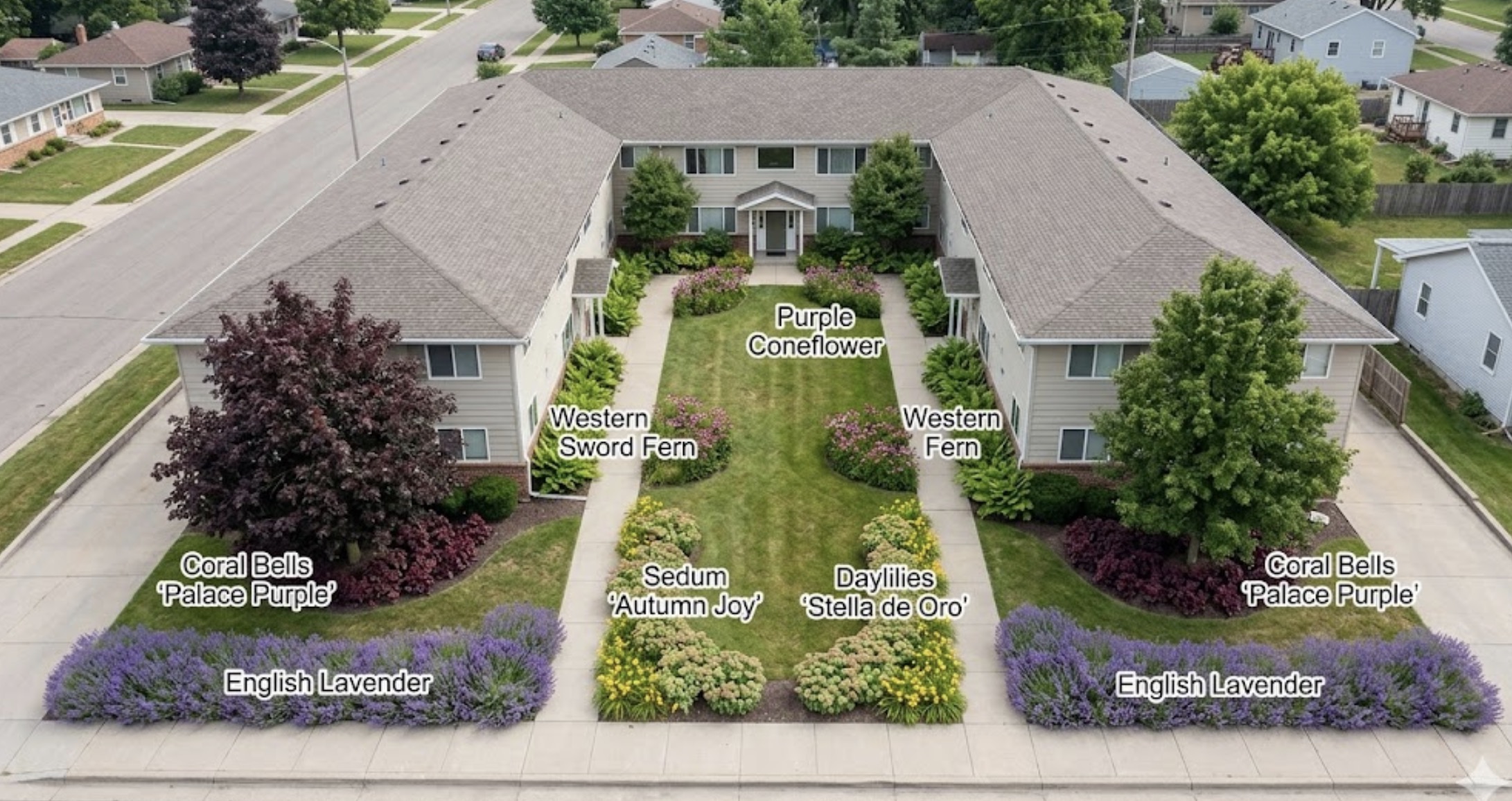
Interesting experiment! I tried it using Gemini, with a random house at 12345 Main St in some random city. Starting from this:

A few runs, and these were the results:
Attempt 1, first using chat and then making an image (not great): https://gemini.google.com/share/cbbd1a0fb802
First it tried to render a whole new perspective of a slightly different place:
Then it plopped down a few random things like it was playing The Sims:

Attempt 2, direct image modification with prompt: https://gemini.google.com/share/34886e1eb1d5

Attempt 3, same prompt as 2, but in “Pro” mode instead of “Thinking”: https://gemini.google.com/share/0955d220154a

I dunno. I guess it can figure out or look up which plants are appropriate for a given zone. I dunno if that landscaping actually looks any good.
And the video walkthrough isn’t adhering to the same details:
I dunno. Overall, I’d give it like a 4/10 for this use case…
Let’s try it with a different building in a frontal view…
(Same prompt, different image & building)
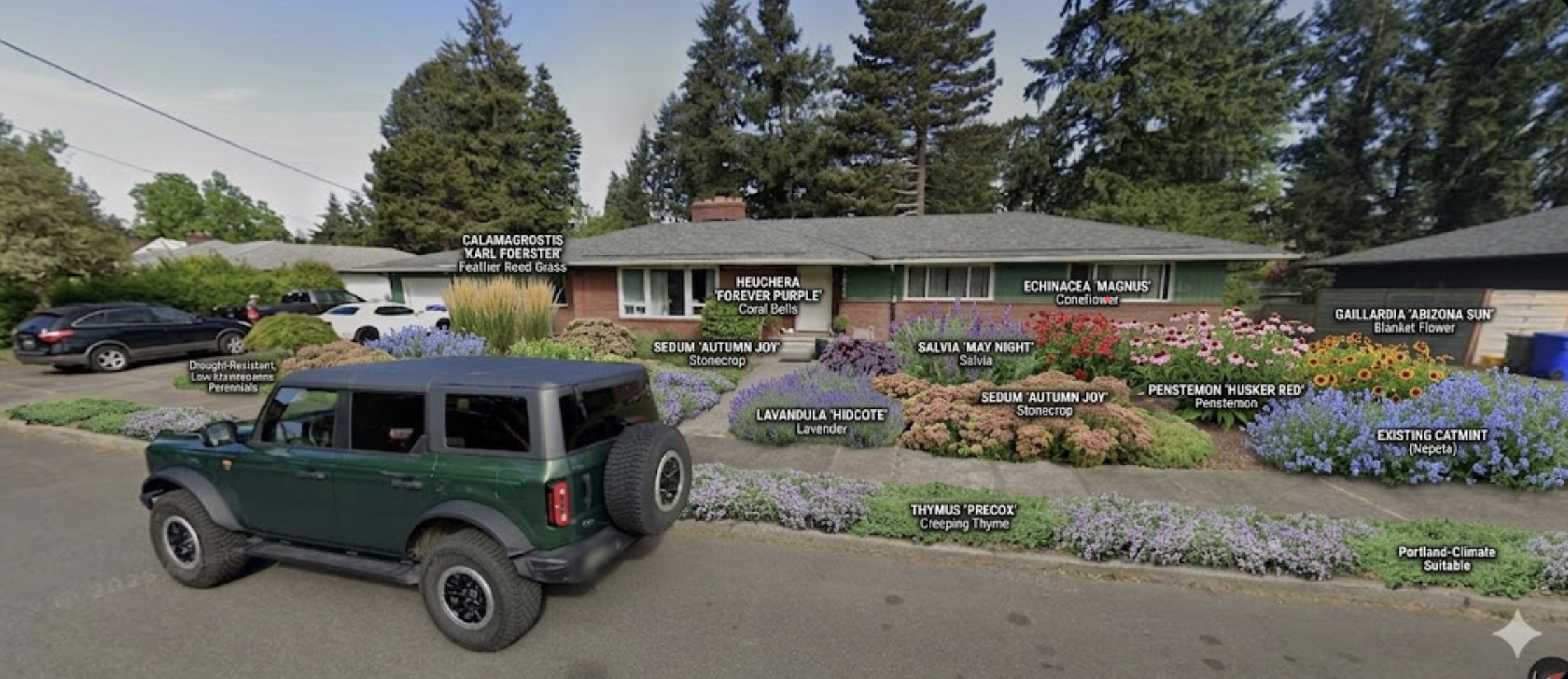
You be the judge, I guess?
Interesting. I think I’ll give it a try.
A couple of days ago I was in the mood for some sci-fi, so I went to ChatGPT and asked it to recommend something, starting with some books I knew I liked (some Ann Leckie, some Adrian Tschaikovsky, some NK Jemisin). It asked me questions about what I like and dislike about those books, ran some options by me, and we fine-tuned until it gave me a list. I’m reading the first book in that list, and I’m really enjoying it (I hadn’t realized Tchaikovsky wrote space operas).
Even though I know (broadly) how it all works, it had all the semblance of a discussion and was helpful.
Image and video generators would try to fill in gaps with random (ideally reasonable) imagery if it doesn’t know what it looks like. So if you just show it a rooftop, the AI won’t really know what the sides look like and will just pull a random view of some walls.
The more precise you are, the better the results. Maybe I’ll post links later, but I made a short AI video of some of my son’s Lego minifigs playing Beirut (beer pong). My first instructions were vague like “bunch of Lego frat guys partying and playing a beer game”. Predictably they did weird shit. One minifig spun the Lego keg handle like a propeller. Stuff like that that didn’t make sense.
My next attempt I was very specific. Male in Blue Shirt throws object into left rear cup. Male in Red Shirt takes a sip. Other characters heads swivel following white object. The results were a lot more predictable.
I also use ChatGPT to create prompts. Which is weird because it seems to know what I want to create but has to create these elaborate instructions to make sure Kling 3.0 produces the right results. A lot of it is camera and lighting instructions and “Negative prompts” like “no extra fingers, no unnatural movement, etc”. But I tend to get better results that way. ChatGPT is also good at providing feedback if you give it a prompt and ask it why it didn’t produce the desired results (ie “why didn’t the camera orbit properly” or “why is my character in pain?”
I mean…AI is trained on millions of Reddit and other social media posts so…a lot.
Honestly, I’m actually finding using AI at work more and more useful. Ironically for filling out bullshit paperwork and Excel files. I commented to my coworker ( a Star Trek fan) that a lot of AI felt like Capt Piccard using the cutting edge antimatter reactor warp drive technology to channel the power to move a starship across the galaxy to “replicator” some boiling water for his Earl Grey tea every episode.
But like it or not, that’s where we are going. Is AI going to eliminate all jobs? No. But a large corporation is really just a big information processing box with a lot of human and non human components connected together. Even now, I can save myself hours referring back to a chat where I loaded all the crap from a project and just ask Copilot “what does this mean”? Heck, I SHOULD be able to ask it now “give me an org chart of the entire NA ops team” instead of having to manually create it from our intranet.