Space colonization

I think the best path toward the colonization of space starts with robots that can at a minimum perform any task that a human could in space, on Luna, or on Mars. Any occupation or significant mining of Luna or Mars will begin a long protracted legal battle on an international and intragalactic scale so how that turns out is anyone’s guess. There will be plenty of controversy about mining asteroids also, but that one will just be a race to get to one with a lot of gold and the winner will have more money than all the major deities combined. But in the end people will be able to live in space once we have about 250,000 hectares of productive farm area in place, producing several times the capacity of Terran farmland of the same size. That would likely be only 1% of what we need to develop to keep feeding earthlings* without depleting Terran resources.

*Is earthling considered a slur? It’s always been used that way and I’m pretty sure it will be in the future as well.

I did say, IIRC. I certainly could have remembered incorrectly but I did hear it explained that there issues with artificial gravity via a rotating ship. I don’t recall any details, maybe a long enough radius would overcome these effects.

The Great Mambo Chicken and the Transhuman Condition discusses simulated gravity via centrifugal force. The only significant detail I recall from the book is the Mambo Chicken concept, from real or imagined experiments with chickens raised in >1G simulated gravity developing enormous legs. The only point relevant to this discussion is that we could raise chickens at further radius than the 1G area for humans, and probably <1G region where plants grow better, and Spacers can have as much dark meat as they like.

Yes, there are a few nitpicks but very few. Where the pen is floating in the lunar shuttle, there is (IIRC) a brief reflection from the acrylic sheet it’s glued to before the flight attendant picks it out of mid-air. Similarly, when they’re testing the failed antenna part on the flight deck, the probe lead hangs down as if pulled by gravity.

All in all though, remarkable for a time with strictly analog special effects.

My big concern with any design is the “all your eggs in one basket” concept. Perhaps it would take a while for the air to drain even from a major strike. But how much air can you afford to lose? How big are the refill tanks? I would think the key to any design is modularity, redundancy, and limiting the extent of any one failure. Your orbital habitat or lunar city night have a giant “central park” but it would not be where everyone lives, those should be multiple separate modules that do not participate in failure of another area. Each area might have a fully functional airlock (double doors) between adjacent modules, that should it get isolated there is easy in-and-out. With emergency temporary pressure suits. And so on.

Much as ocean liners have lifeboats and lifejackets, and isolation doors between lower hull segments.

Echoing @Buck_Godot’s statement, I don’t understand the logic of trying to become a “multi-planet species”. Whatever “difficult mineral and energy resources” remain on Earth, they have to be orders of magnitude easier to get to than anything found in space.

Any issue we “can’t overcome” on Earth will pale in comparison to day to day issues we would experience on Mars or any other body in the solar system.

How does having a few outposts on the Moon, Mars, maybe some Jovian moons and asteroids “save humanity” if we render the Earth uninhabitable? At best a handful of isolated humans survive in some artificial constructs until they run out of resources or suffer an unrecoverable cascade of mechanical problems.

And I’ve seen enough science fiction to know that humans on multiple planets makes the possibility of planetary-level genocides MORE likely, not less. If your enemy is on a completely separate planet, you don’t have to worry about the effects of nuclear bombs, anti-matter bombs, death rays, or asteroid strikes impacting your people.

If the Chicxulub impact happened tomorrow, humans would be done for.

But really, I think it’ll take much less than that to cause problems. Our civilization is on rickety foundations. If we backslide even a little, we lose the ability to extract the difficult resources at all. It’s not just that they get a little more expensive or whatever. It’s that the oil on the seafloor might as well be on Mars if you’ve lost the capability of building an oil rig.

The whole point is that the colony needs to be self-sustaining. If it isn’t, it isn’t of much use in this regard, except that any outpost must necessarily start that way.

There’s no fundamental obstacle here. As I’ve said elsewhere, energy is the ultimate fungible good. And there is plenty of energy in space or on other planets.

The point to doing this work now is that we might not be able to in a century. It might not even be due to catastrophe. It could just be a slow decline in capabilities and economic strength.

I don’t see how a colony could be self-sustaining anytime soon, since it would need to recreate the entirety of industry (mining to steelmaking, manufacturing of silicon wafers all the way to assembling a computer, etc.) And of course there’s no guarantee that all of the raw materials here on earth are going to present on the Moon, Mars or wherever else the colony is established.

Why is this thread on a usless speculation still in Facutal Questions, when there are no facts involved, and cannot possibly?

Eh, probably not. If we didn’t see it coming at least a few years in advance, it’d probably cause the extinction of 90% of our species. I wouldn’t be surprised if it were even 99%. But 99% of humans dying off still leaves hundreds of times the current population of all other great apes combined. We, as a species, would survive.

It can’t be. I don’t think anyone thinks it could happen in under a century or with less than a million people.

I think there are some very interesting questions about how the industrial base could be streamlined. Civilization as it stands is not optimized for reducing the number of required people, or for reducing the number of components needed to produce a set of items. Any product today comes in a million infinitesimally different variants, viable only because it matters if one thing is 0.1% cheaper than another. But you wouldn’t do that if you’re trying to create an industrial base on the bare minimum.

Semiconductor manufacturing is probably the most difficult. Lots of industrial processes have versions that work on a small scale, and with simpler steps. But semiconductors rely on very sophisticated equipment and it’s not obvious how to reduce that.

This is a great topic, What would humanity look like as it came back. What lessons have we learned? What is really important?

To my mind, ending up as roving bands of primates with no ability to bootstrap back up to an industrial civilization is pretty much the same as “done for.” That humans are not totally extinct is not that interesting to me. It’s our ability to look back at the universe and understand it is what makes humans unique, and it’s our techno-industrial civilization that enables this.

We certainly wouldn’t be able to take the same path back up to an industrial civilization: We’ve already used up the easily-accessible fossil fuels. But I don’t think we’d be forever shut out of recovery: Wind power, for instance, or biomass, would still be options.

Of course, I can’t prove that it’s completely impossible for it to be otherwise, but my view is that fossil fuels were the only energy source dense and cheap enough to lead civilization up the development ladder. Less-dense sources like low-tech wind would leave us in a development bottleneck. The energy needs to be cheap enough that basic needs can be met by a small fraction of the population (because they can use productivity enhancers like tractors and fertilizer), while the rest are busy developing the next range of technologies.

Eventually, any technology hits this point. We’re probably near that point for silicon semiconductors, for example: building the next set of fabs is simply too expensive to pay for itself. And the only reason they have reached the point they have is because there’s a market for trillions of chips. If that weren’t the case, we’d have hit the bottleneck far earlier. It’s not that development slows down; it’s that it halts completely.

It would still be a heck of a lot better off than if we were on mars. It would be much easier to create a shelter and colony that could survive post impact on earth than on Mars. Animal life survived the impact and came back. No animal life can survive on Mars.

If survivability is really your goal, build a bunker a mile under ground filled with everything that you wanted to have on your mars colony plus a whole lot more (since transportation is so much easier, have a a number of people live there is shifts, with a stock of nuclear and geothermal power. I guarantee they are much more likely to survive any apocalypse than a Mars colony cut off from earth.

Power is really difficult underground, since there’s no effective coldsink. Any heat engine requires a hot and cold reservoir to work from, and whether the heat is coming from nuclear or geothermal, it has to go somewhere after coming out of the turbine. Underwater would be easier, but that has other issues.

But there’s a significant factor that I think is beyond the pure technological questions, and that is that of having a forcing function. The isolation of Mars (and to a lesser extent, the Moon) is exactly its advantage. Antarctica will never have a self-sustaining colony because it will always be cheaper to just ship stuff there vs. creating it locally. Food and everything else will just get ferried in. They even gave up on nuclear power because it was cheaper to ship in oil.

That’s no longer true in space. Transport is so expensive and time-consuming that there will be enormous pressure to do things locally. So they’ll learn to grow food and mine resources and build components and all the other things. And this will be true at some level for every stage of development, from outpost onward. They won’t be fabbing chips right away, but they’ll be 3D printing bits to repair various things. They won’t grow all their food right away, but even if they’re getting most of their calories imported initially, they’ll still have an interest in growing some fresh foods locally. They won’t be refining titanium immediately, but they might be creating structural bricks from the local regolith. And so on.

I think people underestimate the effect of external pressures on a population. Human ingenuity can’t get around basic physics, but basic physics isn’t the obstacle on Mars or many other hostile environments. The energy and resources needed to support humans are there. What’s more important is that they have an incentive to move in a self-sustaining direction.

That’s assuming that you need the latest and greatest EUL etched chips. If your colony can get by with pentium level chips, that is much easier to achieve.

What high end chips you do need can be transported, semi-conductors are one of the few things that have a high enough value to weight to make it a viable trade.

I am like a broken record on this, but it drives me crazy that people keep thinking Mars is the place to colonize, when we have a much better choice 240,000 miles away: The Moon.

Let’s talk about what’s wrong with Mars. First, it has no magnetosphere, so no radiation shielding. This means everyone will be living underground - either in Lava tubes, or in homes covered in many feet of Martian regolith. There is no good solution to that.

Second, Mars is a long ways away, both in time and energy required. This makes any form of trade unlikely. And if you want to colonize, you need a way to fund it. Earth might be able to fund a scientific outpost indefinitely, but a colony will require a continually growing population, and each one will need substantial suport from Earth for a long, long time. Many generations.

Terraforming Mars is a pipe dream so far into the future it’s not worth speculating on when considering real-world plans for colonization.

To achieve true self-sufficiency on a hostile planet, a colony will have to maintain a very high tech existence. It takes millions, maybe billions of people to do that. There is no way we could or would support thousands to tens of thousands of people before they achieved self-sustainability.

So any colony must be financially self-sustaining and must grow organically based on its needs rather than some planned ‘colonization’. We need it to be able to bootstrap itself, and I know of nothing on Mars that would be of financial value to the Earth.

Now let’s talk about the Moon. First of all, it contains the best, safest places to live in the solar system outside of Earth: The interior of lava tubes. They are a constant temperature (-5 to -21 degrees C), fully protected from all space hazards, they’ve been stable for billions of years, and they may be full of resources.

The Moon has things to sell: Water, titanium, all kinds of useful materials. Not to ship to Earth, but to ship to Low Lunar Orbit or the gateway for use fueling satellites, making space stations, etc. If asteroid mining becomes a thing, fueling mining vehicles could be very lucrative. WIth mass drivers powered by nuclear reactors or solar power, material can be shipped to lunar orbit almost for free.

Then there’s tourism. The moon is close enough for a 2-week vacation, and it could be pretty awesome. A large pressurized dome would allow you to strap on wings and fly like a bird. Old people could get around much easier. Maybe the Moon will become a retirement destination.

And about those lava tubes… We’re not talking about ‘living in caves’. We’re talking about underground enironmets so large that you could have rivers, lakes, farmland, etc.

To give you an idea of the scale, have a look at this diagram from Purdue, showing the potential scale of a lunar lava tube:

That’s the City of Philadelphia shown inside it for scale. We’re talking 5 km wide, 1.5 km high, and maybe hundreds of kilometers long. Enough to house the entire population of the US in one tube. We already know of at least 200 open skylights into potential lava tubes, and there are no doiubt many more without skylights we haven’t seen.

This type of place seems obvious as a first place to go to build a colony. Emergencies can be responded to in days, the cost of transport is much lower, no radiation issues, and sealing/pressurizing a lava tube would be many orders of magnitude easier than terraforming a planet. Nuclear reactors on the surface could provide unlimited power to the tube.

The Moon has been discounted since Apollo since it looked like it was just a dusty rock of limited resources and interest. Now we know that water dan be found in numerous places, we’ve discovered lava tubes and mechanisms for transporting volatiles around to be trapped. The water is a renewable resource as well.
I agree. The trick is that you can’t just replicate those old 180 nm machines. Those were state of the art at the time, and almost as difficult to recreate as modern machines. But, knowing what we do now, it may be that we can use simpler methods to achieve an equivalent tech level. For example, just about every modern processor has some level of defect resistance, via turning off cores or part of the cache. A fab doesn’t have to achieve the same level of quality if you can use these techniques. Another example is that modern processes use double- or multi-patterning to get better resolution from the same frequency light source. Use the same techniques on the old process, and now it doesn’t have to be as good in the first place.

And in general, we’re better at design now. We have a lot more transistors at our disposal, but those transistors are also put to better use. So even a low-transistor chip with a new design would be better than the ones designed back then.

Still, new stuff would have to be developed. It wouldn’t just be a matter of dusting off the plans for the old machines.

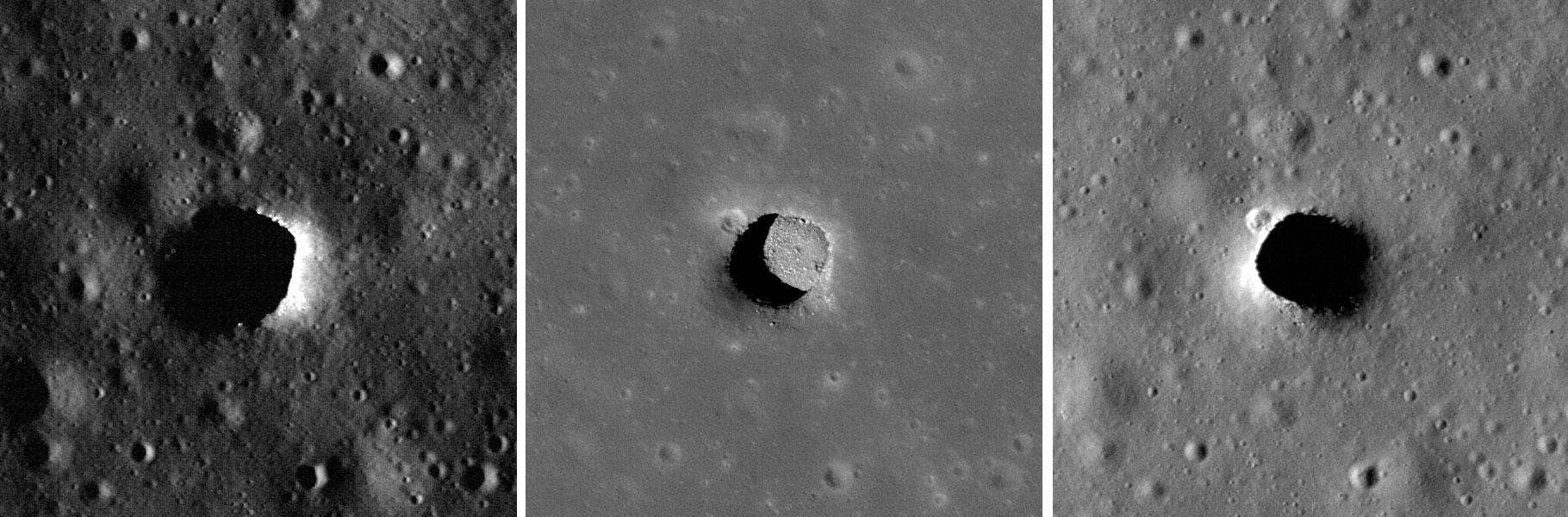
These three photos were taken by the Lunar Reconnaissance Orbiter, and show a lava tube skylight in the Marius Hills region of the moon. The middle image was taken when sunlight illuminated the floor of the tube.

That hole is about 70m wide, and the floor of the tube is about 85 m from the surface.

The GRAIL gravity mapping mission has found a lava tube under that hole. They say it is “wider than several hundred meters”, and could be many kilometers long. What we’re recently learning about the Moon hints that there may even be significant volatiles available in those tubes. And everything in there has been untouched by air, radiation, solar wind or anything else for at least two billion years. A pristine record of the earlier solar system. And it’s right next door.