Space colonization

Aside from the unprovable “nobody thinks xyz” and the bit of junior modding there, would you care to engage with the rest of the material that speaks to the OP, suggesting that the current round of space colonization hype is in fact a scam?

Particularly the fact that the biggest hype-men seem to be focusing their efforts mainly around skimming government money to lift orbital payloads, and no apparent activity around prototyping long-term human habitats while in-transit or on the planetary surface?

Or the way they theorize so energetically about how possible it is to make the Martian atmosphere suitable for life before Earth’s atmosphere becomes unsuitable, while being unwilling to spend a fraction of the cost fixing Earth’s atmosphere?

The underlying mechanism here really is an early-adopter goldrush mentality, combined with a certain political sensibility that leads people to believe it’s easier and more lucrative to exploit Mars than to fix Earth, and the goal of the scam is to help cement the monopoly of a certain private launch company (circling back to the OP asking if it’s a scam ,and explaining how it is a scam).

I’d have to point out that SpaceX is actually saving money as its cost is what? Half that of the competitors? And actually delivers. Those payloads need to go up - the number of ISS flights is minimal compared to actual commercial flights. Copanies pay for the flights because the result makes money for them in the long run.

And - that’s the model for any space work. There will be trailblazers - like Apollo, Mir, Tiangong and ISS - that are profit-proof but proof of concept, followed by increasingly proven lucrative endeavours.

But I do have to say that you match one of my criticisms - I’ve seen a lot of hype on getting the biggest rocket ever to launch the biggest ship ever into orbit, but not a lot on what goes inside that to let people live for years on a trip to Mars and back.


Burrowing into an asteroid - ignores the point that if you can’t practically disturb it without it falling apart, how do you put it into a practical orbit? Not to mention, the rocket fuel needed. Not to mention, how much fuel is needed if we start bringing material in from the asteriod belt and other points outer? There’s a reason cycle orbits are recommended over just pointing the rocket to Mars and firing all the way.


I will agree, the supply chains here are complex, because they can be. If it’s cheaper to run a factory in Vietnam or Thailand, and ship half-way around the world, that’s what we do. If it’s cheaper to have 20 different screws in a product, or pick one of 500 electric motors for an appliance, they do - because those are available. My battery-operated hand drill is far far better than the corded one I owned decades ago, but in all practicality not worth repairing. Same for the batteries (Ryobi) half of which despite tricks cannot be revived. Inside, the cells are soldered together.

First, computer chips seem to be the lightest, most practical things to actually import until a colony is fully robust; I see more that things like screws, wire, sheet metal, bearings, seals, molding and forming equipment, metal refinining and processing, etc. are more practical things to not only make on site, but build progressively more and larger versions of the fabrication plants. The start point is a 3D printer, which then makes rough-and-ready fabrication plant parts, etc. For self-driving mining machines, you’ll repair the moving parts far more often than the electronics, and they are the bulky high-weight parts you are better off making locally - and can start as lower-tech parts. In practicality, it’s a boot-strap process.

The point about simplified parts is key. I recently assembled a new barbeque - it came with a dozen difference bolt sizes - if it were more important to minimize the number of parts, or live with bolts where the end sticks out an inch to minimize variation, that can be engineered. Instead, it was engineered for aesthetics. Colonoists will at first skip that luxury.


Yes, a colony in space will be more regulated and monitored than any authoritarian society on earth. The guy who loses touch with reality on earth takes an AR15 (assuming they are American) and shoots a dozen people. Someone who slips a cog in a space habitat has the potential to kill 50% to 100% of the population and/or doom the rest. By then, I assume AI will fill in the role of the Future Crime committee, warning the colony politburo when someone shows signs of erratic behaviour or insufficient dedication to the cause.

Who is hyping soace colonization? Where are the scams? SpaceX has set Mars colonization as an ‘aspirational goal’ or mission statement, but I’ve seen no attempt to scam anyone or raise any funds at all specific to Mars colonization. There was the stupid ‘Mars One’ thing, and I called that out when it happened and they no longer exist.

Other than that, who is scamming?

Oh, and I have no idea what the ‘Jr. Modding’ comment is about. I did no such thing.

Simply the attractiveness of the concept could affect stock prices. It would be subtle but potentially could amount to a lot of dollars. It might be good for the image.

But who is doing that? Certainly not SpaceX. If anything, their Mars colonization rhetoric would,be a negative to a stock price as it would be nothing but costs for decades or centuries. But SpaceX isn’t public, and has no stock price to affect. SpaceX’s valuation is all about its conventional launch business and Starlink. That valuation is up to about $150 billion now, and none of it has to do with Mars.

There are no other public companies I can think of who have even hinted at a commercial model for space colonization. The only other active player in human habitation in space is Axiom, and they are building orbital habitats and research stations, and are very much NOT a scam.

If anyone is guilty of scamming the public it would be NASA, which has fund-raised on human exploration of Mars since the 1980s but never followed through on anything but conceptual studies. But I don’t think they were scamming - just bloated and expensive and buraucratically locked in place.

Maybe the concept is even more subtle than I originally inferred. What if he is just adding that on to his image as a dreamer and innovator. If a professor talked about this no one would listen or even hear about it. If Elon Musk mentions it even in the most casual way, people might think, " If he is even thinking about it it might be possible?" I think it has the potential to boost his image which is of great value.

Yes and no. Robert Zubrin is a man in just that sort of position (though an engineer, not a professor). He’s been advocating for a Mars mission for decades. He’s written a couple of books, established a Mars advocacy org, and has had some influence at NASA. Not that well-known to the public, but probably familiar to many in space circles.

Actually, no. Lots of companies push hard to standardize and reduce their supply chains as much as possible. That’s ‘vertical integration’. SpaceX does a lot of it. And a big part of manufacturing engineering is to make sure your product is as standardized and as low in part count as possible.

Supply chains are long because of complexity and specialization. Something as simple as a lubricant can require years of testing, research, etc, and manufacturing it can involve years of hard-won trade secrets. If you make cars, you do 't want to have to learn how to mine copper and spin your own electrical wiring. So you contract it out. That modern products can involve thousands of companies is testament to the complexity of modern goods, not a sign of inefficiency.

Pick a product, as simple as you want, and describe every step needed to make it. Include the material and expertise needed to make the machines that mine the raw materials, and the materials and knowledge needed to make or get the raw materials needed to make the tools required to make the materials for the mining machines…

I think just getting to the point where you can manufacture something on Mars using only local materials, capable of drilling a hole into Martian rock big enough for a mining operation is many, many years into the future.

And they’re famous for having weathered the COVID supply chain crunch much better than average. They’re the exception that proves the rule.

But still, one can go much, much further than that. They’re still embedded in the Earth economy and all its variety. And, well, they make rockets, which are already close to the edge of what’s possible in performance. So they often need the highest performance components available.

However, the vast majority of manufactured crap isn’t so close to the edge of what’s possible. It can get 20% worse and still be functional. Or even 99% worse but with 90% of the functionality (like a computer).

I’m not going to name any existing product because my whole point is that it would not be designed like that in the first place if you had very limited supply lines. If I point to some simple toy, you’ll point out that it was injection molded, and the injection mold was made from specialized steel, and needed a sophisticated 5-axis CNC machine to make the die, and so on and so on. And that simply wouldn’t exist in a small colony. They’d make the part with a 3D printer and recycled filament. It wouldn’t look very good, but it would be functional. And you’d design the part to snap or fold together instead of needing screws or adhesive, since those things are expensive.

3D printers themselves illustrate the point. Much of the early work with them was to design a printer that was, to the greatest extent possible (by mass or some other metric), self-replicating. Someone that already had a printer would print up a set of parts for you, you’d add some minimal set of “vitamins” (things that you couldn’t print yourself), and you’d have a printer. Then you’d print up the parts for two additional printers and send them to others.

People are still working on it, but the idea never really took off. Because on Earth, it’s vastly cheaper to manufacture things the traditional way, integrating with all the existing supply lines and using high-volume techniques like injection molding. So only a very small group of dedicated people are doing otherwise, basically as a hobby.

Well, in a distant colony they don’t have a choice. The diverse supply lines don’t exist. They have an extremely powerful interest in designing their tools to need as few advanced components as possible. And for even those to have as much commonality as possible.

It’s really easy to make a machine that can print itself if you exclude all the parts it can’t print. (-: Which for a 3D printer includes the tubing, the extruder, the metal rods, the bearings, the gears, the Arduino processor board and all the chios on it, the power supply, the wiring…

You can, however, print the plastic bits that hold all the other stuff together. Speaking of exceptions that prove the rule…

You may be able to eliminate 80% of the critical pieces of an economy through 3D printing and robotics and other tech. It’s the 20% that kills you.

Just think how hard mining on Mars will be, when everything has to be done in suits.
And you’ll need to make mining machines, which means mining lots of metal for the machines, which you can’t do without the machines…

These problems will eventually get solved, but at some point you need some people making mining machines, and some people making robots, and some people making any number of the many, many pieces that go into any product. You eventually get to millions of people required when you walk down the tree of all necessary goods and all the chains of intermediate goods needed to make them.

Or if you are going to automate it, I hope you can make 5nm GPU chips on Mars. Given that only two or three companies are capable of making them on Earth, I’d say that’s a stretch goal. And a chip fab uses 150 base elements mixed into 430 different compounds in the process of making a chip. Hope you can find and collect them all on Mars. And continue to do so to support the industry without using up more of your extremely valuable human labor.

Perhaps you can ultimately get to self-suffiency after you’ve got 100,000 people and a lot of modern manufacturing knowledge. But how do you support a colony of 10,000 that can’t, and has nothing to sell Eaerth? How about 50,000?

Everybody on Mars would be the most expensive welfare recipients in history until they could support themselves, which would take generations.

You don’t need the rods. I have a half-assembled version right now that eliminates the rods in favor of printed slide bearings. The rotary bearings themselves can mostly be printed. The gears can definitely be printed, as can the lift screws. The Bowden tube isn’t necessary (though it could be made with a rigid, articulated design if needed).

So the 20% gets reduced to 5%, or even 1%, depending on what else is available. Some degree of metal printing is possible. Not enough for precision components like motors, but definitely enough if you need reinforcement in some areas, or heat tolerance.

The supply chain can’t be reduced to zero. The question is if it can be made small enough for a modest colony (say, a million people).

Why? I mean sure, they probably like video games, but it’s hardly required.

My PC 30 years ago was a Pentium (1) at 90 MHz. ~45 MFLOPS. My current PC has 16 cores at 4.6 GHz and is ~950 GFLOPs. 21,000 times faster.

But the new system isn’t 21,000 times better. I’m not sure it’s even 2x better if I’m being honest with myself. The old system could browse the (old) web and write documents and a bunch of other stuff. It was fine back then. And frankly, so was the 386 I had before then.

The future in space may be more like the wireframe graphics in the 1977 Star Wars than we realize. Distant colonies can’t support the supply chain for the chips needed for decent rendering quality.

On re-reading, I guess you meant that they’d be using vision-based robots that need GPUs for their vision processing. No, they won’t be doing that anytime soon. Nor does it make much sense.

The first “mining” will just be driving around and picking stuff up. Mars is covered with meteroites right on the surface. For example, Heat Shield Rock:

That’s >100 kg of high-grade iron-nickel, usable in its native form for all sorts of purposes. Just pick it up with a magnet and dump it in the rover bed. The rovers on Mars have found all sorts of these, and they’ve barely moved at all relative to the size of the planet.

There probably isn’t enough of that to support a million people, at least not without totally scouring the planet, but there’s a lot. And it’s very easy to collect.

Supply chain simplification is a thing, but it’s not the same thing as vertical integration. Vertical integration is when a company buys out their suppliers, or creates their own division for producing what a separate company used to supply for them. If a company uses 50 different kinds of screws, and starts making all 50 of those screws itself, that’s vertical integration.

Not a great example. Lots of 3D printers brag about how they are themself 3D printed, but if you actually take a look at them, the only parts that are 3D printed are, like, two knobs and the hook that holds the filament spool. The stepper motors, the drive belts, the axis screws, the extruder head, the build plate, the electronics… None of those are 3D printed. And it’s those parts that can’t be printed that, for the most part, make the 3D printer what it is.

I wasn’t thinking about rendering quality, I was thinking about AI, simulations, fluid dynamics and other processing that increasingly relies on high speed GPUs with large memory. If you want to automate manufacturing you’re going to need high powered computers, and if you don’t you need a lot more labor. The same goes for exploration, mining, transporting, processing, sensing, information transfer, etc. It’s a catch-22: you need high density computing to automate things to enable a colony without millions of people, but you can’t get the high density computing until you have a colony of millions of people.

As for the 3D printer, okay maybe you can make a few extra plastic parts at the expense of some quality and longevity, but as long as you can’t make a CPU it’s just a chunk of raw material. That’s my point: If you can get down to 1% of materials you can’t make but are critical to survival, you still aren’t self-sufficient. Microprocessors are one of those. Maybe we could make primitive ones, but I’m not even sure how long it would take and how many people would be involved in making traditional circuitry like diodes, transistors, resistors and capacitors at a high enough quality and in packages that could be used to make small devices. And everything would be outrageously expensive because of limited economies of scale.

If we get away from ‘self sustaining’ and change to ‘maximally sustaining’ with a recognition that the colony will always need support from Earth, at least into any kind of reasonable to guess future, Things like GPUs would simply be imported from Earth. Anything that can possibly be made on Mars would be. Originally the list of imported items would be huge, but over time as the colony gained capacity the list of imported goods will shrink.

Maybe the Mars colonists will be made up of people who can put up enough money to pay for their support for the rest of their lives on Mars.

Those are bad examples :slight_smile: . This is the particular one I was thinking of (the Snappy RepRap 3.0):
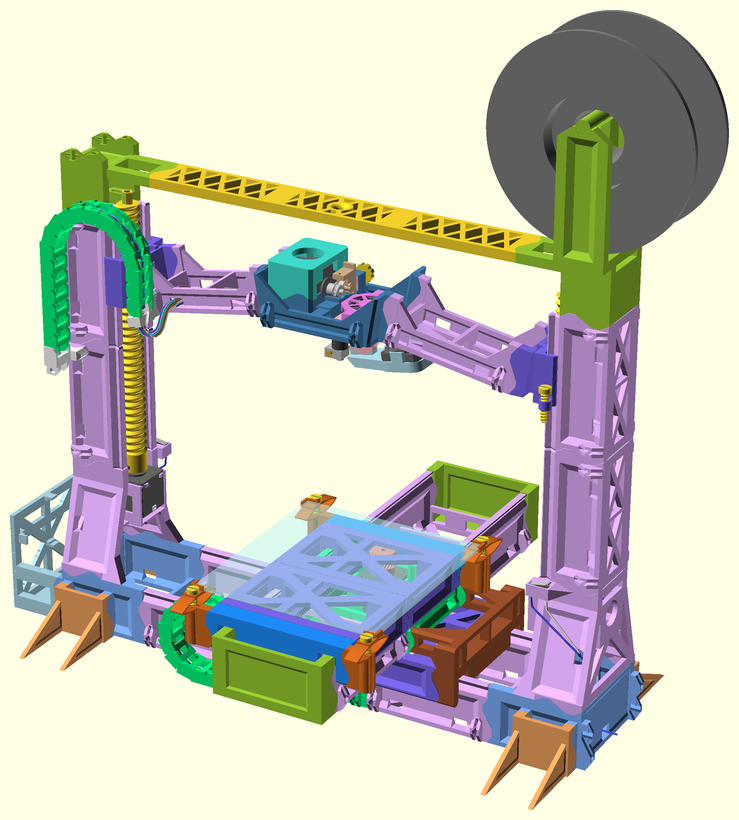
It needs the motors, electronics, and some hot end parts. It also needs a glass print plate, though it’s probably reasonable to assume that can be sourced locally. So by mass, the “vitamin” content is fairly low. <10%.

You can go further if you have some degree of local production and with further design tweaks. For instance, basic wire isn’t that difficult. It doesn’t need flexible insulation; you can use standoffs to handle that.

And again, there’s essentially no motivation to go further here on Earth. This particular one was designed by one person for fun (and they seemingly lost interest after 2018). Put a bunch of smart people in a room with a lot of time on their hands and they’ll come up with something even better.

Hm. And that has enough fidelity to print its own parts?

I’ll admit that I’d have more confidence in that if they showed photographs, not just renders.

The degree of self-sufficiency matters. The colony can’t grow unless it can reduce the amount of imports. Initially, it’ll be 100%, and have to be funded either by the rich or by government research grants and the like. You can support more people if they can cut their imports down to 10%, or 1%, or 0.1%. And they’ll be producing some things of value to pay for that.

So, when is true self-sufficiency possible? Dunno. But I will say that semiconductors really are by far the hardest problem here; everything else is easy in comparison. And… maybe a colony could simply buy all the semiconductors they’d need for a very long time. Excluding the dumb parts like heaksinks, I doubt that all the packaged semiconductors I’ve used in my life weigh as much as a kilogram. And excluding the components where I splurged on something, probably cost <$10k. A kilogram worth of ARM cores, basic microcontrollers, support chips, some basic power semiconductors and so on would last a lifetime. And several kilograms would last hundreds of years. So the colony could, in principle, just stock up on the most crucial vitamins and hope that they can develop a native industry in a few centuries.

That does pose the problem of weakening the forcing function, though. The population may simply keep deferring the creation of local industry, thinking they still have time later to deal with it.

At the point where they’re still using century-old chips, they’re probably going to want to upgrade, to performance levels that didn’t exist when they bought the first batch. And if the trade is cut off by then, their only path to those upgrades would be to make them themselves.

Though I expect that, by that point, access to space will be so cheap that nobody will care if the Mars colony is reliant on trade.

Does my half-assembled version count :slight_smile: ?

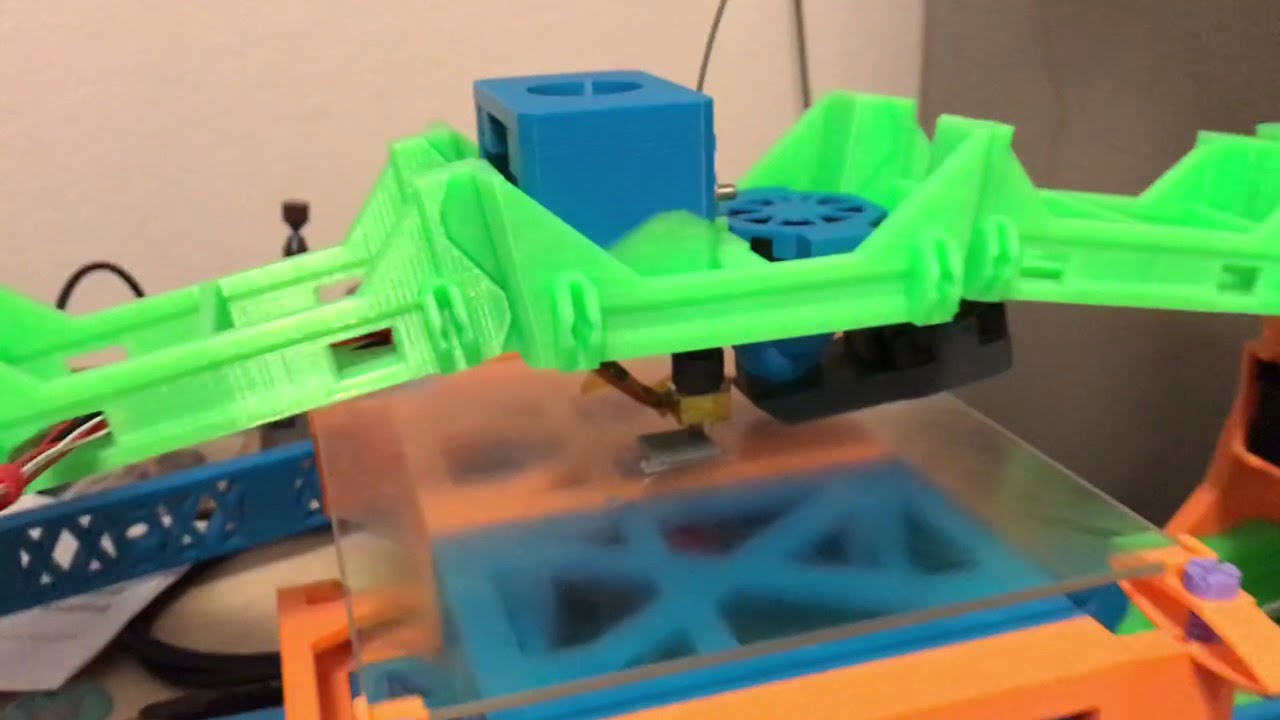
The subassemblines seem to be functional, like this one:

It has a pretty smooth action that seems like it would be sufficient. But I’ll admit, I haven’t tried the whole thing together yet. I got partially stuck on the hot end, as I couldn’t find the same one the developer used. I was going to just customize it to mine, but got distracted.

The snapping together of the parts works surprisingly well.

This one seems to work reasonably well:

Whether it can print itself, I couldn’t say…

This isma really excellent point. All the analysis about the viability of a Mars colony assumes transport costs way higher than they are likely to be. If we get to the point of actually sending colonists to Mars, Starship will be fully amortized and should be getting down to close to the cost of fuel and operations like an airliner. Musk says the ‘aspirational’ price at that point osmabout $10/kg to LEO. That would mean $70/kg to Mars, plus the cost of tying up the vehicle for several years.

At $70/kg, people can have fancy food shipped to them. Shipping an iPad would cost about $50. Mars doesn’t have to be sustainable at that point, and by the time it needs to be it might have imported an entire manufacturing economy from Earth.