Or under water. Tesla catches fire under water after backing a jet ski in.
https://www.youtube.com/watch?v=cUVZR7OIelk
They keep calling it a charger, but the important detail is that this was a “portable” charger - that is, a fully charged standalone battery that can be used for charging other devices without access to an electrical power outlet. A plug-in charger has a capacitor(s) in it, but they don’t store much energy at all and generally dissipate it soon after unplugging.
And here I am, a year older but not a year wiser, wondering about my same problem.
Of note: the local news just ran two stories of batteries causing fires.
In re-reading this thread, I remain confused about some things.
- There is much advice to store batteries at 50% charge. How do I know my battery is at 50%?
- When I leave a battery off the charger, the stored charge depletes. Wouldn’t this alone take a battery down to 50% (and more)?
- Amazon has fireproof battery storage bags. Anyone have any experience with or knowledge of these?
mmm
I won’t be much help here…
I have a new (last Spring) battery powered lawnmower, and weed whacker. Greenworks brand. (Love them btw)
Northern Idaho, freezing temps common for Fall/Winter, during which time I keep the batteries in my (heated) garage. The owners manual specifically recommends charging the idle batteries every two months during the off season.
The discrepancies between what I’m reading here, and what the manufacturer says, are confusing. It seems to me that what you guys are saying makes more sense.
I take my batteries for my power tools indoors in winter, charge them every so often. (and make sure they still work) I guess the point is, if you’ve charged them and used them a bit they should be Ok, but don’t let them drain completely and sit.
I had some Ryobi batteries, and sometimes when they were completely dead the electronics that managed charging was messed up. There was a trick to keep putting them on and off the charger, so it would charge a few seconds before the electronic control said “I’m charged”, until it reached the point where the control could read the battery, then it would charge normally.
Several companies sell outdoor security cameras with batteries. from what I understand, they won’t charge in below freezing temperatures but they will be OK.
Teslas catching fire is pretty rare and getting rarer. usually it’s either an older model (battery making has been getting better) or severe trauma to the battery case. As is evident from the news with exploding e-bike and hoverboard batteries (and one iteration of Samsung phones), it’s the quality of manufacture that matters, and most reputable manufacturers have figured out how to make them reliable.
Tesla batteries are sealed in a steel case specifically to prevent things like damage or water causing short-circuit fires. There’s a lot of fancy circuitry to avoid things like an imbalance of charging that overheats one bank of batteries, and there’s even a cooling system. it’s just they like to feature them on the news and all over social media when one does happen.
I have the very strong feeling (but no quote - there probably aint any) - that LiPo fires are “mentally” overrepresented…
How many billions of LiPos are around nowadays… cellphones/tablets/notebooks/EV-transportation/yardmachines/handy-man tools, etc… and how many fires do you get? … now divide the two numbers to get the ratio 
I think this is ultimately a good example for observation bias (lipo fires make it into the news, all other fires wont) - and while the chance is non-zero, it’s small enough to not keep me awake at night… just like i’m not losing sleep over the chance of a housefire due to shortcircuiting due to e.g. a worn down cable isolation.
To add to my confusion:
There are LiPo (lithium polymer) batteries and anti-fire, anti-explosion storage cases for Lipo batteries.
My (lawn tool) batteries, though, are lithium ion batteries. I see no protective storage cases for these.
Is this because lithium ion batteries are less prone to go boom-boom?
mmm
According to the Wikipedia page on Lithium-ion batteries, there are at least 12 different Li-ion battery chemistries with various pros and cons, of which lithium-polymer is just one type. Apparently LiPo batteries have the best energy density, making them well-suited to applications where minimizing weight is critical:
According to that link, LiPo batteries don’t typically come in a hard case, allowing them to bloat when overcharged or overheated. You do see this sometimes on cell phones and tablet computers.
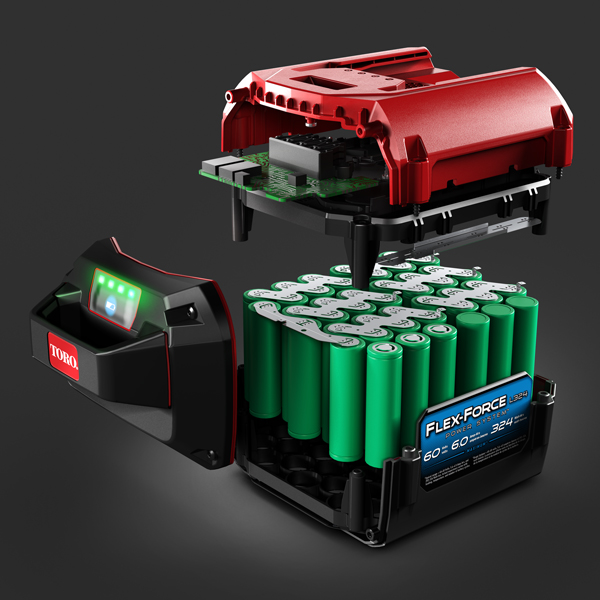
Your (and my) lawn tool batteries are Li-ion, but probably not LiPo. Here for example is a Toro Flex Force battery shown in a disassembled state, and it features hard-cased cylinderical cells:
All helpful info, thanks.
Yes, mine are Li-ion. I am wondering if these are the type that we seem to need not worry so much about fire/explosion. It appears so, since the fire-resistant cases I see listed on Amazon all specify that they are storage for LiPo batteries.
mmm
With their superior energy density, LiPo batteries are commonly used in radio-controlled vehicles like drones and race cars. They typically get subjected to rapid discharge during use (and possible also rapid charging between uses), which I suspect puts them more at risk of fire than Li-ion batteries that are subjected to less strenuous duty cycles. (My lawn mower can flatten a battery in an hour if I’m mowing tall grass, but it also blows cooling air through the battery case.)
If you search for “Li-ion battery fire case”, you can find them, and I doubt they’re any different than those being sold as a “LiPo battery fire case”. I suspect the latter are just being marketed to RC hobbyists, since that’s a search phrase they’re like to use. Many of them are designed to hold multiple RC-vehicle-sized batteries for storage, charging, and transport.