But by gum did it put Ogdenville, North Haverbrook and Brockway on the map!
As to the topic is general, something not wholly addressed in Cecil’s column is the issue of systemic legitimacy.
The value of capitalism in wealth creation is beyond any reasonable debate, but capitalism lies within a broader network of systems that constitute the legitimacy of the extant societal arrangement; in a western country it sits next to things like democracy, humanism, the rule of law, and other societal traditions and expectations. That system is wholly human-made and continues to function as long as the people within the society generally agree that it should continue functioning.
The position of the Elon Musks and Peter Thiels, more or less, is that the system as it exists should continue to exist because, well, that’s the system.
That’s fine to some extent, and I personally think it’s okay to have very rich people. However, if their influence and control over the system becomes too great, what will happen is that many other people will percieve that the system does not work for them. If swathes of people have no chance of success within the system, they will, quite logically, see no value in the system. Eventually their numbers and frustration with that system will become such that they will begin to attempt to change it. Usually, the rich people who control the system will use the influence their wealth gives them to prevent change, and when that fails, use force to prevent that change. Sometimes they succeed, sometimes they fail. I am of course describing revolution.
Revolution can take a very long time (the Englightenment) or happen remarkably fast (Cuba.) What follows revolution might be better or might be worse, but it will inevitably happen if the rich people warp the system too much in their favor. The reactionary/conservative position is hostility to that because it violates the rules, but if enough people see no hope within the system, of COURSE they will change it. Why not?
A stable society must be one that more or less works for the overwhelming majority of people. Billionaires could threaten that fundamental requirement.
People focus on billionaires because they are visible and have a shit-ton of money. But I think what is more important is, as you say, the “issue of systematic legitimacy”.
Take for example, the story of “tech bro” Martin Shkreli.. You may remember him from back in 2015 when he raised the price 5000% for Daraprim, a drug used in the treatment of AIDS. He was later convicted of securities fraud on an unrelated matter an sentenced for 7 years.
What I can’t figure out is how this dipshit man-child who, as far as I can tell, grew up in a working class family and a degree in “business administration” from Baruch (a decent school but not like Harvard or Wharton or anything) is starting hedge funds at 23 and pharma companies at 32 where he is even in a position to set the price for such a drug. I work with tons of Ivy-League Wall Street tech bro types. Yeah, they’re all smart. But they’re also dumb as shit at 23.
But I see this with countless examples like Shkreli, Elizabeth Holmes, Sam Bankman-Fried and the rest of those crypto-idiots at FTX. Like why does Wall Street and Silicon Valley have this desperate need to finance immature 20-somethings to launch half-baked schemes of dubious merit? Sure, Jeff Bezos founded Amazon when he was 30 and Zuckerberg founded Facebook from his college dorm. But they still spent years building their business and there was never really a lot of ambiguity about what those businesses actually did. Is that what it is? All these investors sitting on giant piles of money with no idea what to invest in so they give it to whoever can convince them they will be the next Steve Jobs?
To me, that’s the problem. Not that billionaires exist, but this belief that level of wealth is reasonably attainable and not as much of a fluke as winning seven super bowls. It’s like what people are describing in the “Longtermism” thread. It’s creates a mentality of throwing resources at the “next billion dollar idea” at the expense of more immediate issues that might not pay out as big in the near term.
Well, let’s remember that while Bezos and Zuckerberg did turn out to be creating profitable businesses, in the tech boom the same investors were throwing bags of unmarked bills at people who were claiming that whatthefuck-dot-com was the next big thing, causing it to inflate to 900 times its actual value before deflating and crashing like a Chinese spy balloon. Dutch Tulip Mania has been a thing since… uhhh, since Dutch Tulip Mania. I really don’t comprehend why someone would entrust an obvious thudfuck like Sam Bankman-Fried with their money but if Kevin O’Leary blew millions on that obvious bit of larceny that’s kind of amusing.
As bad as stock bubbles can be, at least most of the 2000 tech idiots lost their shirts; Elizabeth Holmes paid the price, too, as did the Enron people, and Bankman-Fried will, too. The danger is when they DON’T pay the price, as the thieves and grifters who caused the 2008 mortgage debacle did. Even more dangerous is when it seems like the robber barons are essentially running the show, and we may not be far from that. As you point out, we are now being subjected to this ongoing reality show of Ridiculously Weathy People Passing Their Money Back And Forth, while the working class feels like they are going nowhere. The You Can Work Hard And Get This Too thing is still convincing a lot of people, as evidenced by the popularity of Andrew Tate, but that can run its course as well. And when it does, the working class is coming with pitchforks and ropes.
Economically
I’m all for a fair market and that’s exactly the point: I think a fair market is one that punishes anti-competitive practices, that only allows mergers and acquisitions when it’s in the consumers’ benefit, and that taxes corporations.
When all this is true, it should be very difficult to accrue wealth in the billions.
Note the distinction here: I am not against billionaires in the abstract. When Apple revolutionized the iPhone, it changed the lives of billions of people (not all directly…I’m saying Android phones also owe something to the iPhone) and arguably they deserve humungous rewards (that they should be taxed on).
But generally, the existence of lots of billionaires implies market competition is far from optimal.
Democratically
The wealthy have outsized influence basically everywhere, because 1) election campaigns cost money and 2) the rich can afford megaphones. And this outsized influence can be quantified.
In terms of how much of a threat it is to democracy, it depends on a given nation’s economy and governmental rules.
Sorry to say, but the US is particularly vulnerable here, because it has very high wealth inequality, legalized bribery (with bribes defined as “free speech”) and extremely expensive election campaigns.
So even Democrats will try to avoid doing anything to upset the oligarchy. e.g. the “wealth tax” mentioned in the SOTU is apparently not going anywhere.
Who is not a billionaire.
I think the US is particularly vulnerable because we have a particular obsession with wealth, power, and superficial fame. It makes it easy to hold up wealthy people as something to idealize and to trick or coerce people with promises of wealth (or scare them with stories of “those people” coming to take what’s theirs.
Not a big fan of this article as it’s way too US-centric, equates the US with “democracy”, hell, it even kinda equates the Democratic party with “democracy”, and completely ignores the impact of dynastic wealth on societies. Because the issue isn’t the existence of billionaires - in a world with over $1 quadrillion of capital instruments in the form of cash, derivatives, debt, bitcoin, etc, you’re going to have some billionaires. The issue is what will/can happen when this wealth and power is used to create dynasties, passed from generation to generation.
Fortunately, so far, our experience has been to move from one fate-chosen plutocrat (John Rockefeller) to another (Henry Ford) to another (Sam Walton) to another, their influence waning as the wealth becomes diluted, the successive generations more dissolute and removed from the original fortune, the original fortune (and its influence) minimized due to human frailties and market realities (just ask the Fords).
So far.
I built a quick and dirty spreadsheet a couple of years ago which allowed me to calculate Bill Gates’ and Jeff Bezo’s current (2021) wealth in a world with an x% wealth tax. I didn’t calculate for any threshold, it’s all taxed from the first-dollar earned, meaning that the numbers shown are “worse” than they would be in the real world:

Column A is the year, B is his real-world NW (researched), column C is the rate of growth year-over-year for their NW, column D is the wealth tax, and column E is their wealth after the wealth tax.
So, using Gates, we assume he started MS in a world with a 3% wealth tax. I started this in 1984, when MS went public, but it is likely he may have been paying a wealth tax starting in 1982, perhaps earlier.
A couple of things are happening here:
- First thing you’ll note (using Gates) is that the 2021 wealth goes from $144 billion to $45 billion.
- Total taxes paid are $24 billion.
At first blush, it seems that we “destroyed” $75 billion in wealth to pay $24 billion in taxes… and conservatives will, in fact, make that argument. But it’s bullshit, because that’s not how equity works.
In 1984, BG had to sell a $10 million block of MS to pay his wealth tax. The proceeds went to the US government. The stock, OTOH, went to someone not named Bill Gates, someone who… if they keep that block of stock… will enjoy the same year-over-year gains that originally went to Gates. In time, that $10 million block of stock will be so valuable in and of itself that it, too, could pass a wealth tax threshold. (ETA: just ran the numbers: with no tax effects included, this block grows to over $4 billion in 2021 value.)
In 1985, BG had to sell an additional $15 million block of MS to pay the wealth tax. Again, the stock didn’t disappear - it’s now owned by, say, CALPERS… who then enjoys the same capital appreciation from 1986-2021.
Bill Gates is still unimaginably wealthy. If you tell wealth-tax 1984 Bill Gates that he will be worth $45 billion by 2021, he would be just as happy to tackle the world as if you told real-world 1984 Bill Gates that he will be worth $144 billion in 2021. The decisions would be the same. His enthusiasm for playing in the capitalist game is unabated. The wealth created would be the same…
… it’s just not hoarded by Bill Gates. Or Bezos. Or their children. Or their children’s children.
Billionaires are not bad for Democracy. Dynasties are bad for democracy. And that’s the true danger.
(Btw, even as I typed it I was chuckling about how I complained the article was too US-centric… and then formed a US-centric response. What can I say: I am Legion, I contain Multitudes.)
I don’t know why there needs to be a singular “true” danger, let alone that that danger is dynasties.
In fact, the bulk of your argument is mostly about taxation (which I agree with). I think wealth being passed to the next generation is a smaller problem than just corporations paying their fair share in the first place.
I don’t see wealth dynasties as a problem. Basically there are two outcomes: a family fortune successfully perpetuates itself, or it doesn’t. In the latter case you typically have the “three generation rule”: the founder makes the money, the second generation lives off it, and the third generation loses it. So at most you have one or two “parasite” generations. When family fortunes do successfully perpetuate, it’s because they are maintaining viable businesses that contribute to the economy. This article examines the subject:
Do Most Family Businesses Really Fail by the Third Generation?.
What people are mostly objecting to is three things: the existence of a system that concentrates wealth enough to make billionaires a possibility in the first place; the leverage and influence billionaires have while they’re here regardless of how long or how brief their fortunes last; and the prospect of “rent collector” heirs who live off of interest and dividends indefinitely.
I would say that last is improbable because one feature of our predatory economic system is that any large concentration of wealth becomes a target, and will eventually fall if it doesn’t “defend” itself against those who feel they could use the wealth more effectively. IMHO one of Marx’s biggest failings was thinking that the (then new) industrial class were a modern version of feudal land holders who would continue to be rent collectors centuries after their founders actually did anything to earn it. Capitalism doesn’t appear to work that way.
I think it’s more that billionaires have become the most visible symbols of a system that by and large is perceived to not work for the average American. People are fine celebrating the Rockefellers and Bill Gates and Elon Musks of the world when they create thriving successful businesses and hardworking folk all have decent jobs. But since I’ve entered the work force 30 years ago, there have been all manner of systematic economic crisis, often at the hands of “billionaires” who are supposed to be so much smarter than everyone else. And there are all these societal problems where we “just don’t have the money” for things like healthcare or schools, but yet here’s this guy with 85 cars that cost more than most people make in 2 years.
It used to be that it was justified having extremely rich people because they created things of extreme value for society - railroads, software, electric cars, whatever. But now you have people becoming extremely wealthy on things like hedge funds or crypto currencies or social media and it’s not really clear what value, if any, is being created for society. Which begs the question of if these things aren’t creating value, why is society funding them in the first place?
Certain respected groups that rate the level of democracy in various countries have downgraded the US from the top tier to the second highest tier. Although some may argue these groups are seeking attention or funding, the last few years have been disheartening in several countries that have challenged the independence of the judiciary, the accuracy of the popular vote, personal gain from government decisions, obstruction of justice, engaging in disrespectful or genocidal actions, or intimidation of alternative parties.
One must ask whether this is true. And if so in certain countries, why this is.
The quicker way to say this: things have gotten worse since Reagonomics. The change in the US government’s posture towards business changed dramatically, and we’ve seen upheaval and wealth disparity increase as a result.
When in modern times hasn’t the economy kept changing? We virtually refounded the economy in 1935, things limped along until 1940 and then we had a war economy until 1945; then the USA enjoyed a highly abnormal quarter-century based on our enemies and competitors having to recover from WW2; then cracks in the system appeared and widened 1970-1980.
The USA couldn’t go back to “the good old days” circa 1960, short of the rest of the industrialized world destroying itself while leaving the USA untouched.
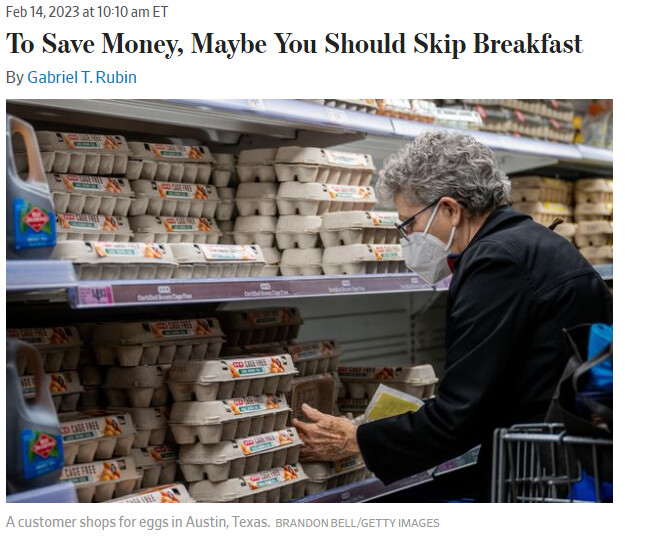
The Wall Street Journal offers hard times advice for non billionaires!
It’s this sort of thing that makes people say “the hell with it, this system doesn’t work. Time to rebel.”
Musk is an Ayn Rand novel.

You could also just drop your WSJ subscription and suddenly afford an omelette every morning.
WSJ subscription*: $40/mo
3 egg omelette x 30 days: 90 eggs/mo
90 eggs ÷ 12 eggs per carton: 7.5 cartons/mo
8 cartons x outrageous $5 per carton: $40/mo
* after 1st year loss leader promo
~Max
First of all what makes you think that is “fictional”? A lot of projects succeeded because someone invested money where everyone else thought it wouldn’t work.
Second, I don’t see what that’s a bad thing. Funding for projects that disrupt the status quo has to come from somewhere.
Third, maybe we would be better off if corporate leaders were more like Ayn Rand characters (or Ayn Rand-esq like Tony Stark or Howard Hughes’s portrayal in The Aviator). Effortless brilliant men of science and business creating wonderous life-improving inventions for the world to awe at.
Longshot projects fail much more often than they actually succeed. That’s why they’re longshots. And that’s why things like literal moonshots tend to be funded by the government - they’re chances nobody else will take.
This is the problem with billionaires. When one person has enough money to put bread on his table for 10,000 lifetimes, it makes him chase idiot schemes. Take Musk’s subway project. The idea here was not “what if we made a really good transit system” but rather “what if I was the founder of a new transit system.” And the harm here is that the failure of Musk-transit is taken as proof that the idea of transit itself is untenable. Transit did not need to be disrupted. All the ideas are sitting there on the table, but taxpayers don’t want to fund it.
Same with Musks’s Twitter purchase. The idea was not “how can I make a fantastic Twitter.” The idea was “if I owned Twitter then I could make it work better for me.” He paid 3-5x for a company that he’s now suggesting had no future and was headed for bankruptcy. This kind of idiot scheme only makes sense if you have tons of surplus capital and aren’t accountable to board members (or voters) on how you spend it.
Ayn Rand characters were ruthlessly anti-regulation and anti-union, and those stances have proven to be very bad for the public.
It also bears mentioning - have you actually read Atlas Shrugged? The central conceit is that billionaires took their ball and went home, but it depends entirely on magic. As in, the libertarian utopia didn’t work because the refuseniks were so smart or productive. It worked because of an energy source that literally pulled electricity out of the air. Ayn Rand literally broke the rules of thermodynamics because she could envision no other way to make a world where billionaires are prosperous without extracting profit from the working class. That ought to tell you something.