The time to boil should also be slowed down by things like the Leidenfrost effect. The ocean would spend a lot of time surrounded by an insulating layer of steam.
But I’m also not so sure we should be using the sun’s energy output to measure the time of boiling. The sun’s surface is relatively cool and not very dense, but we’re still talking about a material that starts out at thousands of degrees, and the water would be denser than the sun’s surface and therefore would tend to sink into even hotter layers.
I certainly don’t see it lasting 1.9 days when you take this into effect… but it is probably a lot longer than a few seconds.
You can’t do that division, unless you’re shielding the Earth with a Pacific-ocean shaped cutout (“dodging”, in photoprocessing terms) to keep light from the rest of the surface of the Sun from “slanting in” and heating the ocean from all other angles. If you’re close enough to the sun to be considered “dropping the Sun into the ocean”, it’s gotta be a factor.
Yes I can. If the Sun is close enough to completely fill the sky, the energy emitted per unit area of the Sun is the same as the energy received per unit area.
These calculations assume that the earth is brought to the “surface” (photosphere) of the Sun and suspended there. If it’s allowed to fall into the sun, you’re right, it will boil away much more quickly.
Also the calculation only takes radiative heating into account, and ignores conductive heating. That may be reasonable though, considering how tenuous the Sun’s atmosphere is.
As MikeS demonstrated - yes, it’s a reasonable thing to do. Vaporizing water takes a huge amount of energy compared to just heating liquid water up to the boiling temperature.
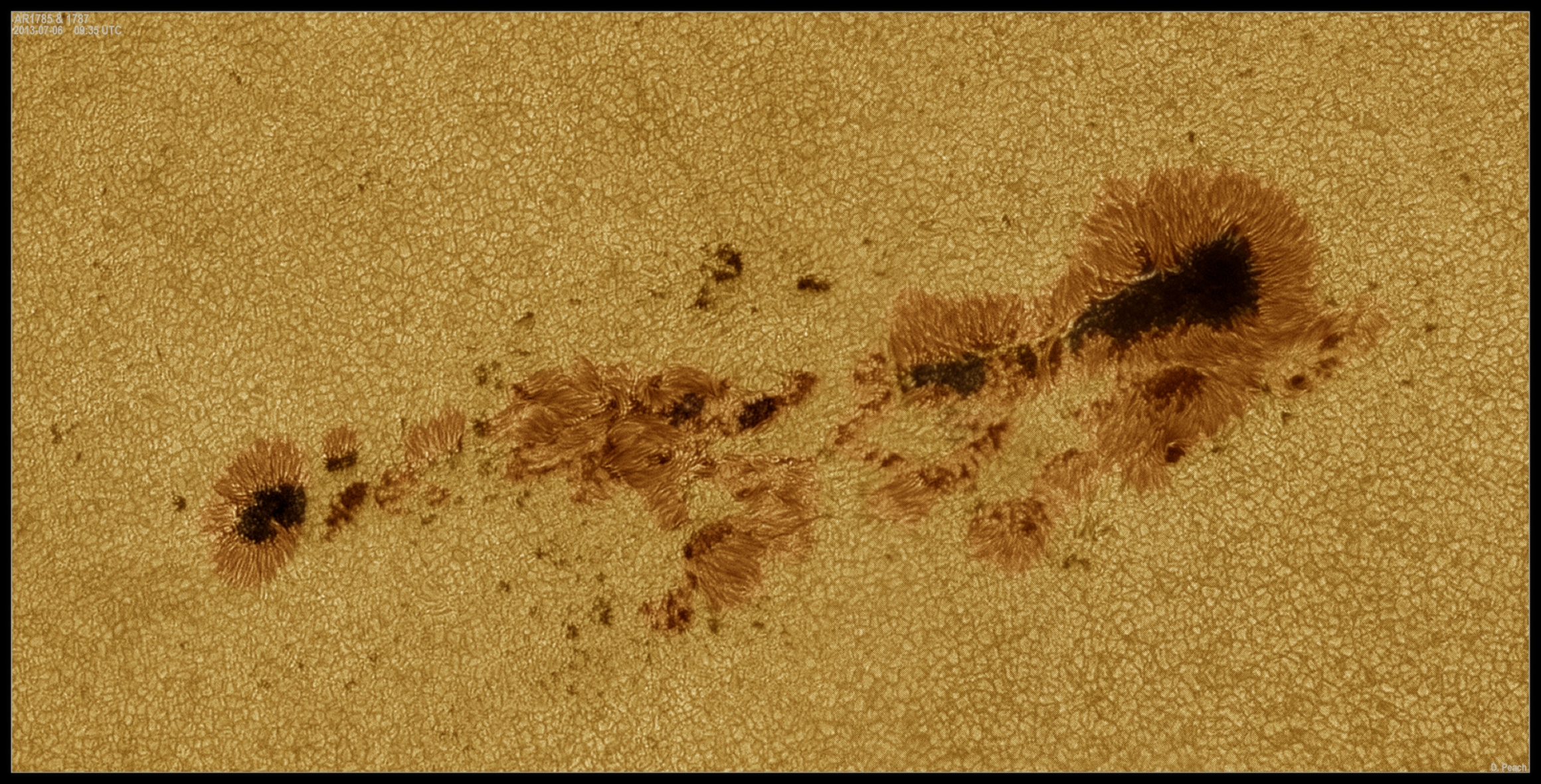
To get an idea of the size of the sun, look at this picture of the current sunspots. See the yellow pebbly-looking background? Each of those ‘pebbles’ is about 1,000 km wide – about 1/3 of the US or about the whole continental Europe. See how many of them there are? And that’s only a picture of a small part of the sun. It’s real big.
Not your math, but your logic: the figure you cite is the omnidirectional power output of the sun, “realistically”, how ever you look at it, you would rapidly reach a point where half or more of that output would be directed away from the earth and into space, so your figure is a bit shorter than what the actual result should be.
Not to hijack, but how many Gigabybes of flashdrive memory can I fit into the Pacific Ocean? I mean, I have an 8GB flashdrive and it measures 1" x 1/2" x 2", but my friend has a memory stick that is different.
The volume of the Pacific ocean is 6.7 x 10^23 cc (from here).
An 8GB flash drive that measures 1" x 1/2" x 2" has a volume of 1 in^3 or 16.4 cc.
So, 6.7 x 20^23 / 16.4 = 4.08 x 10^22 8GB flash drives will fit into the ocean. That means that the Pacific ocean will hold 3.27 x 10 ^23 GB of data. But, it’s pretty clear that this figure is way too small, since one can buy 32GB flash drives that are much, much smaller than the one you own.
Don’t be silly; here on the west coast, we see the sun set into the Pacific all the time. Takes about 3 minutes, and then it’s out, only to be reborn the next morning as it rises over Mt. Diablo.
Not really. It never touches the ocean itself, at least not around here, it always goes behind a bank of clouds on the horizon. I have never seen it touch the water, not once.
CheeseDonkey, don’t abuse this forum by asking questions you know the answer to. This constitutes trolling. No warning issued, but don’t do this again. This is closed.