The Death of Bookstores

That doesnt make Amazon responsible. It can be shown it is just the other way- Amazon is a success as too many big book retailers failed.

Wiki-

By 1986, discounting practices by rival book chains had caused declining profits for B. Dalton stores, as had the decrease in new shopping malls.[3] As a result of the declining profits, Dayton Hudson Corporation sold the B. Dalton chain to Barnes & Noble.[2][5]

https://www.npr.org/2011/07/19/138514209/why-borders-failed-while-barnes-and-noble-survived

But in the mid-1990s, Borders lost its edge.

“It made a pretty big bet in merchandising. [Borders] went heavy into CD music sales and DVD, just as the industry was going digital. And at that same time, Barnes & Noble was pulling back,” says Peter Wahlstrom, who tracks Barnes & Noble for the investment research firm Morningstar.

He says Barnes & Noble also invested in beefing up its online sales. Eventually, it also developed its own e-reader, the Nook.

Borders did not. Instead, it expanded its physical plant, refurbished its stores and outsourced its online sales operation to Amazon.

“In our view, that was more like handing the keys over to a direct competitor,” Wahlstrom says.

In other words- poor business decisions killed the two big book chains. Small Indy bookstores have always had an issue with staying open- actually make that all small indy business have always had an issue with staying open. Not due to Walmart, or Amazon or etc- they are often poorly run on a tiny margin.

According to the Bureau of Labor Statistics “20% of small businesses fail in their first year…and 50% of small businesses fail after five years in business.”

Covid might have closed something like 1/3 all all small businesses.
A couple of observations. The fact that they’re doing better in sales may have something to do with the demise of the old mass market paperback in “favor” of larger and more expensive formats. There are multiple B+N stores near me (two of which opened fairly recently). I hope that they’re not following the path that killed Borders which was, in the opinion of this spouse of a former Borders employee, overexpansion. But those B+N stores don’t offer variety. If I’m looking for a particular book, it’s a safe bet that if one of them doesn’t have it, none of them will.

Portland still has Powell’s City of Books, which AIUI is the largest independent bookstore in the world. It takes up an entire city block and has four stories with over 1 million titles on sale at any given time, including a collection of rare volumes that cost up to and including a king’s ransom. (Their most expensive book, a first edition copy of the journal of the Corps of Discovery expedition, retails for $350,000 and is stored at an undisclosed location, while the most expensive book onsite is a mere $25k.)

On my most recent visit to Portland, I stopped in and found a 900-page Jewish cookbook for $18.

How fitting.

No, I never left a bookstore without buying something, usually a couple of books.

When I said hangout, I meant I would pass time there, but I always paid for the privilege.

This could be the cause of more bookstores. It could also be that when you have a country of readers, voters demand that bookstores be protected.

My mother was a bookseller at a small independent bookstore in Toronto. She loved books, so it was a job that suited her perfectly. “If you work doing something you like, you’ll never work a day in your life,” described her attitude towards her job. As for the bookstore, it was a delight to go into. The smell of decades of books stocking it, floors that creaked, wooden shelves built into the wall … it was heaven.

I miss places like that. I make do with the big box places (here in Canada, those are Chapters and Indigo), but they seem to be giving over more and more floor space to things like stationery and hostess gifts, toys for kids, and board games, and less to books.

I think the future of bookstores is going to be in niche markets: a cookbook store, for example, or a rare book store. In the latter case, last I heard, places like Bauman’s and Type Punch Matrix (which Rebecca Romney of “Pawn Stars” founded) are doing well.

Heh. I wonder if the clerk who priced the book was Jewish and had a sense of humor.

Another thing I’ve noticed w.r.t. museum gift shops. They used to be utterly filled with books for all ages, from preschool ones on the Cute But Lonely Last Velociraptor to 2" thick tomes on paleogeology, birds of prey, and black holes and such. I used to eagerly zoom into them whenever I was done looking at the exhibits to grab some instructive reading material…

Now, it’s all t-shirts and stuffed animals and cheap little planet gizmos and etc., but books? What are those?

This is true, and I miss the old book-heavy museum gift stores. The Museum of Science in Boston used to be FILLED with booksThey had a range and number that were amazing (including a section entitled “beyond science”, which had a lot of debunking books). The Smithsonian Museum of American History used to have a cavernous bookstore that continued through several rooms, covering topic after topic. Both museums now have tiny little gift shops with hardly any books in them.

Art Museums, at least, still have impressive bookstores. The one at the Metropolitan Museum of Art in New York is HUGE. The one at the Boston Museum of Fine Arts is pretrty impressive.

And, I’m happy to say, the last time I visited the American Museum of Natural Hitory in New York, it had an enormous bookstore – much bigger than the tiny one it had while I was growing up. The banisters on the staircase (it’s a two-floor bookstore) are cast in the shape of dinosaur vertebrae.

You don’t have to charge them and you can leave them when you finish them. Paperbacks will always have a place as “disposable” reading material, especially with the demise of local newspapers and magazines.

Three points.

  1. The NPR article you cite says literally that:
  1. The NPR article you cited was written in 2011. A LOT has happened since 2011.

  2. That LOT includes the strategy that the NPR article quoted, apparently approvingly. “He says Barnes & Noble also invested in beefing up its online sales. Eventually, it also developed its own e-reader, the Nook.” We now know that taking on Amazon directly was a near-suicidal move. Amazon steamrolled B&N into hundreds of store closings and near-bankruptcy. From a dominant position in the industry, B&N now controls less than 10% of Amazon’s market share in print books, and virtually no percent of ebooks.

B&N’s market cap today is around $310 million. Amazon’s is $2,460,000 million. Amazon is the reason for that.

On the topic of books sold by Amazon, they’ve started using print-on-demand services lately for certain older books. I ordered a copy of Antiquities of the Jews by Josephus earlier this year and it wound up being a print-on-demand copy of the 1737 translation by Whiston, which according to a small imprint on the last page was literally printed the very same day I placed the order.

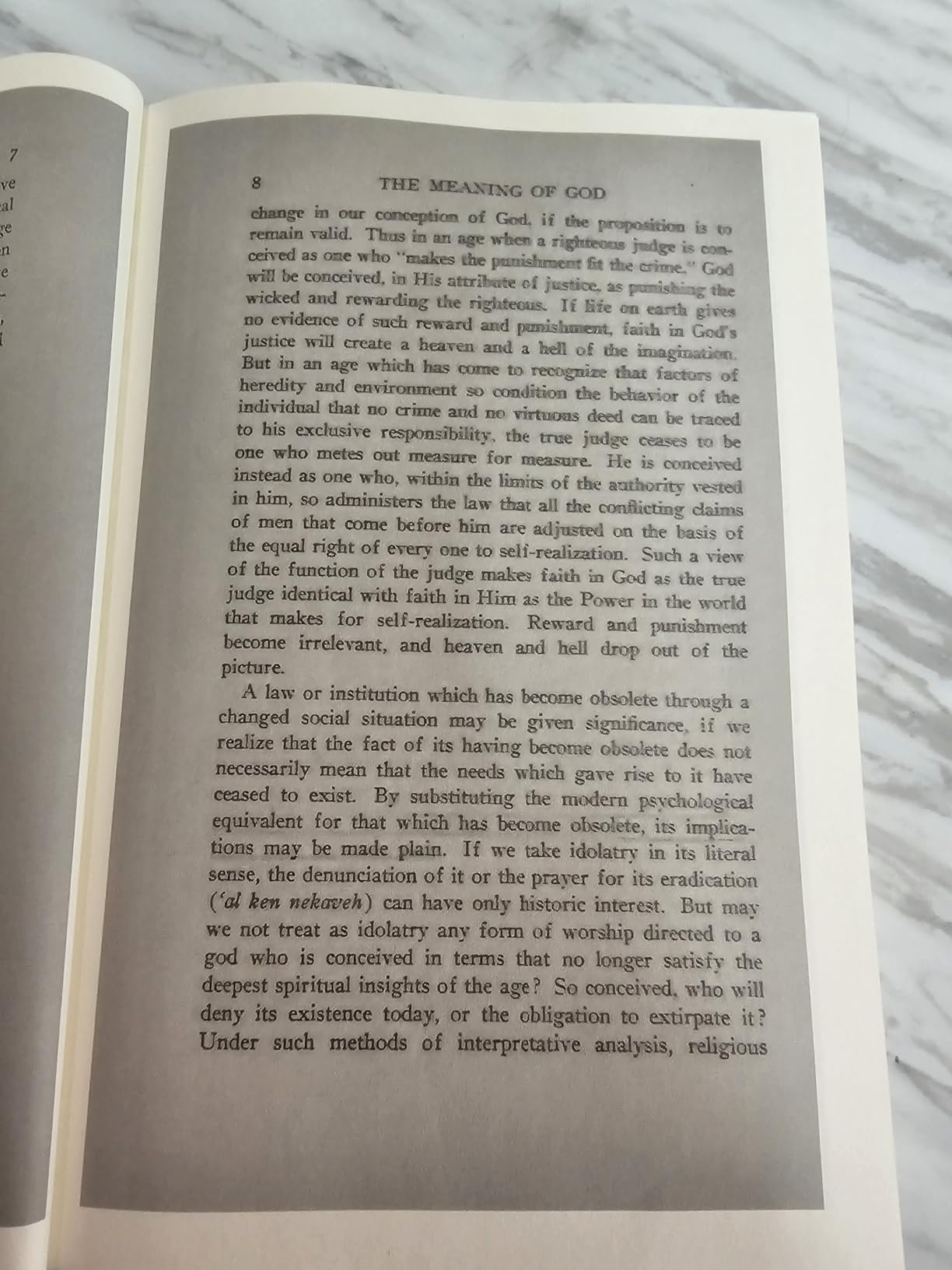
That one was fine, but I’ve also gotten some from them that were ATROCIOUS. I ordered a copy of The Meaning of God in Modern Jewish Religion by R. Mordecai Kaplan, and what I got was quite obviously a scan of a used book - it was a grey background with a white margin, some of the text was blurry, and on certain pages you could literally see that the owner of the souce copy had highlighted or underlined certain passages.

Did you return it? Did you “report a problem with this product or seller”?

I just looked it up on Amazon. The publisher is “Restored Books” and that product is clearly … not ideal. I’d have returned it and clicked that link myself

To their credit returning items to Amazon is not so onerous.

I frequent our newly opened independent neighborhood bookstores. But honestly Amazon has its advantages.

Unfortunately, I didn’t get to reading it until after the return window had closed. I filed a one-star review and bought a better copy from Thriftbooks instead.

We went there for the first time in years last week, trying to sell them my wife’s old Bobbsey Twin books (no go.) Lots of people. I did buy two magazines and a book to fill in my collection for reasonable prices. But I don’t buy all that much any more since I have over a thousand unread books and magazines and the chances of me living long enough to read them all are looking slimmer and slimmer.

I think I’m confused.

Retail stores are nothing but individual examples of the catalog the underlying company chooses to carry. Unless there is a significant regional or socioeconomic difference between two B&Ns I’d expect their on-shelf merchandise to be as identical as modern retailing algorithms and POS stock control can make it. Net of store size of course; a 5,000SF and a 15,000SF store cannot possibly have the same range of titles on display.

Going to one store looking for something, not finding it, then going to the other strikes me as obsolete 1960s thinking. And even back then you’d have done better to visit two stores of different brands than two stores of the same brand. Regardless of what products, books or [whatever], you were seeking.

Not true. There are definitely differences between the stock at different stores. In fact, since the stores all have access to the inventory, I’ve had clerks in one store look to see if they could find the book I‘m looking for (that they didn’t have) in another store nearby. Did it just last weekend.

A semi-related anecdote from yesterday evening.

I wanted to replace my showerhead. Some Amazoning gave me some ideas, but I wasn’t seeing what I wanted in the brand I wanted. So I went to the nearest Lowes big box. Poking around at all the display merch I found something close enough to my desires, but a different brand. OK, I’ll settle. But it was only available in-store in the finish that didn’t match all the rest of my bathroom fittings. Crap.

Uncharacteristically for me, I thought “Now that I know the exact item name, I wonder if Amazon has it in the correct finish?” So standing there in the Lowes aisle with the item in one hand and my phone in the other a few clicks later I saw they had it in stock for delivery tomorrow. Click. I walk out empty-handed.

Sometime around noon today Amazon will bring my item in the correct finish.

I do not make a habit of shopping in person and buying online. IMO that’s anti-social vandalism. But there I was.

Multiply that by a jillion interactions and that’s what happened to bookstores. And is happening to every other category of specialty retail. Of the kinds of things that Lowes or Home Depot sells, I rarely set foot in their stores any more. Amazon gets first crack. Better selection is my primary motivation. Better convenience secondary. If there is a price difference I probably don’t know it.

In the case of my shower head, the Lowes price is 25% higher than the Amazon price. That didn’t make my decision; I’d still have bought from Amazon had it been the 25% higher one. But it sure didn’t hurt. Me. It sure hurts Lowes.

At least the indie places offer a personal touch: