Only one that I know of with a single Mother- It’s Always Jan, but a few with a single Father.
But what’s your point?
Did they discuss pay on TV back then?
This thread is not only about TV shows.
Only one that I know of with a single Mother- It’s Always Jan, but a few with a single Father.
But what’s your point?
Did they discuss pay on TV back then?
This thread is not only about TV shows.
That it was rare to the point of almost being nonexistent, so using it as a counterpoint is pretty much useless when it comes to how women were portrayed on television in the 50s?
I just looked it up, and that is a very depressing “good example of a working single mother in the fifties”. War widow with a small child in a small apartment sharing with two other working women to try to make ends meet, while working as a struggling nightclub singer (wonderful example of what jobs were available for women back then, btw), and during the run of the show she tries, and fails, at her two main goals: getting a better job, and getting a husband.
Quite a lot of women did, at some point in their lives. But that’s not what was presented as normal, however normal it was.
The children’s books I was given in school all assumed that Mother was home, taking care of the house, waiting for the kids to come home from school and for Father to come home from work, so that she could feed them the meals she’d cooked them. I think @wolfpup is pointing out that in the same fashion the TV presented that as normal. Of course everyone knew that the actors playing those SAHMoms were professionals with careers — but that didn’t change the underlying message.
Agreeing with that. A lot of what’s now thought of as the 60s was the late 60s into the early 70s; and some of the changes were for the most part significantly later than that.
Yes, but for the most part the types of jobs they had available were limited, and their work was considered subordinate to their husbands’ and less important (and less important than men’s even for those women without husbands), and was less well paid.
Yes, true.
I found that what I called “60s music” was really 1965 to 1975.
Ruben Bolling’s take:
Entertainers in general also. That’s how John Mellencamp became John Cougar. He fought back and was briefly named John Cougar Mellencamp and eventually dropped the “cougar”. Or John Wayne instead of Marion Morrison..
There’s a case to be made that the whole article is essentially a stealth version of Lenny Bruce’s “Jewish and Goyish” routine, six years before the fact.
See for yourself:
(It’s also oddly prescient of Eli Valley’s “Israel Man and Diaspora Boy,” but that’s a topic for another thread.)
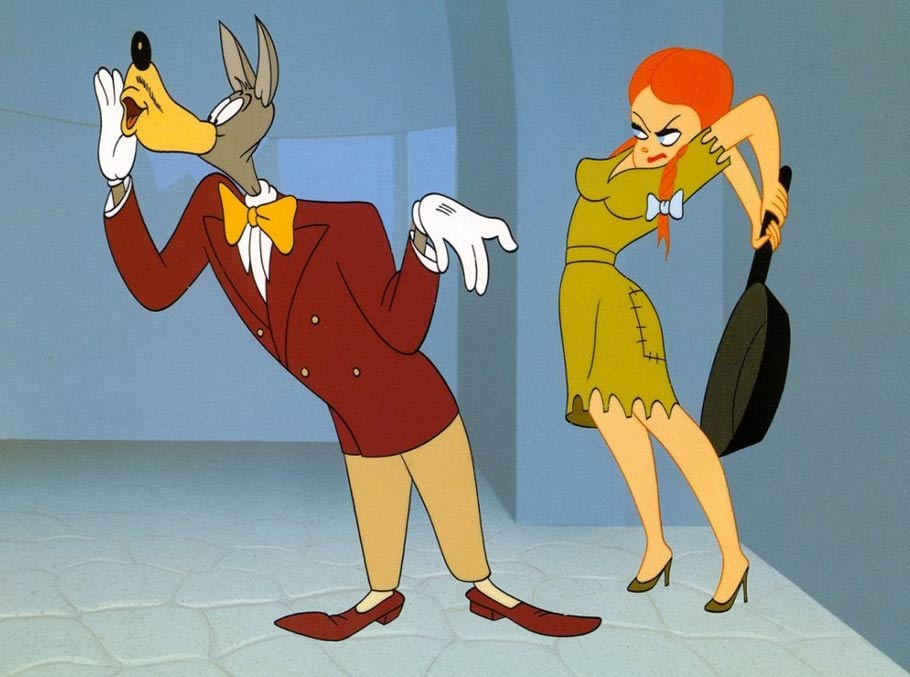
Out of curiosity, I looked it up. The wolf whistle was popularized - if not invented - by Tex Avery.
This image suggests that women didn’t like it even then. But Father Knows Best was deeply entrenched in the zeitgeist of the 50s, and if they could have a whole moralizing plot around the idea that Betty wanted to be whistled at, there must have been at least some truth to it.
And the moral, of course, was not that there was anything wrong with it. Betty eventually learned that the only reason she wasn’t getting wolf whistles was that all the boys in town had known her for years and grew up with her, and it was the new girls that they naturally whistled at!
I must dispute this. For one, the “counterculture movement of the 1960s” was a continuation of the civil rights movement that began in the 1950s (which should be credited to those who fought in WW2).
More fundamentally, the values of mainstream society have long been in flux. As an example , even before the hippies in the 1960s you had beatniks in the 50s. On TV, Maynard Krebs portrayed the stereotype from 1959 to 1963, so even then tv referenced the existence of a counterculture.
The Twilight Zone, from 1960 to 1964, was another subversive show (Rod Serling originally wanted to do a broadcast about Emmett Till, but ran into censorship. The supernatural show was his end around).
I don’t know for certain, but I imagine that counterculture elements made it into radio broadcasts even prior to that. Certainly it was the era of provocative comic books (sufficiently “concerning” that Congress conducted hearings on how it was corrupting the youth).
Father knows best may have presented one version of Americana, but I don’t think it was the only one found in 1950s media.
The radio version scripts of Gunsmoke were actually fairly "progressive’, despite lots of violence. It ran in the early 1950s and reinforced a few things fairly consistently I noticed. American Indians were always portrayed in a sympathetic light, while they were acknowledged to be dangerous, Dillon was good friends with the various tribes and whenever some atrocity occurred against settlers, it invariably turned out to be those ignorant hick hillbillies trying to pull a fast one, and blaming the noble savages.
The bad guys generally always had a southern accent, or ignorant hick rube rocks-in-the-mouth manner of speaking. The only southerner ever portrayed as an OK guy was Chester, Dillon’s affable deputy, but he was just one step removed from an outright idiot.
And he slipped in a lot of stuff in the background - in “Passage on the Lady Anne” when the main characters are at a travel agency, there’s a black couple (one wearing something like a dashiki, I think) also making arrangements of their own, which startled me for a show made at that time period
“I’m so dang mad, I could smoke a pickle.”
The word “counterculture” appears to have coined in the 1968 book The Making of a Counter Culture by Theodore Roszak. The concept of building a better society at utter odds to the current one goes way back, long before America was a dream. In American history, look at the Shakers, the Mormons, or the Transcendentalists. Readers of Edward Bellemy’s utopian novel Looking Backward created “nationalist” communities in the early 20th century to emulate the book.
What changed in the 1960s is that the counterculture grew from a few idealists in San Francisco, the home the beatnik counterculture, into what became the hippies. And the hippies grew into a national collective ideology/movement in a way that no other non-political movement had. (Except possibly the prohibitionists for very different reasons.)
Mass popular culture expanded exponentially starting in the 1950s. Catering to a youth culture as a force with spending money differentiated from adults buying and controlling their purchases developed in the 1940s because of the war. Juvenile delinquency was another product of the same war effect, of adults working or away at war and reducing supervision of bored and disaffected teens, who Lord of the Flies’d it into groups of their own. One major reason why 50s tv shows were so concerned that they determined to air picture perfect families as examples of what the nuclear household should look like, pardon the pun.
Rebelling against the mainstream using mass popular culture was a gamechanger in the way social media are today. The counterculture (or really countercultures - plastic hippies were not hippies) infiltrated every home with music, movies, tv, books, and clothing, aided by the gigantic rise in college attendance which gave them four years of immersion in a youth culture away from their parents.
The 50s spawned the 60s, but that’s like saying fireworks spawned the ICBM. True but not adequate to the scale of the change.