Not a plane I’m familiar with.
See
and
Not a plane I’m familiar with.
See
and
Interesting factoid I just noticed – the Pratt & Whitney PT6 engine on the PAC P-750 is the same engine type used on the Twin Otter you mentioned. As you said, very reliable engines, but both crashes caused by engine failure, pointing to likely inadequate/improper maintenance.
B-52 crash.
Russian Tu-22M3 crashes in Siberia:
Two strategic bombers, on the opposite sides of the world, crash within hours of each other. That’s just weird.
Another type of flying:
One of the big names in base jumping just died in an accident:
Here is a recent interview with him:
Wow, bad week for falling on purpose.
The problem with engine failures, or any other emergency in a plane, is the lack of practice. There’s no requirement that a pilot actively practice for loss of an engine. What often happens is a low altitude stall/spin. There is no recovery from this.
It all starts with trimming the plane for best glide speed. Then, you look for alternatives. They have to be within the range of the plane as it’s trimmed out. This a universal process. If a pilot doesn’t train for this then panic ensues and airspeed gets ignored.
Nope.
It starts with lowering the nose aggressively and instantly. From distinctly nose-high to definitely nose low. At a time when your inner ear is falsely telling you you’re already nosing over. Then establish best glide speed. Then trim.
And simultaneously throughout that process correct for any rolling or turning tendency. Which will be significant immediate loss of control risk in a multi, but will still be a non-zero factor in a single.
And that right there demonstrates the way somebody, anybody, can pick the wrong thing to focus on immediately when they are startled and don’t have a carefully planned and carefully rehearsed “script” to follow.
I remember from my flying days, in a C-172, that best rate-of-climb speed, and best glide speed, were the same. Was that just a coincidence for that particular plane, was it within the rounding error, or is there a good reason? I’ve always suspected that it was the speed of minimum total drag, but I’ve never found out for sure.
Best glide will be at the speed/AOA for lowest drag, best rate of climb will be close to it, but might be higher/lower depending on how the engine and propeller interact with speed. A fixed pitch propeller could deliver more power at a higher engine speed and so give better climb speed faster than best glide.
Well yah. That’s a given. it’s part of the process of establishing a target airspeed. Trimming is done to take pressure off the yoke.
NetJets plane crashes – some interesting video on how hard the window is to break. Six on board, one dead (as I read it, may not be final).
Brian
I am a Vehicle Rescue Technician; the last time I cut a car apart (with the Jaws of Life) was less than 48 hrs ago. Since it was a training exercise, we did everything to that car including some of the things that would rarely need to be done in a rescue. While the side & rear windows in a car are safety glass & will shatter when either hit with something large & solid, like a cop’s baton or a hammer or when enough point pressure is applied at the appropriate place (corner) with a window punch (the preferred method as glass that comes out will fall straight down & not go flying into the cabin where it might hit the trapped people). The front window is laminated with plastic sandwiched between the glass & cannot be broken the same way as the other windows because, for obvious reasons, the front windshield stands a much higher likelihood of an impact while driving including animals like birds & deer, a rock being shot up from the tires of the vehicle in front of you, something falling off of the truck in front of you, etc. The way a windshield is removed is to swing a glass tool/ax to create a purchase point / small hole in the windshield & then use a saw (the black part on the bottom that is folded into the handle channel so the blade is not exposed) or a battery operated cutting tool; we have a dedicated power tool, kind of like this but a Sawzall can also be used.
I can only believe that airplane windshields are at least at that level & probably higher, given the higher speeds & the pressurization of the aircraft. That’s a longwinded way of saying I’m not at all surprised they couldn’t knock the windshield out.
Do you mean ‘not safety glass’? I call the windshield ‘safety glass’ because it doesn’t shatter.
Aircraft windows and windshields, at least in GA aircraft, are made of plexiglass.
Nailed it. The difference, between engine on and engine off is not that you need a significantly different climb speed than glide speed. It’s that when you go from X hundred HP to zero, the pitch attitude to hold that speed changes very abruptly. And every second your nose is higher than the steady state glide pitch, you’re losing speed. Speed that you’ll have to gain back by lowering the nose below the steady state glide pitch until the speed builds back up.
Over at ‘The Points Guy’ website, they have an article with a good breakdown on what cockpit technology looks like today…
Unlike cabin windows, the flight deck windshields are made with glass-faced acrylic — an outer layer of glass bonded to stretched acrylic. Then, there’s a layer between them, made of urethane. Each has anti-ice and anti-fog systems. In the case of the Boeing 787, there are then layers of stretched acrylic, just like the cabin windows, albeit much thicker — between one and three inches thick depending on the aircraft.
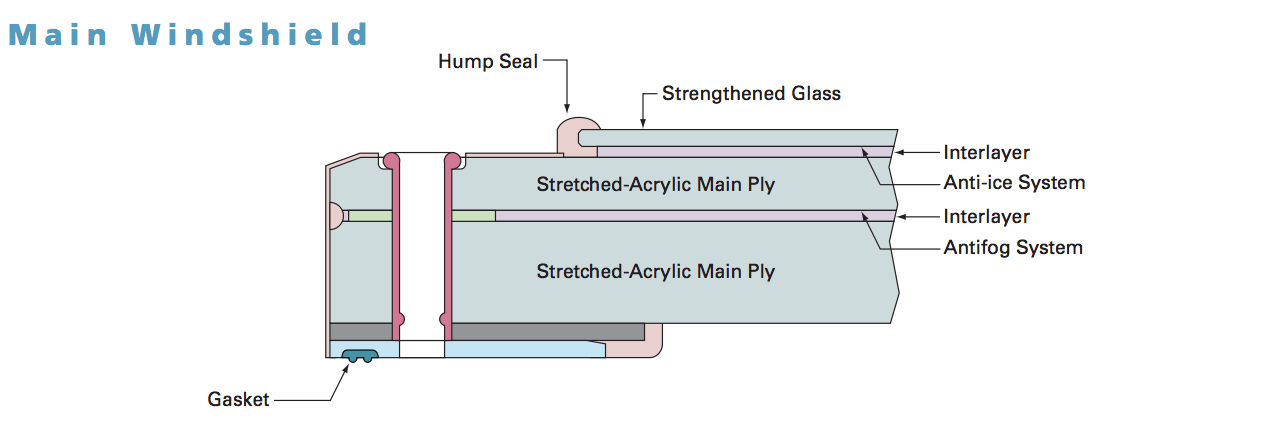
… with some further good info about slightly older versions of the window technology.
In some cases, such as the Boeing 737 and Boeing 747, the windshield features two plies of tempered (i.e. hardened) glass along with an interlayer. This design is likely a throwback to the originally-approved designs, with the Boeing 787 sporting a lighter version with an outside, tempered glass ply.

Now these examples are clearly from commercial airliners, but from my poking about on the web, private jets are very similar, it’s just that I couldn’t find any relevant model-specific cross-section images.
At any rate, multiple layers of bonded, laminated acrylic up to 3 inches thick, yeah, those small glass breaker points meant for tempered glass a car uses are not going to do anything but make a small divot.
The plastic and glass windshield of a Boeing is about 1-1/2 inches thick. Made of several layers of super glass and super plastic. The windshields on a bizjet will need to withstand the same forces. The only difference is they’re generally a little bit smaller, which means they can be a little bit thinner because the unsupported middle isn’t as far from the supported perimeter in its frame.
The canopy of the F-16 is between 3/4 & 2" thick Lexan depending on where. The approved break in procedure is to use a power saw to cut a rectangular hatch into the plastic. Without going in too deep and cutting a hatch into the pilot.
A rescue and a trepanation! What’s not to like?
What I was calling safety glass can also be called tempered glass; it spiderwebs into lots of small pieces that are not supposed to be sharp (like plate glass). In this photo, someone/thing pushed in the middle of the window but you can see how the pieces that are still there that will break away if you touch them; totally different than the windows in your house.
Windshield glass is a laminate, which is a different type of safety glass.
A fair number of people have gotten cracked front windshields on their cars and the question arises whether to leave as is or repair/replace. Is there a safety risk leaving it with the crack?

