I just received the new SB-15 flash from a different seller. The battery holder popped out as designed. I put fresh batteries in it and… nothing. The A/MD/M/TTL indicator did not light up, and there was no familiar high-pitched whine to indicate the flash is charging.
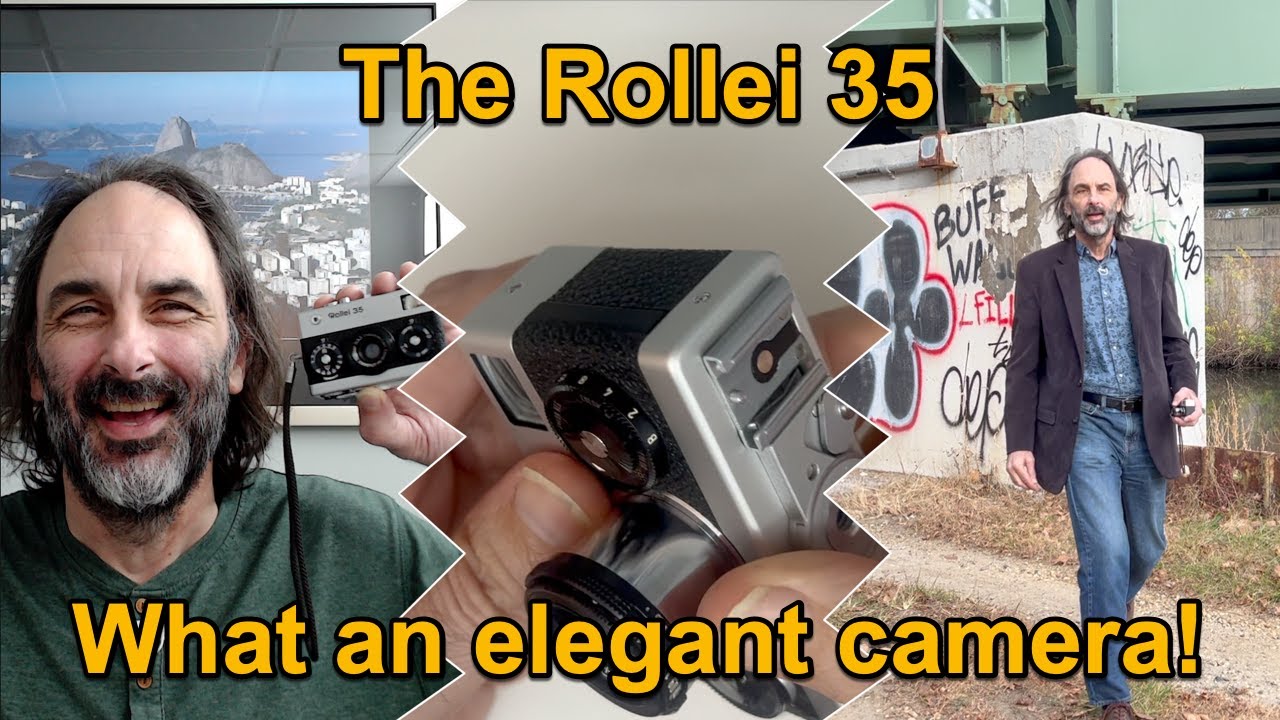
I finally got around to putting together a relatively comprehensive video on the classic Rollei 35 camera (starring the two working specimens I mentioned earlier).
These are super cool cameras, though they really are best used outdoors and for street photography. You use one because they are so cool, and you want the Rollei Experience–that’s often enough to justify owning one. The Rollei 35 is definitely not an all-around “go out and shoot for fun” camera; there are better cameras for that.
I was hoping to finish off the roll of B&W film in the Canon A-1 from our vacation in October, but I haven’t. So I took the three rolls of Fuji colour film to the studio last week.
I still have a roll of B&W I shot specifically for home-development, but I need to watch @minor7flat5’s video a couple more times before I attempt it. (I did d/l the app onto my phone.)
As I said earlier, I my hobbies go in fits and starts.
Very cool! I just figured that if you were into Rollei 35s, you might want to know.
On a slightly different topic, what’s with the new production film cameras being SO expensive? I mean, the new Lomo MC-A is priced at 549.00. That seems more than a little ridiculous for a basic autofocus non-zoom point and shoot. I mean, a much more capable camera in say… 1995 cost less, even adjusting for inflation, etc… Hell for $25 I can get a much more capable, albeit much older camera off eBay.
I suppose supply and demand and all that, but the current film camera prices seem a bit extravagant.
It’s probably the same reason why a good tape player today is super expensive and pretty crappy quality, compared to the heyday: inflation and economy of scale. They could make really good point-and-shoot cameras back when they could sell millions of them, leveraging a highly tuned infrastructure and reaping profits even on narrow margins. Now, to launch a niche camera with the same features is pretty darned expensive.
I’ll have to get one at some point. I love new film cameras.
That’s what I was thinking - a new film camera would be cool, but it just sort of slapped me in the face when I saw that such a basic camera was upwards of $500! I mean it seems to me that a modern new film camera like a Kodak S-88, which has a f10 fixed focus lens, a shutter speed of 1/125, automatic advance and rewind, and flash runs $149.
I had a very junky Vivitar camera that I bought at Wal-Mart in 1991 that did all that, and I think it may have cost $25 (~$60 today).
It’s the crazy asking price for something so bare-bones that gets me, especially when I can still get point and shoot film cameras from the peak of film camera development in the late 1990s for something like 1/5 the price (or even less) used. I mean, I bought my kids spiffy Minolta zoom P&S cameras with sophisticated autofocus and metering for like $20 each on eBay, and they work just fine.
I recently bought an Olympus OM2s in good condition, and am quite impressed with its features.
It’s party trick: off-the-film metering
An advanced feature for its time: true spot metering
The off-the-film metering is pretty darned neat: for slower shutter speeds the camera will stay open until it has counted enough photons and it will close the shutter. This means that in crazy changing light the camera will always nail the exposure.
The spot metering is great because it meters the center circle (the focus circle), which is 2% of the frame. This allows very easy metering of complex light, such as backlit subjects.
Sure, there were other cameras with better features, but I believe the OTF metering was an Olympus-only trick.
Does the emulsion type affect the off-the-film metering? I see differences in both the color and relative glossiness of different film stocks. Wonder how the system adapts?
No idea whatsoever!
Given that the emulsion side is kind of a matte finish, I’m hoping it is pretty good at it.
I suspect it handles films that were popular in the mid 80s.
Wanna see a deep dive, I did a video on it, showing the mechanism, demonstrating it in action, and so forth.
I’ll check out your video shortly. I did some reading about the OM2 this morning and saw that it not only could read off the film, the front side of the shutter curtain has a grid pattern that simulates an average scene, and it can meter off that pattern in really fast shutter speed situations.
And I show that 80’s-era QR code in all of its glory! Yep.
It would read off the film up to the flash sync speed, then after that it would use the QR code thing.
Update… the spiffy old cameras seem to have a limited shelf life, so I’m having to buy mutliples. Mostly because I suspect my older son is less than careful with them- the younger one has had the same one for a year now, and the older son is on his third. Still, for somewhere between $10 and $25 on Ebay, it’s a bargain at twice the price.
Still… the modern film cameras are ridiculous. I feel like they’re aiming at Gen-Z people who don’t know any better. Us Gen-Xers have some sort of intuitive feeling that a fixed focus P&S film camera shouldn’t cost so much. I mean in 1998, I spent around that much and got a P&S with 660 step passive autofocus, a 3.5-9.4 38-140mm zoom lens, and automatic DX coding between ISO 25-3200.
Now for that much new, you get some janky fixed focus camera with much less capability. And you can get a working older one for like $10-30 bucks. It’s kind of galling.
Agree. What’s left, barring some last remaining high end options like Leicas and the new Widelux, are all basically toys. It’s frustrating to me as a photography lover in general to see this flood of really shitty photos posted with some vague concept that “that’s the film aesthetic!”
The art and craft of the medium has been exchanged for what’s no better than a poor quality Instagram filter.