You’ve never owned a jacket or shoes made from leather?
I pet my cat’s skin. I don’t stroke its penis.
And skin and bones are, i dunno, hard dry parts of the body that are well-suited to preserving. Meat, internal organs, fatty tissue aren’t. I guess maybe a penis is, but i wonder what they had to do to preserve it.
Re: chicken wings. That is precisely what I’ve been waiting for the GMO industry to solve. It seems like it would be trivial to code in extra wings on a chicken. The first company to patent the centi-chicken or milli-chicken is going to rake in billions!
Yes, I work in the LED lighting industry, and there is absolutely a cost-correlation with how much quality supporting electronics goes into LED lights. Bottom-shelf brands use cheap low-complexity electronics with relatively high failure rates as a result. Top-shelf lights are UL (and other industry standards) tested heavily with added electronics to add protection and reliability to them. I have some first-gen Phillips lights from the 90s that are still going fine and have never had a failure.
You really wouldn’t like my oosik then. These are a lot like mine, which I acquired whilst living in Alaska. It lives in the umbrella stand by the front door. Some day I’m going to snap and start bashing some solicitor about the head and shoulders with it.
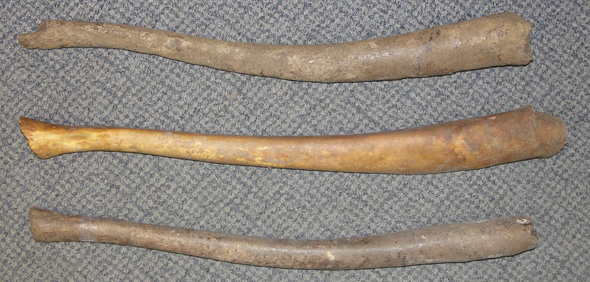
Maybe if you stroked its penis it’d be happier? I’m going to assume if someone went through the effort of creating something out of a cow penis that they took the appropriate steps to preserve it. I’m kind of with you though, I don’t really want to own anything made out of a penis.
I don’t mind giving a dried beef penis to a dog, fwiw. That feels more like jerky to me. But i don’t want a handle made of jerky, either.
Thank you, @tibby. From the bottom of my appetite.
I was telling Racilia (that’s Mrs. Cincinnatus, for you unwashed) about your lamentation, and she went and ordered pounds of wings. You piqued her desire for wings.
She just now paid three bucks a pound and grumbled that they were a buck a pound before covid.
Thanks be to you, I will be enjoying wings real soon.
Paging Doctor Moreau…
Well, yeah. Where else are you going to go when you need a light switch chain? Is anyone going to shop around, or are they just going to pay the $3.95 for it and frown a bit?
That’s just it with a LOT of the things in the thread; they price them where they’re JUST less pricey than it is annoying for you to deal with it yourself.
So you’ll pay $3.95 for a light switch chain, or $25 for pre-punched printer paper, or whatever it may be. That’s the game- the idea is to price it as high as they possibly can, without driving you to whatever alternatives may be available.
Price doesn’t have anything to do with cost whatsoever, except that it’s generally a fundamentally sound business decision to price your good higher than what it costs to make, distribute, market, etc… them. Price, like I was alluding to above, is set by what the market will bear, meaning a seller of goods will try to price something as high as they can without causing you to choose someone else’s product or some other alternative.
There was an attempt-
But there are a LOT of brands of light bulbs right now, so my guess is the margins aren’t huge.
Article in the National Post about stuff more expensive in Canada than elsewhere:
Claims include cell phone service, credit card fees, air travel (though distances can be big), health care and related things and housing. I could think of half a dozen more.
That Dan Halen had some pretty good ideas…
The “game” you’re describing is supply and demand. It’s a rational and desirable system for pricing things.
Anyone else here getting dizzy from going from bull penises in one post to chicken wings in the next and back to bull penises?
Gotta love the Dope 


Probably not.
My whole post was about this idea that people have that somehow because the cost of something rises or falls, there either must be a corresponding rise or fall in price, or that somehow because something costs a large or small amount, that it must be priced accordingly.
Which is not true in the least; plenty of stuff is low margin, and plenty of other stuff has high margins. That’s all dependent on how many alternatives there are/level of competition, what sort of name recognition there is, how well differentiated the products are from those competing products, and so forth. It doesn’t really matter what the actual cost of the product is.
High end hotel rooms. I know that you are thinking “what do you expect?” but if you have been involved with negotiating rates you know that hotel rates make airline seat pricing look rational. For a conference I was just at the hotel could and did sell rooms we didn’t use at a markup of over $200 a night over our negotiated but still wildly expensive conference rate.
Plus I just reserved a room for my 50th college reunion - the 50 year class gets first dibs at the only hotel within easy walking distance of campus. After I did so, I realized that the cost of 6 days of hotel was greater than one semester of tuition 50 years ago. And this is MIT, not a state U.
Cornflakes and venlafaxine.
The cost of the product does play into the supply curve. If there is a vigorous market for product X, and one of the significant inputs into X triples in price overnight, we can expect a change in the willingness of producers to supply X at any individual price point. It is certainly not the only factor, and often is a minor factor, but it’s part of the analysis.
From a practical level, I spent 15 years with the job title “Pricer” and internally, the execs always wanted to know how much it cost before agreeing to a price. Not knowing how much it cost would have been a dereliction of duty.