I don’t know where the “Confessions of a _____” came from rightly. My first memory of it was the book: Confessions of an Economic Hitman but a quick googling turns up Confessions of a Dangerous Mind turns up 2 years earlier.
I guess the question is whether the Marx Brothers assumed, when they first chose those names, that everyone would recognize and chuckle at the homage; vs. whether they just thought it had a neat sound. Assuming it’s the first, then yeah, it’s a perfect example.
The pirate Barbe Rouge and his creware virtually unknown outside of France.
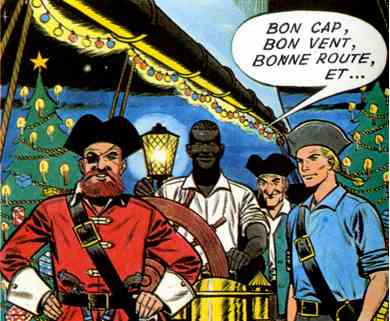
However, the pirates from Asterixare internationally famous.
Anything earlier than “…English Opium Eater?” (1822)
St Augustine, AD 398.
Great show. Howard even guest starred on an episode.
I always wonder whether the name also came from the Beat Generation.
Many of the early Warner Brothers cartoons are filled with caricatures of celebrities and politicians, many of which are relatively unknown today.
I thought of that too, but the hook is the “of a,” no?
Most definitely. I had basically memorized the excellent Bugs Bunny cartoon “Hair-Raising Hare” before ever seeing Casablanca. When I first saw Ugarte appear I shouted “That’s the Evil Scientist!”
Again, TV Tropes has a page on this: Weird Al Effect.
I’ve got this book from 1989 called Bugs Bunny: Fifty Years and Only One Gray Hare. The writer of it makes a similar point. When discussing the cartoon “What’s Up, Doc?” (which was kind of a parody of all those rise-to-fame type movies), he points out the scene where vaudeville star Elmer Fudd comes upon Bugs, who’s fallen on hard times along with several other out-of-work stars. He turns his nose up at Eddie Cantor, Al Jolson, and Bing Crosby doing their familiar shticks, then greets Bugs, “Hey, Bugs Bunny! What are you doing here with these nobodies? They’ll never amount to anything!”
The writer goes on to say that this was tongue-in-cheek satire back then, but to kids watching Saturday morning cartoons today, it’s dead serious…they’ve got absolutely no idea who these guys are!
Like Morbo, I was first acquainted with Peter Lorre, Edward G. Robinson, Humphrey Bogart, and others through their caricatures on these cartoons.
Back when Pop-Up Video was big on VH1, I often thought the Cartoon Network ought to follow suit with “Pop-Up Cartoon Classics”…running Bugs Bunny and other classic cartoons with pop-up factoids to explain all the cultural references that we wouldn’t get so easily today (references to rationing cards in cartoons made during WWII, for example).
There’s ‘The Private Memoirs and Confessions of a Justified Sinner’ (James Hogg) but that’s 1824 – could be the earliest example of the trope, though.
The Confessions of the Celebrated Countess of Lichtenau, Late Mrs. Rietz …
By Wilhelmine Enke Lichtenau 1799
The Confessions of a Singer
Fanny Lyndhurst - 1806
The confessions of an odd-tempered man.
By Amelia Alderson Opie 1818
The Confessions of a Drunkard: A Narrative Founded on Fact
By Luke Howard 1821
Millions of people who know the Beatles and beat music couldn’t tell you the origin and meaning of the phrase:
Indeed, how many of them even know the word “beatific”? The late 1950’s and early 1960’s is a period that fascinates me. It got so overshadowed by the later 1960’s.
And speaking of Airplane!, I’ve met younger people who say “Don’t call me Shirley” who have no idea where it came from.
Voltaire’s Candide was a ruthless satire of Leibniz optimistic philosophy (among other common views of the time). This is perhaps a little bit different since most people read Candide for school, where they probably discuss these facts, but I’d still say that the parody of these viewpoints that Candide portrays are far better known and remembered than the actual viewpoints they’re criticizing.
There is also a joke by Groucho in “Duck Soup” that often gets edited out that references
a popular song of 1930 that was recorded by Kate Smith and Paul Robeson.
Don Quixote himself is the example that I came in to mention. Cervantes wrote Don Quixote as a parody of the then-popular (although fading) chivalric romances; the romances from that era have been mostly forgotten, but Don Quixote himself survives as our familiar exemplar of a “chivalrous knight”.
Three Stooges short “Men in Black” overshadows the Clark Gable-Myrna Loy film “Men in White” it spoofs.