What is it about cold fusion that makes people defend experimental error with such fervor?
The possibilities are so delicious … imagine a free non-polluting energy source that can’t be weaponized … unmetered electricity for everyone on the planet … helium for pennies to the ton … the list goes on …
It’s also something that somebody who enjoyed college Physics 101 but only got a C can sort of relate to. It seems to be at the ideal level of complexity for arm-waving amateurism.
Actual true fusion is way up there in complexity both as raw science and as engineering. This cold fusion stuff is not.
Hey, OP -
Why don’t you try your experiment with these rods, instead of pencil lead, and see if you detect any iron in the ash?
If you don’t (or if it is significantly less than your original experiment), how does that change your hypothesis?
Be a Scientist, not a crank!
I’ve been looking, but I haven’t seen anything relating the mechanism of radioactivity to QCD such as: Quantum chromodynamics - Wikipedia. So it isn’t terribly obvious, maybe you can give me a reference.
The paper that referenced did not calculate the spectral lines of carbon. It calculated “excitation energies” which sounded like energies required to remove electrons from a specific shell location, so this is not exactly what I was asking for. I asked for this because I’m pretty sure this type of calculation can’t even be done for Helium, or if it can, only by shoehorning a best fit solution using the resources of a supercomputer to do it. As you mention these QCD lattice calculations are horrendous. The question is if they are horrendous because they really are, or they are horrendous because you are trying to do something akin to calculate the motion of the planets assuming the Earth is at the center of the universe. Things would get a lot more complicated with the wrong theoretical basis.
I bring this topic of spectral lines up because this is something that is not very well handled at all. How good can your theory be if it can’t even predict the spectral lines for Helium which is just the next larger atom than Hydrogen which is really the only atom you can make any predictions for using quantum mechanics.
When I look at the problem in view of my cubic atomic model, I know that the electrons are not orbiting outside of a tiny nucleus, they are normally locked within the body of the atom. What can happen is that they can get knocked off of the atom and they appear to take quantized steps away from the atom because I believe that space itself is quantized. If you take this simplified view, then the spectra is just due to the potential coulomb force difference between the various steps an electron can take away from an atom. The Rydberg formula which describes the spectral lines for hydrogen is just such a subtraction of Coulomb force equations. Energy = R(1/n1^2 -1/n2^2). The work that I have done has shown this can be extended to explain the spectral lines for Helium, Lithium and Beryllium as just scaled versions of the Rydberg formula. I did this by finding staircase patterns in the spectral data and fitting those to formulas. So the spectral lines for Lithium can be explained with just 5 scaled Rydberg-like formulas. I discuss this in my paper:Explaining the Spectra of Helium and Lithium using the Rydberg formula
Considering that this isn’t something that quantum mechanics can’t do without breaking out a supercomputer and whole lot of bailing wire and duct tape, it is something worth considering because it so totally simplifies the picture of what is going on with the electron that is generating the spectra. It’s like finding out the Earth isn’t the center of the universe.
The reason why this is so much simpler is that you don’t have to deal with all the other electrons flying around the nucleus which presents a gigantic multi-body problem. If all those electrons are safely locked away in the atom, then we only have to consider the single body problem of an electron making quantum jumps away from the bulk of the electrostatic force of the atom. If you look at the charts in the paper, it is very easy to see a stair step pattern emerge which fits most of the brightest spectral lines. Of course there are going to be other things going on and there are some multi-body considerations and this doesn’t explain all the lines, but it does explain the brightest ones. Even if you don’t believe in my crazy atomic model, you should still look at the data and see how I have organized the scatter chart spectra into neat predictable categories and patterns.
Now if you don’t believe me, then please find me that quantum mechanical calculation for the spectral lines of lithium. (The paper should mention ‘wavelengths’ or ‘frequency’.)
Did you see my redo of the experiment:
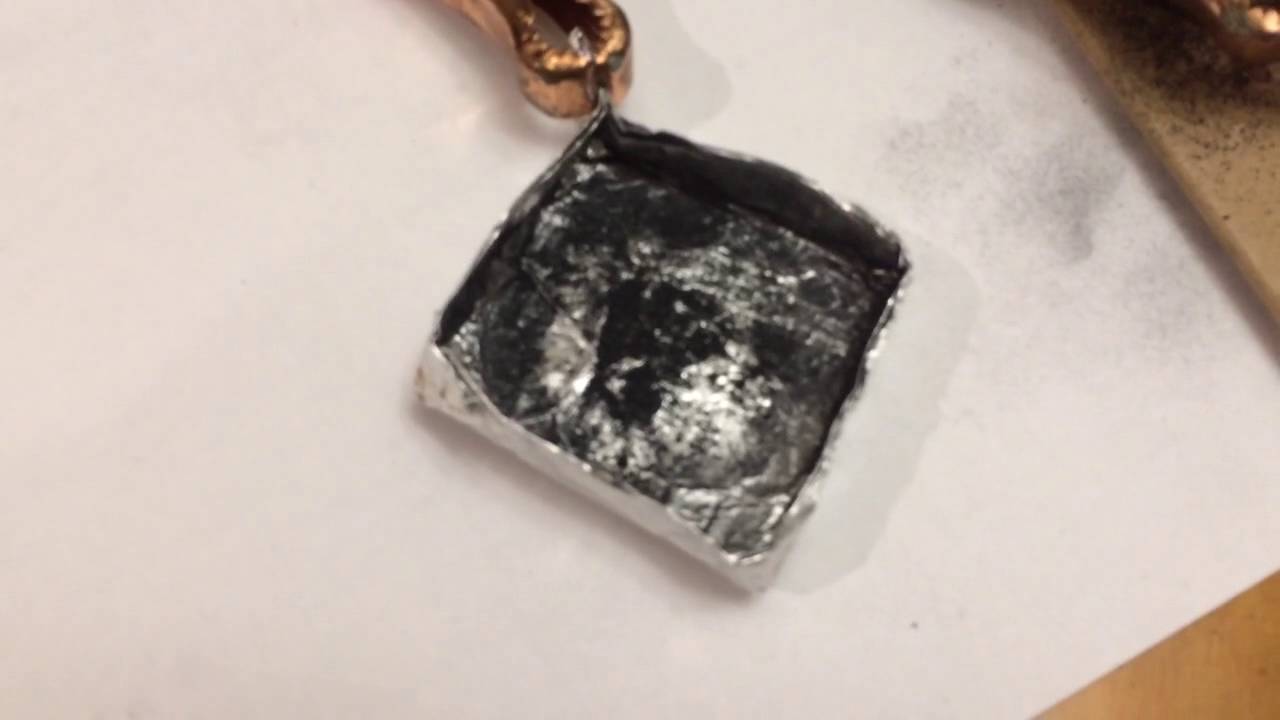
For that, I did buy some carbon stirring rods from ebay, but I found that even these still had traces of magnetic material. Somebody did make a comment that maybe the reason why we can’t find any carbon without iron is because it is so easy for carbon to turn into iron in the presence of oxygen.
Eventually, I had to take the purest graphite powder I had and run a magnet over it a zillion times to remove all the magnetic particles and then perform the experiment on that. Magnetic particles were immediately found when there was none to be found prior to the sparking. That’s pretty much as good as I can do. There have already been university funded and published replications of this experiment, so if you don’t believe me, believe them.
You could read my paper on how electromagnetism works:
Now this is a no holds barred, attempt to explain the electrostatic field in a fully mechanical manner. There is no action at a distance since space is completely filled with an aether which is composed of positron/electron dipoles which I call ‘poselectrons’. The basic mechanism is that positrons and electrons emit waves in opposite phases. So phases of similar charges add creating a repelling high pressure and phases of opposite charges cancel, creating an attracting low pressure. That’s all it is.
Now considering that mainstream science cannot even approach this question of how ‘charge’ works, I think this is worth considering. When Lisa Randall was asked how charge worked, she honestly answered, we don’t know. Anyone else would honestly answer the same way or just say we don’t need to understand.
Except cold fusion wouldn’t be an energy source. It’s like getting excited about a new form of coal that burns at room temperature, or that you’ve finally invented lightbulbs that stay dark when they are switched on. Darkbulbs.
Your version doesn’t explain charge either. What keeps these aetheric ‘poselectrons’ from just floating around aimlessly? What is ‘dipole’ about them unless they exhibit the ability to attract or repel one another?
Darkbulbs exist in Terry Pratchetts Discworld, because you see dark is separate from light in that universe. The speed of dark is also different to the speed of light. Must make for interesting physics experiments!
FranklinH why did you completely ignore my reasonable question:
Where are your thousands of experiments and observed data that you have used to form your cubic model? What specific things do you believe that your model explains that the standard model doesn’t? (I mean in addition to your arc pencil lead experiment).
Why can’t we turn brass into gold?
[sup]29[/sup]Sn + [sup]50[/sup]Cu -> [sup]79[/sup]Au
Nitpick: that’s bronze into gold.
But maybe Aluminium Bronze into Gold and Chlorine would work:
Al + Cu -> Au + Cl
I can’t see a problem. 
Awesome coinage. Bravo!
I think we’ve found ourselves a darkbulb. A flux of insight is directed towards it and somehow the insight goes in and stays in, never to emerge in the form of an improved understanding.
I sense the birth of a new SDMB in-group meme.
I can’t take the credit for it. A former colleague ran a maintenance workshop - there was a Mythbusters-type wall of storage boxes, some of which were labelled ‘light bulbs’. the recycling can for spent or failed lamps was labelled ‘dark bulbs’.
Yes, better … for your third try could you pretty please do some quantitative analysis … specifically regarding mass … correct me if I’m wrong, but your claim is that we’re adding 2 oxygens for each reduced iron created, two more if the iron is oxidized … this should be plain from the before and after mass measures …
Also, what are the voltage and power inputs … and how does changing these effect the outcome?
Cite?
Dammit … I typed “bronze” in … turned my back and my fucking cat edited my post … I swear …
Praseodymium … about $50 an ounce … [sigh] … I guess I better call the real estate agent and have her stop looking at villas up above Monaco … and disconnect my plumbing from my electrical service … apparently 110 VAC doesn’t work for this process …
Cool.
I live on a beach not too far from a real working lighthouse. During the day it just looks like a big black post or smokestack in the middle distance. At night of course you can see the beam sweeping across about 90 degrees of the horizon. Wife and I tend to go for walks in the late afternoon near dusk. It’s always fun to discover whether today we’ll see a lighthouse or a “darkhouse”. IOW, before or after it’s late enough to have switched on.
We’ve been using that coinage now for a couple years. I’ll have to tell her about the darkhouse being equipped with darkbulbs. 
The Darkhouse is probably pretty useful for making sure ships don’t crash into the rocks on very bright, sunny days.
Which university? Published where?
Do you have links?
I think the point of the cold fusion folks is that you can get it to occur at normal temperatures, not that the reaction produces no energy.
The OP’s reaction produces no energy, though.