Maybe so. But at least there are no paradoxes.
Well, nothing at the arriving end. If this process causes you to disappear from the departure end then that’s something - just more something along the lines of being tricked into committing suicide.
Well, it’s just like winding a movie back and watching it again
Except it is impossible, because the machine that made it happen would first turn itself off, then deconstruct, by virtue of the premise.
Didn’t they say that the person traveling would remember nothing of the future? From whose perspective is this ‘rewinding’ apparent?
That’s the point - you could argue that time is doing that continually (although what does continually even mean in that context?) - if everything rewinds, there is no noticeable effect
Okay, sure - there’s no real time travel there.
On a separate subject, I don’t get the argument that time machines would either self-destruct or be unable to send things back before their own creation (except as an arbitrary restriction for narrative purposes). If something could send things back, I don’t think it would care at which point the molecules in itself were rearranged from being a not-time-machine into a time machine.
This stuff comes from the link I posted earlier. The “time machine” there consists of a hypothetical wormhole where one mouth is fixed while the other end goes on a “twins paradox” trip, creating a time differential. To send something back (or forward), you need to send it through the tunnel, so first of all the tunnel shortcut needs to exist, and not collapse before you can make your trip.
As for exploding,
**Time machine self destruction:** If it turns out that wormholes can be held open, then doing so is not enough to guarantee that an ultra-advanced civilisation can convert a wormhole into a time machine via a twins-paradox trip (carrying one mouth out into the Universe at high speed and then back). There is a second obstacle that must be surmounted — time machine self destruction:
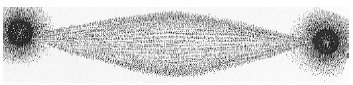
Time machine self destruction: As the right wormhole flies back toward the left, at the end of its twins-paradox trip, vacuum fluctuations flow through the wormhole then out through the space between them, returning to their starting point at the moment they left. Their gravitating energy grows extremely large, and perhaps destroys the wormhole at the moment it becomes a time machine. (Figure adapted from my book Black Holes and Time Warps, [4].)
As the travelling mouth is returning to Earth, there comes a first moment when its wormhole can be used to travel backward in time. The first thing that can do so, and thereby meet itself before it left, is an entity that enters one mouth, exits from the other before it entered, and then flies through the Universe back to its starting point at the highest possible speed, the speed of light — arriving back at the first mouth at precisely the moment it started its trip. Even if no light or other light-speed radiation travels on this round-trip time-travel route, vacuum fluctuations will always do so. They cannot be stopped. Upon arriving back at their starting point at the very moment when they left, the vacuum fluctuations will pile up on top of their younger selves. The result is a duplicate of every fluctuation, and then, with another round trip, a quadrupling of every fluctuation, and so forth. The bottom line, according to a calculation that I did with my postdoc Sung-Won Kim in 1990, is an explosive flow of gravitating fluctuational energy through the wormhole at precisely the moment when time travel is first possible — at the moment of time machine activation [4].
Will this explosive fluctuational energy destroy the wormhole and thence the time machine? At first Kim and I thought the wormhole could survive. However Stephen Hawking gave strong arguments to the contrary, in his seminal 1991 research paper on chronology protection. The explosion is very likely to destroy the time machine when it is first activated, Hawking argued — and not just this time machine, but any time machine that even the most advanced civilisation might conceive and build. Over the next few years many other physicists weighed in, with analyses of other time machine designs, and it began to look like Hawking might be wrong: a sufficiently clever design might protect a time machine from self destruction. Then in 1996 Bernard Kay, Marek Radzikowski and Robert Wald developed a powerful mathematical proof that the version of the laws of quantum physics which we were all using to analyse time machine self destruction are incapable of revealing the explosion’s outcome. The outcome is held tightly in the grip of the laws of quantum gravity, which we do not yet understand fully.
Investigating major historical events in contemporary time? I’ve only read the first two, but thoroughly enjoyed them and would like to read more.
That’s a good one, too.
My favourite is The Sorrow of Odin the Goth, part of Poul Anderson’s “Time Patrol” series.
There are four ways to prevent a paradox in a time machine.
1/ First is the ‘boring physics’ option; time machines don’t work, period. This is the most likely one to be the actual case.
2/ Second is to invoke Novikov consistency; if you travel to the past you can only perform certain actions, because they are fixed and have already happened.
3/ Third is to make sure that (if you are using a wormhole time machine) your wormhole mouths never come close enough to allow the formation of timelike loops. This is also a kind of ‘boring physics’ option, since you can never travel back in time to your absolute past; but it can be surprisingly useful, since you can travel back to a point that nearly creates a timelike loop, and thereby get more time to play with. Do it right and you could travel all over the visible universe in a negligible timespan (as seen from your own frame of reference, of course).
4/ The other way to avoid creating a timelike loop is to place your second wormhole mouth in a different timeline, i.e. an alternate universe. There wouldn’t be any virtual particles to collapse the wormhole if each mouth were in a different universe.
https://www.researchgate.net/profile/Xiao_Yuan10/publication/269722579/figure/fig2/AS:299381459832860@1448389510683/Deutschian-timelike-curves-a-depicts-a-physical-visualization-of-a-CTC-where-an.png
Thank you for that. I enjoyed it. 
I love that one! I read it ages ago and have been looking for it for a long time (on and off…mostly off but occasionally I would remember and try again).
Thanks for posting that. Bookmarked for future reference.