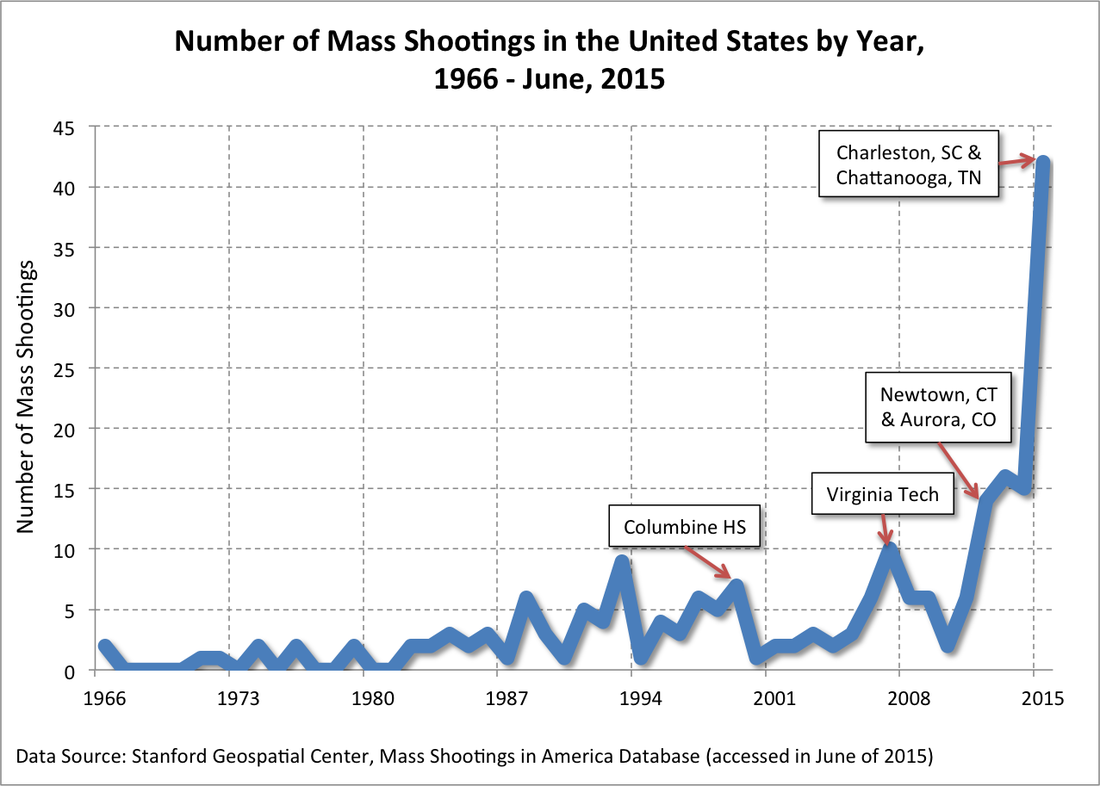
Violent crime has fallen compared to the absurd levels of the early-mid 90s, but even with mass incarceration and mass surveillance, violent crime remains above the rate it was in the late 60s.
I don’t think sitting in traffic for hours each week provides any psychological benefits. And I also believe that the sedentary nature of most people’s lives can be attributed to the fact that most places in the US are designed for cars, not pedestrians or bicyclists. If we were just a little more physically active, I think we would see increased wellness–mental and physical.
But I don’t know if the physical ugliness of our environments is responsible for social pathology more than the stress of modern life.
Japan has a massive manmade environment and they do not have the problem with drugs, crime or mass shootings that we do. Depression, anxiety and suicide are common there though
Also according to steven pinker, people are much more violent in hunter gatherer tribes than they are in modern society.
So if megacities like Tokyo are “monumentally dehumanizing and atomizing”, why are crime, drug addiction, and mass shooting so low there? You’re being hopelessly inconsistent now. You have to pick a single set of causes and a single set of effects (and you have to define them presisely). Then you have to show that consistently, with some statistical evidence (not anecdotes), everywhere that the causes existed there was an increase in the effects. You can’t just say that in country X from year Y to Z the cause existed and during that time there was an increase in the effects. That increase could have come about because of other causes. If something truly causes something else, it should consistently cause it, not just in a few cases.
I’ve been there a few times and I strongly disagree, the city is full of humanity, and I’m not talking about population numbers. It absolutely exudes culture (AKA human space), street performers, festivals, parks, temples, shrines bars an little Mom & Pop restaurants. a million things here and there in little gardens, alleys and side walks that show the touch of human hands working alone or as a community to create a healthy environment for people.
I’ve never been to Tokyo, but I’ve found that plenty of cities are like that; I live in a city like that.
Some people, though, just don’t like cities, and nothing you say will ever make them see anything other than an overcrowded hellscape. I suspect the OP is one of those people.
Show us the statistics that indicate that people who spend their time on streets like the first of your links are more prone to the problems that you talk about than people who spend their time on streets like the second of your links.
I’m sure you thought you were being clever or poetic or whatever, but that’s not really what “entropy” means.
If you zoom out, you can see the rigid structure of 1 mile square superblocks, enclosing various geometrically laid out subdivisions, strip malls and office parks. That is literally the opposite of entropy. It is a system designed for strict order, isolation and repeatability.
I don’t think anyone is talking about a return to prehistoric living conditions. People are discussing creating urban environments that are more livable and sustainable.
What they are really talking about is the landscaping and architecture relative to the scale of the buildings and interaction with cars and other transportation networks.
For example, the Target store and its parking lot to the north near the rail yards has about the same footprint as 3x2 blocks of townhouses in Hamilton Park or the residential towners in Newport. It’s not “walkable” because it’s just a hot, flat, asphalt ocean surrounded by 6 lane highways. And the only thing you end up walking to is the Home Depot next door.
My first response was flippant. But it was to contrast the heavily over-wrought OP about the effects of poor urban planning compared with some unspecified ideal of pre-industrial civilization. Do I like nature and trees more than concrete jungles? Sure. Who doesn’t. Can urban planning be improved? For sure. But is there a real need to make the walk from Target to Home Depot a lovely and relaxing experience? Would be nice, for sure. How much should we invest in urban planning to make that possible when 98% of the traffic between the two is done by car because people aren’t likely to carry schools supplies in one hand and paint cans in the other. They just want to push the shopping cart to the car and then get home as quickly as possible using the maximum available lanes of road in order to do so. In summary, ugly suburban landscapes sometimes put function over form because it’s more efficient. But I would not object at all if they planted more trees on the route.