I think he may be getting at different control strategies, so to speak. In an airplane you turn the yoke to the left, the plane rolls, you turn the yoke back to the center and the plane (more or less) holds that bank angle. To get back to straight and level, you turn the yoke to the right. (I assume helicopters are somewhat similar.) When the yoke is in the neutral position, that means “keep doing what you are doing”. A steering wheel in a car is different. When the wheel is in its neutral position, that means “go in a straight line”. I remember reading something about it once; wish I could remember the specific terms they used for the different types of controls. It’s the difference between using controls to make a change in your orientation, and use controls to define a change of position.
I wouldn’t be at all surprised if there are drones that implement the controls as a change of position. Push the joystick forward, drone moves forward. Move the joystick left, drone moves left. You and I know that the onboard controller is making that happen by changing the pitch and roll, but it doesn’t provide true pitch and roll controls to the pilot. I think that sort of control strategy might be easier for a non-pilot to grasp, but could be absolutely infuriating for a pilot.
No, I didn’t.
I’m an A&P, 23+yr helicopter mechanic (.civ and .mil), and former helicopter aerial observer/aerial gunner. I’m also a Quality Assurance Inspector at my current job, working on Sikorsky S-92s.
So, now that we have each established our qualifications…
Correct.
Correct.
Incorrect; the model *is *controllable in the pitch control axis, through the pilot’s manipulation of the cyclic.
I *believe *you are referring to pitch as a function of the collective (i.e. “pulling pitch”). I am referring to pitch in terms of either the flight control axis (nose-up, nose-down), or the main rotor blade angle.
On the V911, the right stick on the radio functions just like the cyclic** in a 1:1 helicopter - it controls the movement of the helicopter in the pitch and roll axes by altering the rotor tip path plane (or rotor disc angle, depending on how you were taught).
The left stick on the radio functions as both the collective and the tail rotor pedals**. In a “fixed-pitch” model, moving the left stick up and down (i.e. moving the collective up and down) speeds up and slows down the main rotor, which increases or decreases lift and thrust. In a “collective pitch” model, the rotor speed is set by a separate switch (the Idle-up switch), and collective up and down moves the swashplate, which changes the main rotor blade pitch angles collectively, which increases or decreases lift and thrust, just like a 1:1 helicopter.
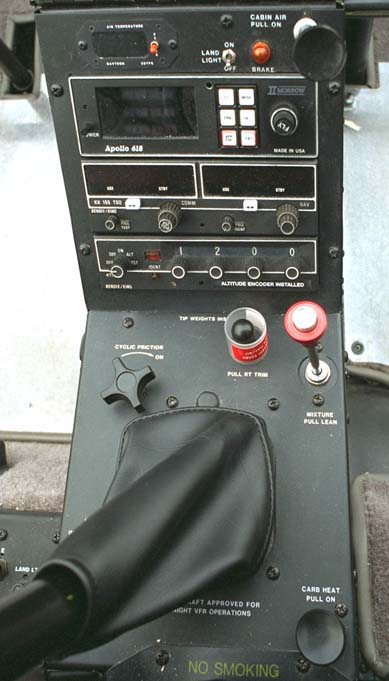
I didn’t know Robbies (other than the R66) had a power compensation system; good to know. This leads me to a couple questions: does the Robbie have a twist grip throttle, or a throttle lever on the console? What about mixture & carb heat controls? I’ve never worked on a Robbie or sat in one, so I don’t know a whole lot about them.
** There are some RC pilots who reverse the controls on their radios, and have cyclic on the left stick and collective/yaw on the right stick. Not sure why, but apparently it’s a European thing. The RC industry calls that “Mode 1” control, and calls cyclic on the right and collective/yaw on the left “Mode 2” control.
Aha! Yes, I was thinking of controllable pitch as in ‘feathering hinge’.
Robinsons (and Hughes/Schweizer/Sikorsky 269/300s – you may know them as TH-55s) have twist grip throttles. Both the Robbos and the Schweizers I’ve flown have throttle correlators. Both helicopters have the mixture and carb heat controls on the panel or console. Here is a photo of an R22 mixture control. Note the plastic tube that says ‘control guard’ on it. That’s there so that you don’t pull mixture when you intend to pull on right-trim. The carb heat is in the lower corner of the console, on the same side as the mixture. Here is a Schweizer 300C panel.
Thirty years ago, I flew/crashed/repaired a Hirobo Shuttle. Powered by a nitro motor, controlled by a early computer radio,and kept somewhat straight by a tail rotor gyro.
Most of the time spent on that heli was spent on replacing parts and balancing all the moving bits. A couple of years ago I bought a micro heli. along with a modern radio. What a difference! Its tiny, about the same size and weight as a sparrow. Flown over fairway length grass I’ve piled it in at high speed inverted, no damage as long as the electric drive motor is throttled down while the crash is going down. Pick it up, place it up-right and have another go. Almost as painless a way to learn to fly rc helicopters than a good rc simulator.
I’m in the process of upgrading to a 3-d electric heli (Which is RC for variable pitch , and can fly inverted) and I’d strongly recommend either the VL 911 or Nine Eagles Solo Pro as a starter before you go that route. I’m looking at the VL950 , most likely. Here. Parts are cheap, and you can hot rod them pretty easily.
Also, the new radios are digital spread spectrum so your old gear probably won’t work, Johnny.
Cool. I know a little bit about the S300; I spent a day helping get the first Sikorsky-built S300 ready for first flight, back when I was a Sikorsky employee.
The closest I’ve been to a Robbie was an R66 that a customer flew into a different employer’s heliport, to drop off a pilot to fly their Hughes 369A home after maintenance. Nice little machine.
Unfortunately, that radio won’t be even remotely compatible with any RC helis in current production. '70s-vintage gear is 27/72/75MHz AM analog; current gear is 2.4GHz spread-spectrum digital.
Fortunately, there is a small segment of RC hobbyists who lust after vintage radio gear; you should be able to significantly offset the cost of a RTF (Ready To Fly) heli by selling the vintage radio if it’s in good shape. Bonus $$ if it’s operable.
The new radio gear is incredible compared to the old. One decent-quality transmitter can have “model memory” for dozens (in some cases, hundreds) of models - you just buy separate receivers for each model. The computer that drives the Tx digitally “binds” itself to each receiver, and changes settings as required to accommodate each model; high-end Txs can even be used for both helis and fixed-wing models. Tx antennas are small, not unlike what you’d see on a wifi router; receivers are tiny, without the long antenna wires that loved to get tangled on everything… yet the range is basically “If you can see it, you have control of it”. Servos are tiny, fast, and powerful. No more 3ft metal whip Tx antennas to poke people’s eyes out, no more checking frequencies in use nearby to see if you can fly (or even power-up your radio), no more glitching if a trucker with a big CB booster keys up in your ZIP code. Turn the Tx on, turn the model on, listen for the beep, fly.
Thanks. I was also a KC-10 boom operator in the USAF Reserve for 9 years, so I’ve got some fixed-wing covered as well.
My brother had one that was tethered to a base. (It was only a few inches long.) He could basically just make it go up and down. Sometimes he’d let me “fly” it. It was awesome, I thought at the time.
Thats the one I’d recommend too. Ready to fly. Transmitter, battery, and battery charger included. I would get a handful of extra batteries though, time stands still while waiting for your only battery to charge.
The reviews are interesting. It seems they have some QC problems. As with most things digital, it’s either perfect or unusably glitchy. If the latter, send it back ASAP.
 The
The